

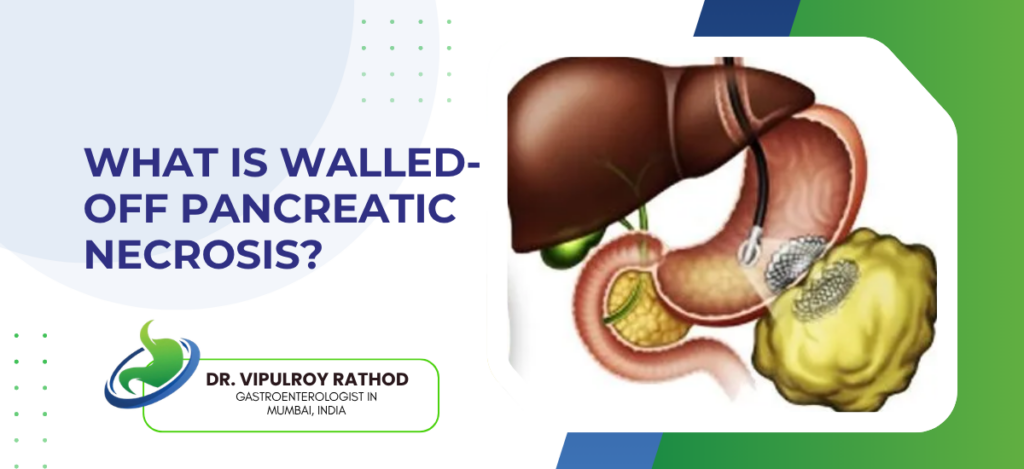
Walled-off pancreatic necrosis, or WON, is what dead pancreatic tissue becomes once the body has had four to six weeks to build a thick capsule around it. Before that wall forms, the dead area is loose, soft, and unsafe to touch. After the wall forms, it can be drained, accessed, and eventually cleared out without open surgery. Most patients reach this stage after a severe episode of acute pancreatitis with necrosis, and timing matters more here than in almost any other GI condition a Gastroenterologist in Mumbai deals with.
According to Dr. Vipulroy Rathod, Gastroenterologist in Mumbai, “WON is one of the few situations in gastroenterology where waiting is the right thing to do, the cavity has to mature before drainage is safe, and patients who get rushed into procedures during the first three weeks usually end up worse than the ones who were watched carefully and treated at the right time.”
How walled-off necrosis forms and how it gets diagnosed?
The wall doesn’t appear overnight, it’s the body doing slow inflammatory work, and recognising the stage on imaging is what tells the treating doctor whether to act or to keep waiting.
- The dying phase, week one to two. Severe acute pancreatitis kills off sections of the pancreas and the fat surrounding it. At this stage there’s no capsule, just necrotic tissue mixed with fluid sitting in the upper abdomen.
- Inflammation and demarcation, week three to four. The body starts forming a fibrous reaction around the dead area. The contents stay messy, partly solid, partly liquid, but a boundary begins to appear on CT.
- Walled-off stage, after week four. A thick non-epithelial wall now contains the necrosis. This is the point at which the lesion gets formally called WON, and it’s the point at which endoscopic drainage actually becomes a reasonable option.
- Imaging confirmation. Contrast-enhanced CT or MRI is the test of choice, both to confirm wall maturity and to see whether infection, gas bubbles, or new fluid pockets have developed alongside.
Reading the imaging right is half the management. Once a mature wall is confirmed and the patient has symptoms, pancreatic stone extraction and EUS-guided cavity drainage can be planned safely, often as the same procedure if the anatomy allows
How walled-off necrosis is treated, step by step?
Not every WON needs intervention. Some shrink on their own once the wall has matured fully, the body absorbs the contents over months, and the patient never needs a procedure. The ones that do need treatment usually announce themselves through symptoms or infection.
- Watch and wait when the patient is well, the cavity is small, and there’s no infection. Repeat scans every few weeks, monitor for fever or weight loss, intervene only if something changes.
- EUS-guided drainage for symptomatic or infected collections. A stent, often a lumen-apposing metal stent, is placed through the stomach or duodenum directly into the cavity under ultrasound guidance. Fluid drains out, the cavity starts to collapse.
- Direct endoscopic necrosectomy. Once a stent is in place, the same opening can be used in follow-up sessions to enter the cavity with a scope and physically remove dead tissue. This is repeated, sometimes five or six times, until the cavity is clean.
- Stent removal and follow-up. When the cavity has shrunk and there’s no more debris, the stent comes out. Imaging at three and six months confirms the cavity has closed.
The hardest part for patients is accepting that treatment isn’t one event, it’s a sequence. Read more on pancreatic necrosis treatment for how the step-up approach plays out across multiple sessions in real cases.
Why choose Dr. Vipulroy Rathod for walled-off necrosis management ?
Dr. Vipulroy Rathod has been managing walled-off necrosis at Fortis Hospital Mulund for over three decades, including some of the earliest EUS-guided drainage cases performed in India. Many of the patients we see arrive after weeks of antibiotics elsewhere, with collections that should have been drained sooner or, occasionally, ones that were touched too early and made worse.
Getting WON right is mostly about timing and access. The procedure itself is technically demanding, but the bigger judgment call is choosing the right week to intervene and the right route into the cavity. Both come with volume.
Book your consultation today with one of India’s most experienced specialists for walled-off pancreatic necrosis assessment and endoscopic drainage.
Frequently Asked Questions
A mature wall usually takes four to six weeks after the original episode of acute pancreatitis. Before this window, the collection is called acute necrotic collection, not WON, and it isn’t safe to drain.
Smaller, sterile, asymptomatic collections often shrink and get absorbed over several months without any intervention. Larger ones, infected ones, or any that cause pain, fever, or pressure on nearby organs do need drainage.
The procedure is done under sedation or general anaesthesia and patients don’t feel it. There can be some abdominal discomfort for a day or two afterwards, but most patients are eating and moving within twenty-four hours.
If it stays sterile and small, sometimes nothing. If it gets infected or grows large, it can cause sepsis, compress the bile duct or stomach outlet, bleed, or perforate. These complications are why most symptomatic cases need active management.
Reference links-
- Acute Pancreatitis Management Guidelines, American College of Gastroenterology — https://gi.org/guideline/acute-pancreatitis/
- Necrotising Pancreatitis Treatment Standards, World Gastroenterology Organisation — https://www.worldgastroenterology.org/guidelines/acute-pancreatitis/acute-pancreatitis-english
