

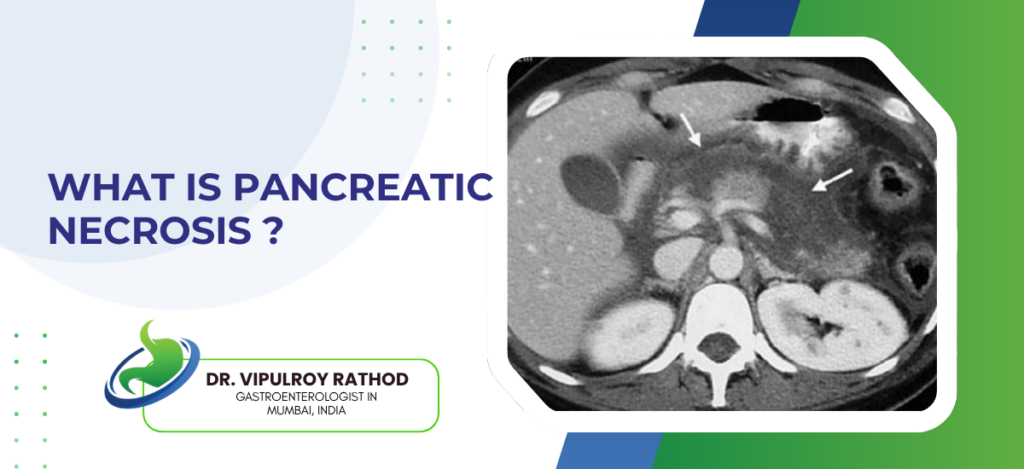
Pancreatic necrosis means part of the pancreas has died, usually after a severe attack of acute pancreatitis cuts off its own blood supply. It happens in roughly one out of every five or six severe cases, and once tissue is gone, it’s gone, the pancreas can’t grow it back. The bigger problem isn’t the dead tissue itself, it’s what happens when bacteria find their way into it. A Gastroenterologist in Mumbai who handles severe pancreatitis spends most of the effort stopping that infection from setting in.
According to Dr. Vipulroy Rathod, Gastroenterologist in Mumbai, “Most patients with pancreatic necrosis we see in 2026 are managed endoscopically rather than surgically, which is a complete reversal of how this condition was treated even 15 years ago when open necrosectomy was the default and mortality sat above 30 percent.”
How pancreatic necrosis develops and what it looks like?
Necrosis builds in stages, and the stage you catch it at decides what kind of treatment is even possible.
- Inflammation first. Severe acute pancreatitis sets enzymes loose inside the pancreas itself, the small vessels feeding it get damaged, and within three or four days, certain pockets of the organ stop getting blood. That’s where the dying starts.
- Tissue death. With perfusion gone, sections of the pancreas and the fat around it turn necrotic. Soft, unencapsulated, no clear border. You can’t see this clinically, only a contrast CT or MRI tells you how much has been lost.
- The wall forms. Over the next four to six weeks the body does something useful, it builds a thick capsule around the dead tissue. This is walled-off necrosis, or WON, and it’s the stage at which endoscopic drainage becomes safe to attempt.
- Infection. About thirty percent of cases get infected when gut bacteria translocate into the dead collection. Fever, rising white counts, deterioration. This is the version that kills people, and confirming it usually means a fine-needle aspiration or a clinical picture that makes the diagnosis obvious.
Where the patient sits in that sequence matters more than the necrosis itself. Caught during the walled-off phase, the collection is often manageable with endoscopic drainage rather than the open surgical debridement that used to be routine.
How pancreatic necrosis is treated without open surgery?
The way this disease is treated has shifted more in the last ten years than in the four decades before it, and the shift has saved a lot of lives.
- Step-up, not all-at-once. Start with whatever is least invasive, escalate only when the previous step fails. Open surgery is now the last resort, not the default, because the mortality difference is large enough that nobody serious recommends going straight to it anymore.
- EUS-guided stent drainage. A stent placed through the stomach wall straight into the necrotic cavity under ultrasound guidance. It drains pus and fluid continuously, gives the dead material a route out, and lets the cavity slowly shrink.
- Endoscopic necrosectomy. Once drainage is established, the same access point can be used to go in with a scope and remove dead tissue physically, in repeated sessions, over weeks. It’s not one big procedure, it’s a sequence of smaller ones.
- Percutaneous drainage when endoscopic access doesn’t work, usually because of where the collection sits anatomically. A catheter goes in through the skin, and if drainage alone isn’t enough, the same tract can be used for minimally invasive debridement later.
Centres doing this at volume have brought mortality in necrotising pancreatitis from above thirty percent down to under ten. Read more on pancreatic necrosis treatment for how the step-up approach actually unfolds case by case.
Why choose Dr. Vipulroy Rathod for pancreatic necrosis management ?
Dr. Vipulroy Rathod has been managing necrotising pancreatitis at Fortis Hospital Mulund for over three decades. Many of the patients we see have already been through weeks of antibiotics elsewhere before anyone offered drainage, and by then the cavity is fully walled off and the patient is exhausted. The endoscopic route still works at that point, but timing it correctly, choosing the right access, and knowing when to escalate are all judgment calls that volume teaches.
Necrosis isn’t a condition that should be managed in centres that see one or two cases a year. It needs a team that does this routinely, with the imaging, the scopes, and the experience to know when to drain and when to wait.
Book your consultation today with one of India’s most experienced specialists for pancreatic necrosis assessment and minimally invasive drainage.
Frequently Asked Questions
It can be, particularly once the dead tissue gets infected. In centres doing endoscopic management at volume, mortality is under ten percent, but it climbs sharply when infected necrosis is recognised late or pushed straight to open surgery.
The organ keeps working with whatever tissue survived, but the dead portion doesn’t regenerate. Depending on how much functional pancreas was lost, patients may end up needing enzyme replacement, may develop diabetes, or sometimes both.
Walling-off itself takes four to six weeks. After that, endoscopic drainage and necrosectomy sessions usually span another six to twelve weeks before the cavity closes properly. It’s a slow disease to manage and patients should be told that upfront.
A pseudocyst is fluid only. Necrosis contains solid dead tissue along with fluid, which is why it can’t be managed by drainage alone, the solid material has to be physically removed in stages.
Reference links-
- Acute Pancreatitis Management Guidelines, American College of Gastroenterology — https://gi.org/guideline/acute-pancreatitis/
- Necrotising Pancreatitis Treatment Standards, World Gastroenterology Organisation — https://www.worldgastroenterology.org/guidelines/acute-pancreatitis/acute-pancreatitis-english
