

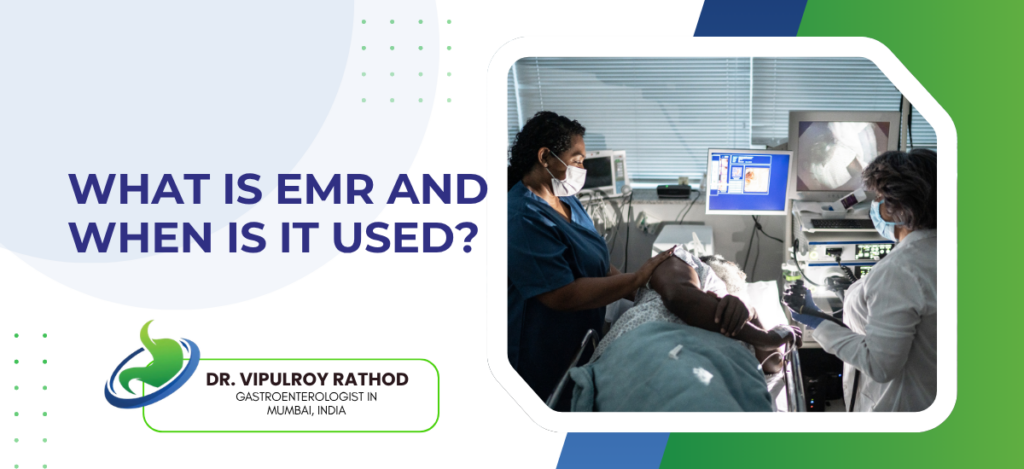
Endoscopic Mucosal Resection is a procedure that removes abnormal tissue or early-stage tumours from the lining of the digestive tract through an endoscope, without any cuts or open surgery. It’s used in the oesophagus, stomach, and colon, typically when a lesion is caught early enough that it hasn’t grown beyond the inner mucosal layer. The procedure combines diagnosis and treatment in a single sitting, which is what makes it clinically significant for patients where early-stage disease has been confirmed on prior imaging or endoscopy.
According to Dr. Vipulroy Rathod, Gastroenterologist in Mumbai, “EMR has changed what we can offer patients with early GI cancers. A lesion that would have meant major surgery ten years ago can now be removed endoscopically in under an hour, with the patient going home the same day and margins checked on histology within the week.”
What Conditions Is EMR Used For?
The procedure isn’t limited to one site or one diagnosis. Several GI conditions across different organs meet the criteria for EMR when the lesion is appropriately sized and confined to the mucosa.
Barrett’s oesophagus with dysplasia: When Barrett’s progresses to high-grade dysplasia or early adenocarcinoma, EMR removes the affected segment before it invades deeper layers, effectively treating the cancer before it becomes a surgical problem.
Early oesophageal and stomach cancers: Lesions confined to the mucosal layer, without lymph node involvement, are suitable candidates. Accurate pre-procedure staging with EUS is what determines whether EMR is appropriate or whether deeper invasion requires a different approach.
Large colorectal polyps: Polyps too large or flat for standard snare polypectomy get removed via EMR, often in a piecemeal technique where the tissue is taken out in sections over the lesion’s surface.
Submucosal lesions with surface involvement: Certain GI tumours that arise just beneath the mucosa but involve the surface layer can also be addressed endoscopically depending on their characteristics and location.
Whether EMR is the right option depends entirely on lesion size, depth, and location factors assessed during workup rather than assumed at the time of the procedure. An endoscopic resection specialist can evaluate the findings and advise whether EMR, ESD, or surgery makes more clinical sense for a given case.
How Is EMR Performed and What Should Patients Expect?
Most patients arrive with a prior endoscopy report or biopsy result. The procedure itself builds on that workup.
Submucosal injection: A fluid solution is injected beneath the lesion to lift it away from the deeper muscle layer. That separation is what makes safe resection possible without perforating the gut wall.
Snare resection: A wire loop passed through the endoscope is placed around the lifted tissue and closed. A brief electrical current cuts through the base while sealing blood vessels at the same time, removing the lesion cleanly.
Piecemeal removal for larger lesions: Lesions wider than 2 cm are often taken in multiple sections rather than a single pass. Each piece goes to histology separately, and the margins are assessed on the combined specimen.
Recovery and follow-up: Patients are monitored for a few hours after the procedure and discharged the same day in most cases. A follow-up endoscopy at 3 to 6 months checks the resection site to confirm complete removal and look for any recurrence at the edges.
Understanding which symptoms or findings should prompt investigation in the first place matters as much as knowing the procedure itself. Read more on cancer warning signs to know what presentations warrant urgent endoscopic evaluation.
Why Choose Dr. Vipulroy Rathod for EMR?
Dr. Vipulroy Rathod has been performing advanced therapeutic endoscopy at Fortis Hospital Mulund for over 30 years, with EMR forming a core part of his GI cancer practice since the technique became established in India. His EUS experience since 1998 means lesions are staged accurately before any resection decision is made, so patients aren’t taken to EMR when surgery is actually what’s needed, or pushed to surgery when EMR would suffice. Physicians from 35 countries have trained under his endoscopic approach, and referred patients regularly arrive having been told surgery was their only option.
Book your consultation today with one of India’s most experienced specialists for early GI tumour assessment and endoscopic mucosal resection.
Frequently Asked Questions
EMR stands for Endoscopic Mucosal Resection, a procedure that removes abnormal tissue or early-stage tumours from the GI tract lining through an endoscope without open surgery.
No. EMR is a minimally invasive endoscopic procedure performed under sedation. Most patients are discharged the same day or within 24 hours.
EMR is used to remove early-stage oesophageal, stomach, and colorectal cancers, large polyps, and precancerous lesions such as Barrett’s oesophagus with dysplasia.
EMR removes lesions in pieces using a snare, while ESD cuts beneath the lesion to remove it in one piece, allowing more accurate margin assessment for larger or complex lesions.
Disclaimer:
This blog is intended for informational and educational purposes only and should not be considered medical advice.
Please consult a qualified gastroenterologist or healthcare professional for personalized diagnosis and treatment.
