
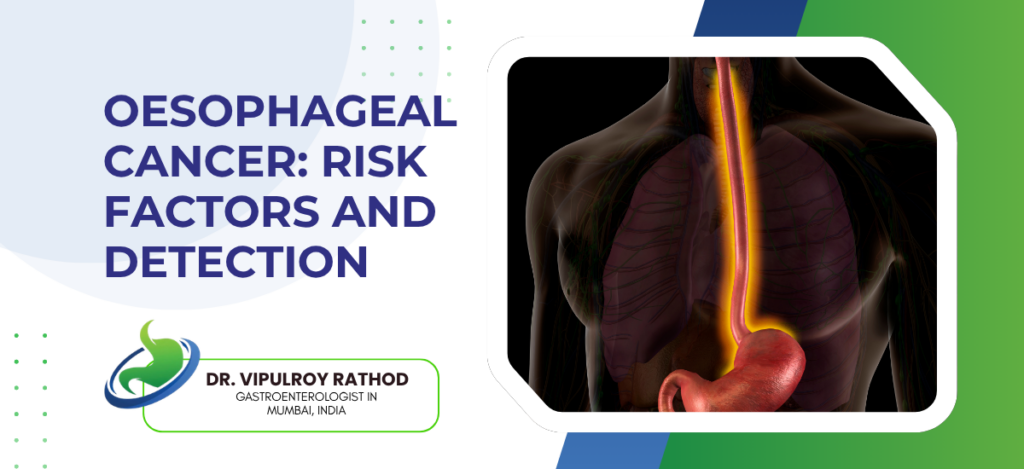
Oesophageal cancer grows in the lining of the food pipe and is most commonly linked to chronic acid reflux, tobacco use, and heavy alcohol intake. It presents in two forms: squamous cell carcinoma, which arises in the upper and middle oesophagus, and adenocarcinoma near the lower end, a type that’s become more prevalent as rates of long-term GERD rise. Late diagnosis is the rule rather than the exception here, because early-stage disease rarely causes symptoms distinct enough to trigger investigation. Risk assessment and timely endoscopic evaluation are what close that gap.
According to Dr. Vipulroy Rathod, Gastroenterologist in Mumbai, “Most patients assume persistent swallowing difficulty is just acidity acting up. By the time they come in, the window for minimally invasive treatment has often passed. Anyone with chronic reflux or known risk factors should get scoped rather than just medicated.”
What Are the Risk Factors for Oesophageal Cancer?
This cancer builds over years, not weeks. Certain conditions and habits cause repeated mucosal injury, and it’s that accumulated damage over time that eventually tips into malignancy.
Untreated acid reflux: Prolonged GERD causes the lower oesophageal lining to undergo a cellular change called Barrett’s oesophagus. It’s precancerous, and patients who’ve had reflux for years without adequate treatment carry a meaningfully higher adenocarcinoma risk than those whose reflux was managed properly.
All forms of tobacco: Squamous cell carcinoma of the upper oesophagus is strongly tied to tobacco use in any form. Cigarettes cause consistent damage, but gutka and pan masala are particularly relevant in India, where chewing tobacco is widespread and often not discussed as a GI cancer risk by treating physicians.
Heavy alcohol consumption: Regular heavy drinking erodes the oesophageal mucosa directly. When tobacco and alcohol coexist in the same patient, the combined risk is considerably greater than either factor produces on its own.
Obesity: Excess abdominal weight increases intra-abdominal pressure, pushes gastric contents upward, and worsens reflux even in patients who don’t experience classic heartburn. That chronic low-grade acid exposure raises adenocarcinoma risk without the patient ever connecting the two.
Patients carrying two or more of these factors shouldn’t wait for a swallowing problem before seeking evaluation. A referral to an oesophageal cancer specialist can clarify whether surveillance endoscopy makes clinical sense before anything turns symptomatic.
How Is Oesophageal Cancer Detected?
Stage at diagnosis is what determines whether a patient has treatment options or is managing a disease that’s already past the point of cure. These are the investigations that actually make that difference.
Upper GI endoscopy: A flexible camera passed through the mouth gives a direct view of the oesophageal lining. Any area that looks abnormal gets biopsied on the spot, in the same sitting. It’s the starting point for any diagnostic workup where oesophageal pathology is suspected.
Endoscopic ultrasound (EUS): Unlike external imaging, the EUS probe is placed inside the oesophagus itself, right against the wall being examined. That proximity allows it to assess tumour depth and regional lymph node involvement with a level of accuracy that CT simply can’t match for local staging.
NBI endoscopy: Narrow band imaging works by filtering light to highlight the mucosal vessel architecture. Early flat lesions that look completely unremarkable under white-light endoscopy often show clearly abnormal vascular patterns under NBI, which is why high-risk patients shouldn’t be cleared on a standard scope alone.
CT and PET-CT scanning: Once a cancer is confirmed endoscopically, cross-sectional imaging establishes whether it has spread beyond the oesophagus to regional nodes, liver, or lungs. That staging information is what determines whether the patient goes to endoscopic resection, surgery, or systemic treatment.
Knowing which symptoms warrant urgent investigation matters as much as the investigations themselves. Read more on cancer warning signs to understand which clinical presentations need scoping without delay.
Why Choose Dr. Vipulroy Rathod for Oesophageal Cancer?
Dr. Vipulroy Rathod has been working in advanced GI endoscopy at Fortis Hospital Mulund for over 30 years. He started performing EUS in 1998, long before the technique became widely available in India, so oesophageal tumours get accurately staged in the same sitting rather than through a separate referral weeks down the line. NBI endoscopy in his practice has identified early oesophageal lesions in patients who’d previously been scoped elsewhere and cleared. Over 35 countries have sent physicians to train under his approach, which reflects the kind of clinical reputation that takes decades to build and doesn’t come from credentials alone.
Book your consultation today with one of India’s most experienced specialists for oesophageal endoscopic diagnosis.
Frequently Asked Questions
Chronic acid reflux, smoking, heavy alcohol use, obesity, and Barrett’s oesophagus are the leading risk factors for oesophageal cancer.
Upper GI endoscopy with biopsy is the primary detection method. EUS and NBI endoscopy improve accuracy for staging and identifying early flat lesions.
Yes. Long-standing untreated GERD can cause Barrett’s oesophagus, a precancerous change that raises the risk of adenocarcinoma over time.
Yes. Early-stage oesophageal cancer confined to the inner lining is highly treatable through endoscopic procedures such as EMR or ESD without open surgery.
Disclaimer:
This blog is intended for informational and educational purposes only and should not be considered medical advice.
Please consult a qualified gastroenterologist or healthcare professional for personalized diagnosis and treatment.
