

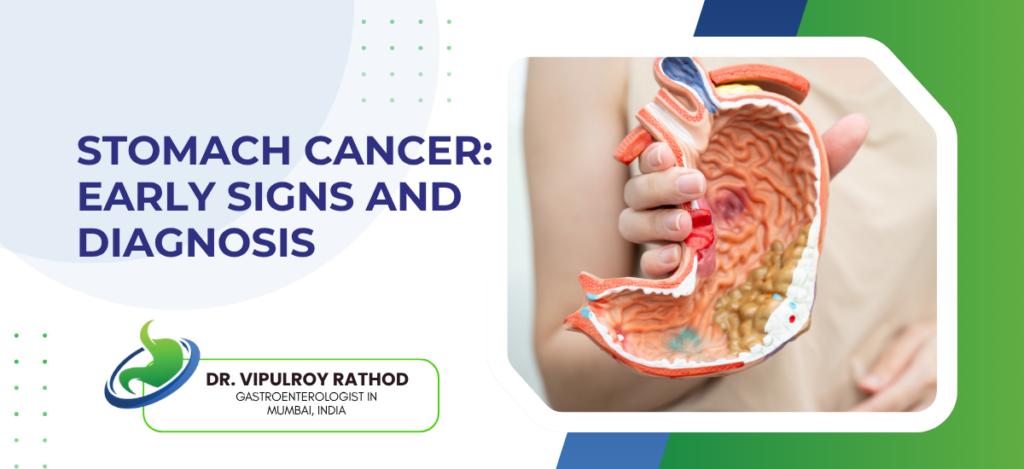
Stomach cancer often produces vague early symptoms that mimic ordinary indigestion, which is why most cases are diagnosed at an advanced stage. Persistent dyspepsia, unexplained weight loss, early satiety, iron deficiency anaemia, and progressive difficulty swallowing are the features that should prompt endoscopy rather than another course of acid suppression. Diagnosis is by upper GI endoscopy with biopsy. Staging adds CT, EUS, and sometimes PET imaging.
According to Dr. Vipulroy Rathod, Gastroenterologist in Mumbai, “Last month a patient came in with a year of indigestion. PPI for ten months. Eradication treatment for H. pylori twice. Nobody scoped him. By the time the diagnosis came, the cancer had grown through the wall. This is not an unusual case. It’s the typical case. In India, stomach cancer in the under-fifties is rising, and the threshold to scope persistent symptoms should be much lower than most doctors apply.”
What are the early signs that should prompt evaluation?
The early symptoms aren’t specific. Recognising when ordinary symptoms warrant investigation is what separates early-stage diagnosis from late presentation.
- Iron deficiency anaemia in adults: Men and post-menopausal women with low haemoglobin and low ferritin need both upper and lower endoscopy. Gastric cancer is a recognised cause of chronic occult bleeding in this group and the workup shouldn’t be delayed.
- Persistent dyspepsia that doesn’t settle on standard PPI treatment, particularly in patients over forty, with risk factors, or with family history of gastric cancer. Continuing empirical management beyond a few weeks delays diagnosis without changing outcomes.
- Unintentional weight loss: One of the strongest predictors on its own. Any patient losing weight without obvious cause, particularly with upper GI symptoms, needs imaging and endoscopy without delay.
- Early satiety and post-meal fullness can indicate a tumour reducing gastric capacity or causing obstruction at the antrum or pylorus. Often dismissed as functional dyspepsia in younger patients, which is part of why diagnosis gets delayed.
The threshold to investigate should be low in higher-risk patients. Endoscopy services with NBI and chromoendoscopy capability detect early gastric cancers and precursor lesions that standard white-light examination can miss, particularly in patients with chronic atrophic gastritis or intestinal metaplasia.
How is stomach cancer diagnosed and staged?
Diagnosis is by endoscopy with biopsy. Staging adds imaging, EUS, and sometimes laparoscopy to decide whether the cancer is resectable.
- Endoscopy with biopsy: The definitive diagnostic test. Multiple biopsies from the lesion and the surrounding mucosa establish the histology, depth pattern, and the extent of mucosal involvement.
- EUS measures depth of invasion through the gastric wall and identifies regional lymph nodes. The information decides whether early lesions go to endoscopic resection or formal surgery.
- CT chest, abdomen, and pelvis: Standard staging investigation. Looks for liver metastases, peritoneal disease, and distant lymph nodes that change the treatment plan entirely.
- Staging laparoscopy in selected cases finds peritoneal metastases that CT missed. Particularly useful in linitis plastica and advanced presentations where occult peritoneal disease is common.
Accurate staging changes the treatment plan completely. Read more on Role of endoscopy for how stomach cancer detection fits into the broader screening strategy for high-risk patients.
Why choose Dr. Vipulroy Rathod for stomach cancer assessment?
Dr. Vipulroy Rathod has been performing upper GI endoscopy and EUS at Fortis Hospital Mulund since the late 1990s, with the volume of cases that builds pattern recognition for early gastric disease. Most patients arrive after months or years of PPI treatment for symptoms that should have triggered a scope earlier. Recognising the patterns that warrant endoscopy, and then identifying the subtle changes once the scope is in, separates early-stage diagnosis from advanced disease.
The harder problem isn’t the diagnosis. It’s that no one suspected cancer in the first place. Indian patients with chronic dyspepsia get treated for years before anyone scopes them. Lowering the threshold to investigate in patients over forty with persistent symptoms, family history, or alarm features is what changes outcomes at scale.
Book your consultation today with one of India’s most experienced specialists for stomach cancer assessment and endoscopic diagnosis.
Frequently Asked Questions
Over forty with persistent symptoms or family history. The threshold drops further with H. pylori infection or known chronic gastritis.
Not reliably enough to base a diagnosis on. Tumour markers like CEA and CA 19-9 lack the sensitivity, and endoscopy with biopsy remains the standard for confirmation.
Yes, chronic H. pylori infection is a major risk factor for gastric adenocarcinoma, particularly the distal type. Eradication reduces but doesn’t eliminate the long-term risk in patients with established mucosal changes.
Yes,stage one survival exceeds ninety percent with surgery or endoscopic resection, falling sharply with delayed diagnosis. Early endoscopy in symptomatic patients is what makes the difference.
Disclaimer:
This blog is intended for informational and educational purposes only and should not be considered medical advice.
Please consult a qualified gastroenterologist or healthcare professional for personalized diagnosis and treatment.
