

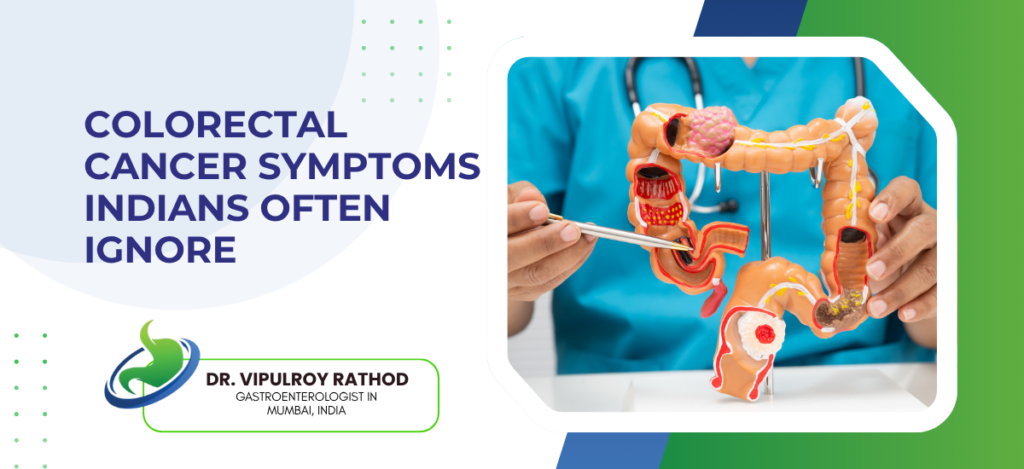
Colorectal cancer is consistently diagnosed at a later stage in India than necessary, not because the disease hides well but because its earliest symptoms are ones most people have a ready explanation for. Blood in the stool becomes a piles problem. Months of altered bowel habits become a diet conversation. The result is that patients arrive at a gastroenterologist with a disease that’s had time to grow while every individual symptom was being managed as something else entirely.
According to Dr. Vipulroy Rathod, Gastroenterologist in Mumbai, “The symptoms patients ignore most often are the ones I see most frequently in late-stage referrals. Rectal bleeding, unexplained weight loss, a change in stool frequency that’s been going on for weeks none of these should be dismissed without a proper workup, and yet most patients wait six months before mentioning them to a doctor.”
Which Symptoms Do Patients Most Often Dismiss?
These four presentations account for the majority of delayed diagnoses seen in referred colorectal cancer patients, and each one has a common benign explanation that absorbs the symptom before investigation happens.
When blood appears in or on the stool, the assumption in most Indian households is haemorrhoids, and while piles are genuinely common, that assumption in practice functions as a reason not to investigate rather than a working diagnosis to confirm, and the colonoscopy that should have followed the very first episode gets deferred indefinitely.
Altered bowel habits get absorbed into existing labels a patient with a prior IBS history who develops looser stools, increased urgency, or a shift to alternating constipation and diarrhoea will typically have the new pattern attributed to their existing condition rather than investigated as a change from it, which is exactly the clinical scenario where something early gets missed.
Losing weight without trying is the symptom patients most frequently rationalise rather than investigate, particularly when they’re otherwise functional and not expecting a serious diagnosis, and in referred patients it’s routine to find that several kilograms disappeared over a three to four month period before anyone considered an oncological cause.
In the lower abdomen, a heaviness or discomfort that antacids don’t resolve and that dietary adjustment hasn’t changed over several weeks is worth a scope rather than another empirical treatment trial, because a tumour causing early partial obstruction produces a picture that’s clinically indistinguishable from functional bloating without one.
Any one of these lasting more than three weeks, or two of them appearing together, warrants investigation by a colorectal cancer specialist rather than further empirical management.
Why Is Late Diagnosis So Consistent in the Indian Population?
Several factors explain why this delay pattern repeats across patients from different backgrounds, ages, and cities, and understanding them is what makes earlier presentations possible.
Throughout the months a colorectal cancer grows undiagnosed, the patient typically isn’t ignoring the symptom entirely but is instead managing it actively with a pharmacy product, a dietary change, or a home remedy, which produces enough functional relief to suppress the urgency to investigate further while the underlying disease continues.
Talking about bowel function remains a genuine barrier in clinical interactions, and patients who wouldn’t hesitate to describe chest pain in detail will often omit rectal bleeding from a consultation, particularly when the appointment is nominally about something else and nobody asks directly.
The absence of organised colorectal screening in India means that most people have never been told to consider a routine colonoscopy at age 45 regardless of symptoms, which is the single most effective structural intervention for catching this cancer early, and without that baseline expectation there’s no default prompt to investigate before something symptomatic develops.
If a patient is under 50, the probability of colorectal cancer gets dismissed almost automatically, both by the patient and sometimes by the treating clinician, despite the fact that under-50 colorectal cancer rates are rising in India as they are globally and that younger patients who do present with it often do so at a more advanced stage precisely because of that age-based assumption.
Understanding which of these presentations should trigger an urgent referral rather than another repeat consultation is where better outcomes start. Read more on cancer warning signs to know which clinical pictures need a scope without delay.
Why Choose Dr. Vipulroy Rathod for Colorectal Cancer?
Dr. Vipulroy Rathod has been treating colorectal cancer endoscopically at Fortis Hospital Mulund for over 30 years, and his EUS practice since 1998 means the staging that decides between an endoscopic, laparoscopic, or open route happens accurately in the same workup. Patients referred for open surgery on lesions that were actually suitable for endoscopic removal frequently find a less invasive option available. Physicians from 35 countries have trained under his approach at Fortis.
Book your consultation today with one of India’s most experienced specialists for colorectal cancer screening, symptom evaluation, and endoscopic diagnosis.
Frequently Asked Questions
Blood in stool, unexplained change in bowel habits lasting more than three weeks, persistent bloating, and unintended weight loss are among the earliest signs that are most commonly dismissed.
Most symptoms like bloating, irregular stools, and rectal bleeding are attributed to common conditions like piles or acidity, leading to delayed consultation and late-stage diagnosis.
Screening with colonoscopy is recommended from age 45 for average-risk individuals, and earlier for those with a family history of colorectal cancer or inflammatory bowel disease.
Not always, but rectal bleeding should never be assumed to be piles without a proper examination, as colonoscopy is the only way to rule out colorectal cancer with certainty.
Disclaimer:
This blog is intended for informational and educational purposes only and should not be considered medical advice.
Please consult a qualified gastroenterologist or healthcare professional for personalized diagnosis and treatment.
