
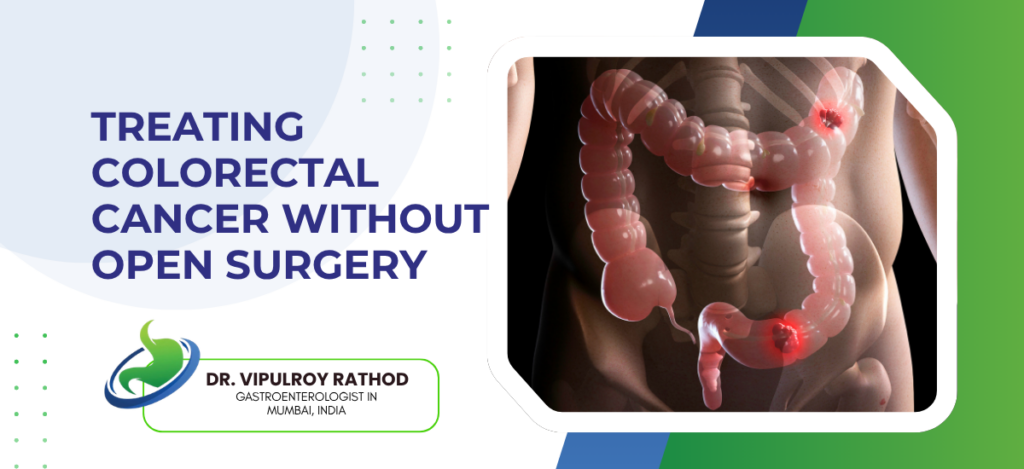
Open surgery is no longer the default for colorectal cancer the way it was two decades ago. Early-stage tumours and large precancerous polyps are now routinely removed through the colonoscope itself, and even cases that do need an operation are often handled laparoscopically rather than through a large incision. What determines the route is stage, depth, and location, which makes accurate workup before treatment the single most important factor in keeping a patient out of open surgery.
According to Dr. Vipulroy Rathod, Gastroenterologist in Mumbai, “The patients who end up in open surgery are often the ones who presented late. Caught early, a colorectal cancer confined to the lining can frequently come out through the scope in a day procedure. The earlier we see it, the less invasive the treatment, which is the entire argument for screening.”
What Are the Non-Surgical Treatment Options?
The treatment route depends almost entirely on how early the cancer is caught.
Removing the lesion endoscopically through EMR or ESD handles early cancers confined to the mucosa, taking the tumour out through the colonoscope with no incision and same-day discharge.
Large or flat polyps that standard polypectomy can’t manage come out via EMR before they ever progress to invasive cancer.
When a cancer sits slightly deeper but hasn’t spread, laparoscopic resection removes the affected segment through small keyhole incisions instead of an open laparotomy.
For rectal cancers, transanal endoscopic approaches reach early lesions through the anus, avoiding both abdominal incisions and, in selected cases, a permanent stoma.
Which of these applies comes down to staging, and a colorectal cancer specialist determines the least invasive route that still treats the disease completely.
When Is Open Surgery Still Necessary?
Not every case can avoid open surgery, and knowing the limits matters as much as knowing the options.
Deep invasion into the bowel wall takes a cancer past what any endoscopic technique can safely remove, and resection becomes necessary.
If lymph nodes are involved, the cancer has spread beyond a local problem, and surgery with node clearance is required regardless of how the primary lesion looks.
Large or obstructing tumours blocking the bowel usually need surgical removal, often urgently, before endoscopic options can even be considered.
Once a tumour is technically complex in its position or extent, open surgery offers the control that keyhole or endoscopic routes can’t reliably provide.
Catching colorectal cancer before it reaches these stages is what keeps treatment minimally invasive, and that starts with knowing who needs screening. Read more on colon cancer screening to understand who should be screened and when early detection changes the treatment route entirely.
Why Choose Dr. Vipulroy Rathod for Colorectal Cancer?
Dr. Vipulroy Rathod has been treating colorectal cancer endoscopically at Fortis Hospital Mulund for over 30 years, and his EUS practice since 1998 means the staging that decides between an endoscopic, laparoscopic, or open route happens accurately in the same workup. Patients referred for open surgery on lesions that were actually suitable for endoscopic removal frequently find a less invasive option available. Physicians from 35 countries have trained under his approach at Fortis.
Book your consultation today with one of India’s most experienced specialists for colorectal cancer assessment and minimally invasive endoscopic treatment.
Frequently Asked Questions
Yes. Early-stage colorectal cancers and large polyps can be removed endoscopically through EMR or ESD, while more advanced cases may be treated with laparoscopic surgery rather than open surgery.
Endoscopic treatment removes early colorectal cancers and precancerous polyps through a colonoscope using EMR or ESD, without any external incision and usually as a day procedure.
Open surgery is needed when the cancer has invaded deeper bowel layers, spread to lymph nodes, or is too large or complex for endoscopic or laparoscopic removal.
Yes. For suitable early-stage lesions, endoscopic removal is safe, avoids general anaesthesia in many cases, preserves the bowel, and allows same-day discharge with faster recovery than open surgery.
Disclaimer:
This blog is intended for informational and educational purposes only and should not be considered medical advice.
Please consult a qualified gastroenterologist or healthcare professional for personalized diagnosis and treatment.
