

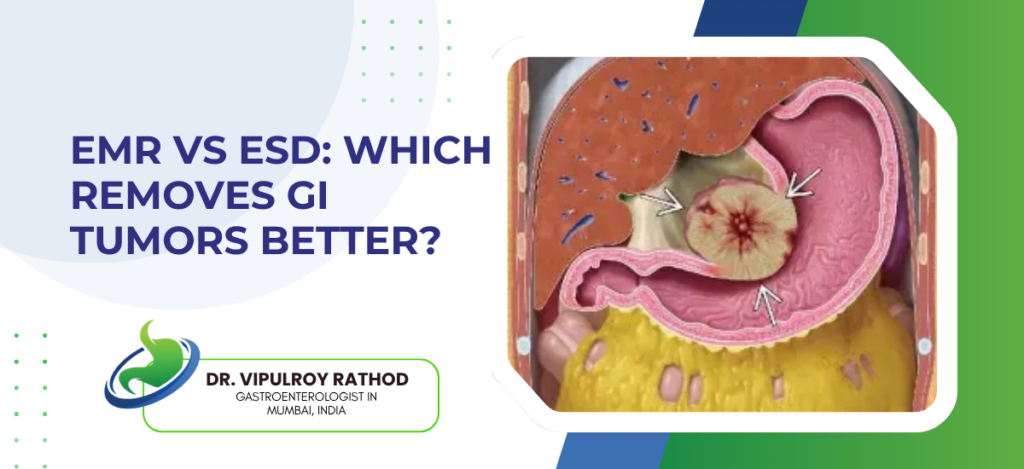
EMR and ESD are both endoscopic techniques for removing early GI tumours without open surgery, but they aren’t interchangeable. EMR lifts and snares a lesion off in pieces, while ESD dissects beneath it to take the whole thing out in one specimen. The choice between them comes down to lesion size, depth, and whether the pathologist needs an intact margin, which means the better technique is the one matched correctly to the lesion rather than the one that’s better in the abstract.
According to Dr. Vipulroy Rathod, Gastroenterologist in Mumbai, “Patients often ask which procedure is superior, and the honest answer is that it depends entirely on what we’re removing. A small polyp doesn’t need ESD. A large flat lesion where margins matter for staging shouldn’t have EMR. Getting that decision right before the procedure is what actually determines the outcome.”
How Do EMR and ESD Differ?
The two procedures share a goal but differ in how they reach it.
Factor | EMR | ESD |
Removal method | Snare, in pieces | Dissection, single piece |
Best lesion size | Under 2 cm | Above 2 cm |
Specimen quality | Fragmented | En bloc, intact margins |
Procedure time | Shorter | Longer |
Recurrence risk | Higher for large lesions | Lower |
Snaring the lesion is how EMR works, lifting it with a submucosal injection and cutting it free, which suits smaller superficial lesions well.
ESD dissects under the lesion with a fine knife, freeing it in one intact piece. That single specimen is what gives pathologists a clean margin to assess.
For lesions above 2 cm, EMR usually means piecemeal removal, and fragmented specimens make accurate margin assessment harder and recurrence more likely.
Where en bloc removal matters for staging, ESD is the better choice despite taking longer and demanding more technical skill.
Choosing correctly needs accurate pre-procedure staging, which is where a specialist in endoscopic resection determines which technique fits the lesion in front of them.
Which One Is Right for a Given Tumour?
There’s no universally superior technique, only the right match for the lesion.
Small, clearly superficial lesions do well with EMR. It’s faster, simpler, and carries a lower complication rate.
Large or flat lesions belong to ESD, where en bloc removal gives a complete specimen and a markedly lower recurrence rate.
If the lesion’s depth is uncertain, EUS staging settles it before anything is cut, and that assessment often decides EMR versus ESD on its own.
Once invasion beyond the mucosa is suspected, neither technique is appropriate and surgery becomes the safer route, which is why staging always precedes the resection decision.
Understanding where these procedures sit within endoscopy’s broader treatment role helps put the choice in context. Read more on role of endoscopy to see how EMR and ESD fit alongside endoscopy’s wider diagnostic and treatment capabilities.
Why Choose Dr. Vipulroy Rathod for EMR and ESD?
Dr. Vipulroy Rathod has been performing both EMR and ESD at Fortis Hospital Mulund for over 30 years, and his EUS practice since 1998 means the staging that decides between the two techniques happens accurately in the same workup rather than as guesswork. Patients referred for surgery on lesions that were actually suitable for endoscopic removal frequently find a less invasive route available. Physicians from 35 countries have trained under his approach at Fortis.
Book your consultation today with one of India’s most experienced specialists for EMR, ESD, and endoscopic GI tumour removal.
Frequently Asked Questions
EMR removes lesions in pieces using a snare, while ESD dissects beneath the lesion to remove it in a single piece, allowing more accurate margin assessment for larger or deeper lesions.
It depends on lesion size and depth. EMR suits smaller superficial lesions, while ESD is preferred for larger lesions above 2 cm or where en bloc removal is needed for accurate staging.
ESD carries a slightly higher risk of perforation and bleeding due to its complexity, but in experienced hands it offers higher complete resection rates and lower recurrence than EMR for suitable lesions.
Yes. Both remove early-stage GI cancers confined to the mucosa, but ESD allows en bloc removal that gives pathologists a complete specimen for accurate margin and depth assessment.
Disclaimer:
This blog is intended for informational and educational purposes only and should not be considered medical advice.
Please consult a qualified gastroenterologist or healthcare professional for personalized diagnosis and treatment.
