
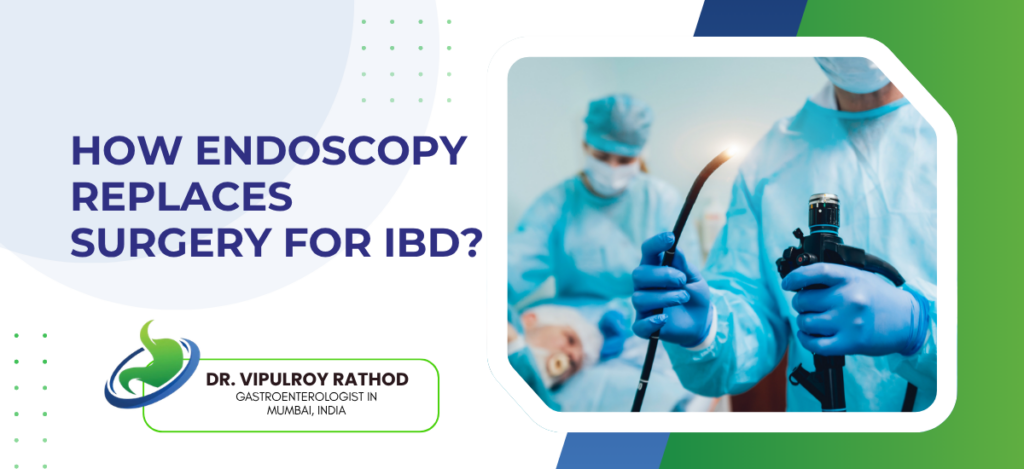
Many IBD complications that once meant surgery are now treated through the endoscope. Strictures, dysplastic lesions, perianal abscesses, and acute bleeding in Crohn’s and ulcerative colitis patients can be managed in a day procedure that leaves the bowel intact. Surgery still has a place in IBD care, but for complications a scope can reach, it has stopped being the automatic first answer it used to be.
According to Dr. Vipulroy Rathod, Gastroenterologist in Mumbai, “IBD patients used to face surgery almost inevitably once complications developed. That’s no longer true in most cases. Balloon dilation, endoscopic resection, EUS-guided drainage these have changed the conversation from when do we operate to whether we need to operate at all, and for a lot of patients the answer is we don’t.”
What Complications Can Endoscopy Now Manage?
Four interventions account for most of the shift away from surgery.
Balloon dilation opens short fibrous strictures in Crohn’s without resecting bowel. It can be repeated over years, which spares patients the cumulative damage of multiple surgeries.
Removing dysplastic lesions in ulcerative colitis through EMR or ESD keeps patients out of the colectomy pathway, provided the lesion is well demarcated and confined to the mucosa on EUS.
If a perianal or abdominal abscess develops in Crohn’s, EUS-guided drainage clears it through the rectal wall. No general anaesthetic, no external wound, much faster recovery than operative drainage.
Acute bleeding during a flare gets controlled with APC or clipping at the bleeding point, sparing a patient with active colitis the substantially higher risk of emergency surgery.
A specialist in IBD management can assess which of these applies before any surgical referral is made.
How Does Endoscopy Monitor IBD Between Flares?
Monitoring matters as much as treating. It’s how complications get caught early.
Mucosal healing is the treatment target now, not symptom control, and only colonoscopy with biopsies can confirm it. A patient who feels fine may still have active inflammation underneath.
Dysplasia surveillance in long-standing ulcerative colitis runs on a structured colonoscopy schedule. Regular biopsies catch early change that’s still treatable through the scope.
Symptom improvement isn’t the same as mucosal healing. Endoscopic confirmation after starting a biologic tells you whether the drug is actually working, and the treatment decision changes accordingly.
When Crohn’s affects small bowel beyond colonoscopic reach, capsule endoscopy or balloon-assisted enteroscopy covers the segments a standard scope can’t, so disease activity gets tracked across its full extent.
A closer look at what colonoscopy finds in IBD, and where it falls short, is worth reading first. Read more on Crohn’s detection to see how colonoscopy fits into diagnosis and monitoring for Crohn’s disease.
Why Choose Dr. Vipulroy Rathod for IBD?
Dr. Vipulroy Rathod has been managing IBD endoscopically at Fortis Hospital Mulund for over 30 years, with EUS since 1998 adding a drainage and staging capability most IBD centres don’t deploy for perianal and abdominal complications. Patients referred for surgical opinions on strictures or colonic dysplasia often find an endoscopic route their previous gastroenterologist hadn’t explored. Physicians from 35 countries have trained under his approach at Fortis.
Book your consultation today with one of India’s most experienced specialists for IBD endoscopic assessment, stricture management, and dysplasia surveillance.
Frequently Asked Questions
In many cases yes, with balloon dilation for strictures, EMR for dysplastic lesions, and EUS-guided drainage for abscesses addressing complications that previously required open surgery.
Colonoscopy with biopsy for monitoring, balloon dilation for intestinal strictures, endoscopic mucosal resection for dysplasia, and EUS-guided drainage for abscesses are the main procedures used in IBD management.
Yes. Endoscopic procedures carry significantly lower risk than open surgery, with shorter recovery times and no need for general anaesthesia in most cases.
Endoscopy does not cure IBD but manages its complications and monitors disease activity and treatment response, reducing the need for surgical intervention in many patients.
Disclaimer:
This blog is intended for informational and educational purposes only and should not be considered medical advice.
Please consult a qualified gastroenterologist or healthcare professional for personalized diagnosis and treatment.
