

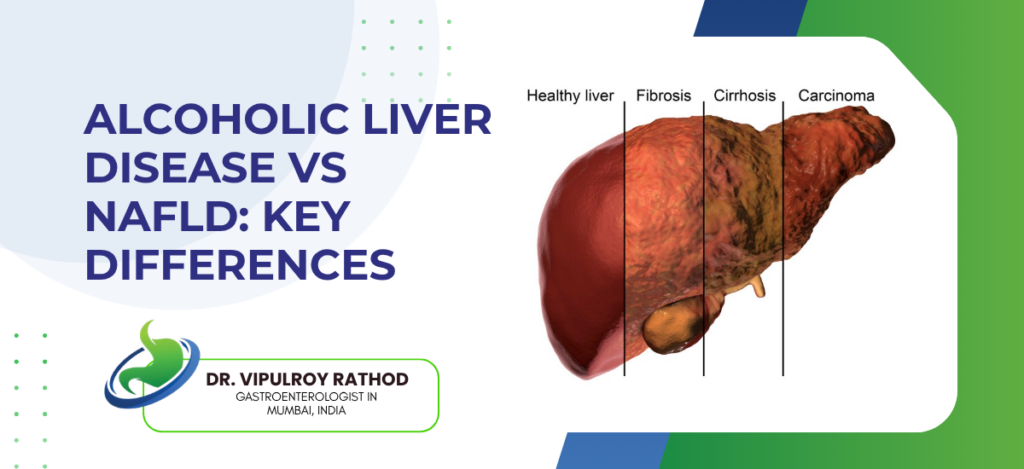
Alcoholic liver disease and non-alcoholic fatty liver disease both deposit fat in the liver and can both progress to cirrhosis, but they arrive there through entirely different mechanisms and need different clinical approaches. ALD is driven by alcohol; NAFLD develops in people who drink little or none, tied instead to obesity, insulin resistance, and metabolic syndrome. With NAFLD now affecting an estimated 25 to 38% of the Indian adult population, confusing the two or missing either diagnosis carries real consequences for long-term liver health.
According to Dr. Vipulroy Rathod, Gastroenterologist in Mumbai, “Both conditions are underdiagnosed because neither produces reliable symptoms until significant liver damage has already occurred. The patient with NAFLD often has no idea their liver is affected until a routine ultrasound picks it up, and by the time ALD causes clinical symptoms, the disease has frequently moved well past the fatty liver stage.”
How Do ALD and NAFLD Differ?
On ultrasound alone, a radiologist can’t always tell them apart; the distinction comes from clinical history, blood patterns, and staging investigations.
Factor | Alcoholic Liver Disease | NAFLD |
Primary cause | Heavy alcohol use | Obesity, insulin resistance |
Typical patient | Any adult with significant intake | Diabetic, overweight, metabolic syndrome |
Key blood marker | AST:ALT ratio above 2:1 | ALT typically higher than AST |
Reversibility | High if alcohol stopped early | Reversible with weight loss in early stages |
Progression risk | Faster with continued drinking | Slower but accelerated by diabetes |
Sustained heavy alcohol use sets off a cycle of hepatic inflammation, fat accumulation, and progressive scarring that moves toward cirrhosis at a pace considerably faster than NAFLD, and the defining feature clinically is that the damage halts and partially reverses when drinking stops but accelerates sharply when it doesn’t.
What makes NAFLD harder to catch is that the patients most at risk overweight, diabetic, dyslipidaemic don’t think of themselves as having a liver disease, and the metabolic drivers including central obesity, insulin resistance, and hypertension work together to push fibrosis forward even without any alcohol involvement, often across years of entirely normal liver function tests that provide false reassurance.
When both conditions coexist in the same patient, which happens more often than expected in someone with metabolic syndrome who also drinks at harmful levels, the AST to ALT ratio provides a useful but imperfect guide, and a FibroScan or biopsy becomes the investigation that separates a clinical assumption from an actual answer.
Getting staging right before committing to a management plan matters because the patient who gets lifestyle advice for what turns out to be advanced fibrosis, and the patient who gets referred for a transplant workup when their disease was still reversible, both suffered from the same failure of accurate baseline assessment.
A fatty liver finding on ultrasound needs proper staging rather than a repeat scan in six months a fatty liver specialist can determine what’s actually driving it and how far along the fibrosis has already progressed.
How Is Each Condition Managed?
Each has one non-negotiable intervention, and everything else builds around it.
Stop drinking. In ALD that’s not one recommendation among several it’s the treatment, and continued alcohol use in the context of alcoholic hepatitis or early cirrhosis carries a mortality risk no pharmacological intervention currently overcomes without abstinence running alongside it.
Achieving 7 to 10% body weight reduction is the most reliably evidence-backed intervention in NAFLD, producing measurable histological improvement in both hepatic steatosis and fibrosis across multiple patient populations and remaining first-line ahead of pharmacotherapy even for patients who arrive convinced a medication will do what lifestyle hasn’t yet managed.
Thiamine, folate, and protein deficiencies are routine findings in patients with ALD and compound the liver damage if not corrected alongside cessation, which is why the patient who stops drinking but receives no nutritional input often fails to recover as expected despite doing the one thing that should theoretically be enough.
GLP-1 receptor agonists and SGLT-2 inhibitors have shown hepatic benefit well beyond glycaemic control in recent NAFLD data, and for diabetic patients in particular the most productive treatment conversation is increasingly the one that happens between the gastroenterologist and the treating endocrinologist rather than either working through it independently.
Both conditions raise long-term GI cancer risk if they progress to cirrhosis, and the metabolic factors that drive NAFLD connect to broader cancer risk worth understanding. Read more on colon cancer screening to see how overlapping metabolic risk factors including fatty liver influence long-term GI cancer risk.
Why Choose Dr. Vipulroy Rathod for Liver Disease?
Dr. Vipulroy Rathod has been managing ALD and NAFLD at Fortis Hospital Mulund for over 30 years, regularly seeing patients who’ve had fatty liver flagged on imaging with no staging of how advanced the fibrosis actually is. FibroScan assessment and EUS when indicated quantify structural damage accurately in the same workup, and patients who arrive managing what they believe is mild fatty liver frequently leave with a clearer picture of where their disease sits and what’s realistically needed. Physicians from 35 countries have trained under his approach at Fortis.
Book your consultation today with one of India’s most experienced specialists for alcoholic liver disease and NAFLD assessment, staging, and management.
Frequently Asked Questions
Alcoholic liver disease is caused by heavy alcohol consumption, while NAFLD occurs in people who drink little or no alcohol and is driven by obesity, insulin resistance, and metabolic syndrome.
Yes. NAFLD can progress through steatohepatitis and fibrosis to cirrhosis and liver failure, particularly in patients with diabetes, obesity, or metabolic syndrome who do not modify their lifestyle.
Diagnosis involves a detailed alcohol history, liver function tests, ultrasound, and in some cases FibroScan or liver biopsy to assess the degree of fibrosis and rule out concurrent causes.
Early-stage fatty liver in both ALD and NAFLD is potentially reversible with alcohol cessation or weight loss respectively, but once significant fibrosis develops the damage becomes increasingly permanent.
Disclaimer:
This blog is intended for informational and educational purposes only and should not be considered medical advice.
Please consult a qualified gastroenterologist or healthcare professional for personalized diagnosis and treatment.
