
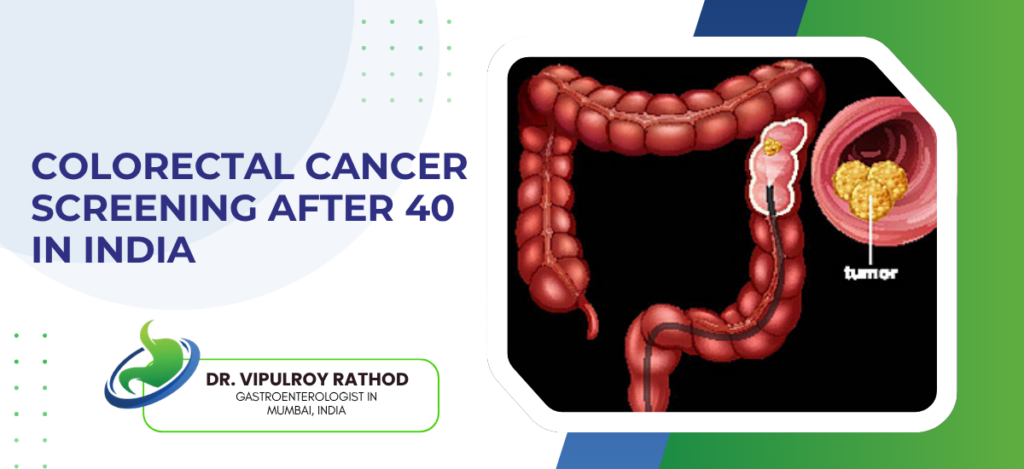
Colorectal cancer is appearing earlier than it used to, and in India it’s too often caught at an advanced stage that screening could have prevented. Average-risk adults are advised to start at 45, yet a meaningful share of patients carry risk factors that bring that age down to 40 or below. Working out which group you belong to matters far more than treating 45 as a fixed rule for everyone.
According to Dr. Vipulroy Rathod, Gastroenterologist in Mumbai, “Colorectal cancer in India is being diagnosed at younger ages and more advanced stages than it should be. The age cutoff is a starting point, not a finish line, because plenty of patients in their 30s and 40s walk in with findings everyone assumed were nothing. Screening timing should follow personal risk, not just a calendar.”
Who Should Start Screening at 40 or Earlier?
Personal risk, not age alone, decides when screening should begin, and several factors move it forward.
If a parent or sibling has had colorectal cancer, your screening starts 10 years before their diagnosis age or by 40, whichever lands first.
Long-standing IBD changes the picture entirely. Once Crohn’s or ulcerative colitis has been active in the colon for 8 years or more, surveillance colonoscopy every 1 to 3 years becomes part of routine management.
Inherited syndromes such as Lynch or FAP move screening into the teens or twenties with much tighter intervals, placing these patients on a completely separate track.
Symptoms override age. Rectal bleeding, a persistent shift in bowel habits, or unexplained weight loss warrants investigation immediately, whether or not someone has reached 40.
Pinning down exactly where you sit on this spectrum is where a colorectal cancer specialist sets the right screening age and interval for you.
Why Does Screening After 40 Matter So Much in India?
Catching this cancer early transforms the outlook, and the Indian context makes that timing especially important.
Cases in younger adults keep climbing. Colorectal cancer is turning up under 50 more often in India, which quietly undermines the old assumption that it belongs to older age groups alone.
Most patients present late after months of blaming symptoms on piles or acidity, so screening catches disease before treatment becomes far harder and far more invasive.
Colonoscopy prevents cancer rather than just finding it, because polyps get removed during the same session, stopping many tumours from ever forming.
Nobody schedules it for you here. Without an organised screening programme, the initiative rests with the individual, which makes knowing your own risk and acting on it the deciding factor.
Knowing precisely when to book that first scope comes down to your individual risk profile. Read more on first colonoscopy age to work out the right age for your first colonoscopy based on your personal risk factors.
Why Choose Dr. Vipulroy Rathod for Colorectal Screening?
Dr. Vipulroy Rathod has spent over 30 years performing advanced endoscopy at Fortis Hospital Mulund, with more than 80,000 procedures including thousands of colonoscopies. That volume translates into a careful reading of subtle findings, the kind that matters when a small polyp or unusual patch shows up during an otherwise routine screening scope. Physicians from 35 countries have trained under his approach at Fortis.
Book your consultation today with one of India’s most experienced specialists for colorectal cancer screening and colonoscopy.
Frequently Asked Questions
Average-risk adults should begin colorectal cancer screening at 45, but those with a family history, IBD, or genetic syndromes often need to start at 40 or earlier depending on individual risk.
Colorectal cancer is rising in younger Indian adults and is often diagnosed late. Screening after 40, especially for higher-risk individuals, catches disease early when it is far more treatable.
Colonoscopy is the most thorough screening test as it examines the entire colon and allows removal of polyps in the same session, unlike stool tests or sigmoidoscopy which are more limited.
People with a first-degree relative who had colorectal cancer, those with inflammatory bowel disease for over 8 years, and anyone with genetic syndromes like Lynch or FAP should start screening earlier.
References
- Colorectal Cancer Screening (PDQ) — National Cancer Institute, https://www.cancer.gov/types/colorectal/patient/colorectal-screening-pdq
- Colorectal Cancer Screening Guideline Update — American Cancer Society, https://www.ncbi.nlm.nih.gov/pmc/articles/PMC5943635/
