

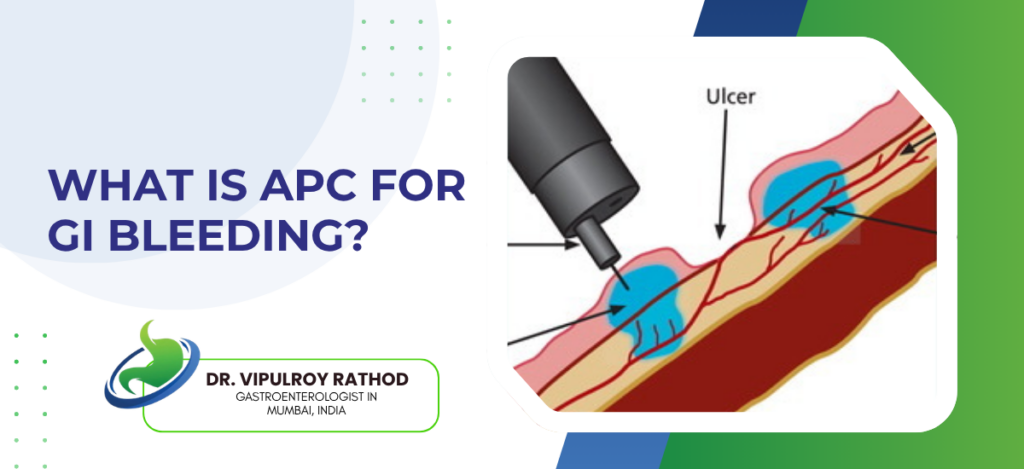
Argon plasma coagulation is a non-contact endoscopic technique that stops bleeding in the gastrointestinal tract without the probe ever touching the tissue. It works by delivering ionised argon gas, energised into plasma, that coagulates bleeding vessels and abnormal mucosa at a controlled depth through the endoscope. What makes it valuable is its ability to treat wide areas of diffuse bleeding evenly, the kind of bleeding where clipping a single vessel or injecting a spot simply isn’t practical, which is exactly where many patients would otherwise face repeat transfusions or surgery.
According to Dr. Vipulroy Rathod, Gastroenterologist in Mumbai, “APC has changed how we handle diffuse GI bleeding. When someone has bleeding spread across a wide area of mucosa, you can’t clip your way out of it. APC lets us treat that whole surface precisely, in the same session as the diagnosis, and most patients avoid both surgery and repeated transfusions as a result.”
How Does APC Work and What Does It Treat?
The technique combines precision with reach, treating sources that other methods struggle with.
Passing a probe through the endoscope, APC releases argon gas that’s energised by high-frequency current into plasma, coagulating the target tissue at a controlled depth without any contact.
Angiodysplasia and GAVE, the vascular lesions that cause slow chronic bleeding and anemia, respond particularly well because APC treats their scattered surface pattern evenly.
In radiation proctitis, where the rectal lining bleeds diffusely after pelvic radiotherapy, APC ablates the fragile mucosa across a broad area that no single clip could address.
For bleeding or obstructing tumours, APC offers palliative control, sealing the bleeding surface and easing symptoms in patients who aren’t surgical candidates.
Deciding whether APC fits a given bleed needs endoscopic assessment of its source and pattern, which is where an APC bleeding control specialist matches the technique to the lesion.
When Is APC the Right Choice for GI Bleeding?
APC suits specific bleeding patterns, and knowing where it fits is what separates a controlled bleed from a surgical referral.
Diffuse mucosal bleeding across a wide surface is APC’s clearest indication, since it treats the whole area evenly where clipping or injection would only address isolated points.
When bleeding comes from vascular lesions, particularly angiodysplasia and GAVE, APC delivers reliable control that reduces the transfusion dependence these conditions often cause.
In non-variceal upper GI bleeds such as certain ulcers, APC can supplement injection therapy to improve the durability of hemostasis at high-risk sites.
Where surgery carries high risk, APC offers a same-day endoscopic alternative that controls the bleed without an incision or general anaesthetic in most cases.
Understanding how APC fits within the wider range of endoscopic bleeding techniques helps put it in context. Read more on GI bleeding treatment to see how APC sits alongside clipping, injection, and band ligation in controlling GI bleeding without surgery.
Why Choose Dr. Vipulroy Rathod for GI Bleeding?
Dr. Vipulroy Rathod has been controlling acute and chronic GI bleeding at Fortis Hospital Mulund for over 30 years, using APC alongside clipping, injection, and variceal band ligation across a case volume few centres match. Patients arriving in active bleeding referred for a surgical opinion most often leave having had the source controlled endoscopically the same day, without ever meeting a surgeon. Physicians from 35 countries have trained under his approach at Fortis.
Book your consultation today with one of India’s most experienced specialists for GI bleeding assessment and endoscopic bleeding control.
Frequently Asked Questions
APC, or argon plasma coagulation, is a non-contact endoscopic technique that uses ionised argon gas to deliver controlled thermal energy, sealing bleeding vessels and abnormal tissue in the GI tract without touching them.
APC treats angiodysplasia, gastric antral vascular ectasia, radiation proctitis, bleeding tumours, and diffuse mucosal bleeding across wide areas where clipping or injection is impractical.
Yes. APC is minimally invasive, controls bleeding precisely without contact, avoids surgery in most cases, and allows same-day recovery, making it a safe alternative to repeat transfusion or operation.
APC releases ionised argon gas energised by high-frequency current, forming plasma that coagulates tissue at a controlled depth, sealing bleeding vessels evenly across the affected surface.
References
- Improvement of Short-Term Outcomes for High-Risk Bleeding Peptic Ulcers With Addition of Argon Plasma Coagulation — NCBI/PMC, https://pubmed.ncbi.nlm.nih.gov/26266385/
- Comparison of Argon Plasma Coagulation in Management of Upper GI Angiodysplasia and GAVE Hemorrhage — NCBI/PMC, https://www.ncbi.nlm.nih.gov/pmc/articles/PMC3439282/
