

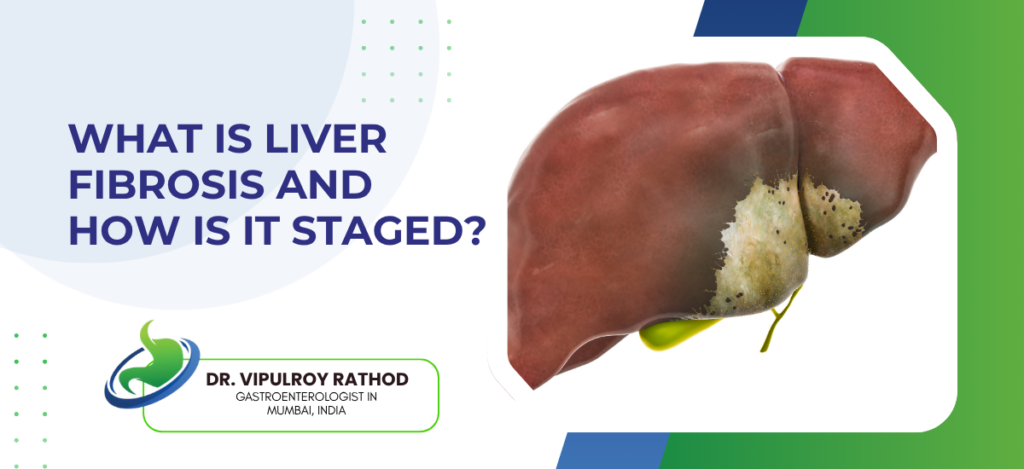
Liver fibrosis is the scarring that develops when the liver is repeatedly inflamed or injured, gradually replacing healthy tissue with stiff scar tissue that impairs how the organ functions. It progresses through defined stages, from no fibrosis at all to full cirrhosis, and the stage at diagnosis determines whether the damage can still be reversed. The difficulty is that fibrosis is silent until late, so most patients have no idea it’s developing, which is exactly why accurate staging matters before symptoms ever appear.
According to Dr. Vipulroy Rathod, Gastroenterologist in Mumbai, “Liver fibrosis is largely a silent disease, and most patients are at stage IV when the damage is already irreversible. Accurate assessment at the correct stage is vital, because early intervention can slow progression, help the liver heal, and prevent the life-threatening complications that come later.”
How Is Liver Fibrosis Staged?
Staging answers the one question that changes everything: how much scarring has already happened, and is it still reversible.
Stage | What It Means |
F0 | No fibrosis, healthy liver |
F1 | Mild fibrosis, minimal scarring |
F2 | Moderate fibrosis, scarring spreading |
F3 | Severe fibrosis, extensive scarring |
F4 | Cirrhosis, irreversible damage |
Measuring liver stiffness through FibroScan has become the first-line approach, because it produces a fibrosis stage in a few painless minutes using transient elastography rather than a needle, which is why it’s now the default for most patients.
Blood-based scores such as FIB-4 and APRI combine routine markers into a fibrosis estimate, useful as a screening filter that decides who genuinely needs imaging and who doesn’t.
Where the non-invasive results don’t agree or the picture stays unclear, liver biopsy remains the reference standard, sampling tissue directly to settle the stage with certainty.
EUS earns its place in selected cases, assessing the complications like portal hypertension that begin to develop as fibrosis pushes toward the cirrhotic end of the scale.
Working out which of these a given patient actually needs is where a liver cirrhosis specialist guides the workup rather than reading a single stiffness number in isolation.
Why Does Staging Fibrosis Matter So Much?
The stage isn’t just a label on a report, it sets the entire direction of treatment and tells you whether the liver still has a route back.
At F1 and F2, the liver can still heal, so treating the underlying cause at this point often reverses the scarring, which is the strongest practical argument there is for catching fibrosis before it advances.
Moving from one stage to the next changes the monitoring interval, the urgency, and the intensity of treatment, meaning the gap between F2 and F3 carries far more clinical weight than the numbers alone suggest.
Once a patient reaches F4, the focus shifts away from reversal and toward surveillance for liver cancer and management of the complications that cirrhosis brings with it.
No stage improves while its cause goes untreated, which is why fibrosis driven by fatty liver, alcohol, or hepatitis won’t stabilise unless that underlying driver is addressed alongside the staging itself.
Since metabolic disease drives so much of the fibrosis seen today, the way fatty liver and diabetes feed each other is worth understanding. Read more on fatty liver to see how metabolic conditions like diabetes accelerate fibrosis progression.
Why Choose Dr. Vipulroy Rathod for Liver Fibrosis?
Dr. Vipulroy Rathod has been staging and managing liver fibrosis at Fortis Hospital Mulund for over 30 years, pairing FibroScan with EUS since 1998 to assess both the scarring itself and the complications that follow as it advances. Patients told they simply have mild fatty liver often find, on accurate staging, exactly where their fibrosis sits and how much of it is still reversible. Physicians from 35 countries have trained under his approach at Fortis.
Book your consultation today with one of India’s most experienced specialists for liver fibrosis assessment and staging.
Frequently Asked Questions
Liver fibrosis is the build-up of scar tissue in the liver caused by ongoing inflammation or injury, which gradually replaces healthy tissue and impairs liver function if it progresses.
Liver fibrosis is staged from F0 to F4, where F0 means no fibrosis and F4 indicates cirrhosis. Staging is assessed through FibroScan, blood-based scores, or liver biopsy.
Early-stage fibrosis can improve or reverse if the underlying cause is treated, but advanced fibrosis and cirrhosis at stage F4 are largely irreversible.
FibroScan is the most widely used non-invasive test for staging fibrosis by measuring liver stiffness, while liver biopsy remains the reference standard when results are unclear.
Disclaimer:
This blog is intended for informational and educational purposes only and should not be considered medical advice.
Please consult a qualified gastroenterologist or healthcare professional for personalized diagnosis and treatment.
