
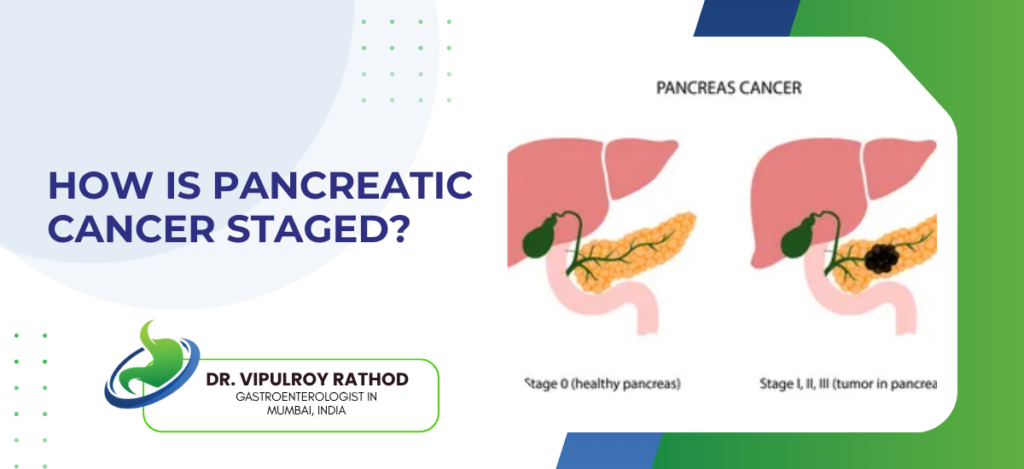
Pancreatic cancer staging uses the TNM system, looking at the tumour itself, whether nearby lymph nodes are involved, and whether disease has reached distant organs, with the resulting stages from I through IV deciding what treatment is realistically possible. EUS combined with CT and MRI gives the most accurate staging picture because external scans alone consistently miss small tumours and the kind of subtle nodal involvement that quietly changes the entire treatment plan.
According to Dr. Vipulroy Rathod, Gastroenterologist in Mumbai, “Staging accuracy in pancreatic cancer is everything because the difference between Stage I resectable disease and Stage III locally advanced disease often comes down to a few millimetres of vascular involvement that CT cannot reliably show, and getting that wrong sends the patient down completely the wrong treatment pathway.”
How Is Pancreatic Cancer Staged Using the TNM System?
TNM works by combining three measurements into a single picture, and that combined picture decides what’s realistically possible for the patient sitting in front of you.
- Tumour: T staging looks at size and local invasion with T1 meaning a tumour under 2 cm sitting inside the pancreas while T4 means disease has reached major vessels like the celiac axis or superior mesenteric artery, so the difference between T2 and T4 often decides surgical eligibility even when the actual size on imaging looks similar across the two stages.
- Nodes: N staging counts how many regional lymph nodes contain cancer with N0 meaning none, N1 meaning 1 to 3 positive, and N2 meaning 4 or more, and EUS-guided FNA biopsy of suspicious nodes gives the kind of accuracy CT-based staging consistently fails to deliver here because size alone never confirms whether a node is actually involved.
- Metastasis: M staging is binary because either disease has reached distant organs or it hasn’t, but even one small liver lesion or peritoneal deposit moves the patient straight to Stage IV regardless of how favourable the primary tumour and nodes might look in isolation, which is why thorough M assessment matters as much as anything else in the workup.
- Stages: Stage I means localised and resectable, Stage II means nearby tissue spread but still potentially operable, Stage III means locally advanced with vascular involvement that often closes the surgical door, while Stage IV means metastatic disease where surgery is almost never the answer anyway and management shifts toward systemic treatment.
Getting all three components measured accurately at the start changes the entire treatment plan, and specialist in pancreatic cancer treatment uses EUS alongside CT and MRI rather than relying on external imaging that consistently misses what matters.
Why Does EUS Matter So Much in Pancreatic Cancer Staging?
CT and MRI give the broad anatomical picture, but EUS gets close enough to the tumour to see what those scans miss, and that proximity changes staging decisions in a meaningful percentage of cases.
- Size: EUS picks up pancreatic tumours under 2 cm that CT regularly misses entirely because the smallest resectable cancers carry the best survival rates and finding them through EUS is often the only way these patients reach surgical consultation while early-stage intervention is still possible.
- Vessels: Vascular involvement is the single biggest factor in surgical resectability and EUS shows the relationship between tumour and major vessels with millimetre accuracy CT simply cannot replicate, which is why patients who looked unresectable on CT sometimes turn out to be operable after proper EUS staging changes the picture.
- Nodes: EUS-guided FNA samples suspicious lymph nodes that CT only flags by size, giving real tissue diagnosis rather than radiological guess, and that distinction matters enormously because not every enlarged node is malignant and not every normal-sized node is clean even when the scan looks reassuring at first glance.
- Tissue: EUS allows fine needle biopsy of the primary tumour itself in the same session as staging providing histological confirmation before any treatment decision gets made, which is critical because pancreatic cancer treatment is too aggressive to start without biopsy proof sitting in the file ready to act on.
EUS-based staging consistently changes surgical decisions in patients whose CT staging looked definitive in either direction. Read more on staging to see how staging principles apply across all GI cancers and why the staging investigation drives the treatment plan rather than the other way around.
Why choose Dr. Vipulroy Rathod for analyzing the early staging of pancreatic cancer ?
Dr. Vipulroy Rathod has spent over 30 years staging pancreatic cancer through EUS, FNA biopsy, and integrated imaging at Fortis Hospital Mulund, catching the small resectable tumours that CT staging missed entirely and clarifying borderline cases where vascular involvement decided whether the patient was operable, and has trained physicians from 35 countries in this specific staging approach.
Most patients arrive with a CT staging report and an assumption their disease is one stage when in fact it’s another, and many leave with EUS-corrected staging that opened up surgical options nobody thought were on the table or, equally importantly, ruled out unnecessary surgery in cases where the disease was already further along than CT suggested it was.
📞 Call Now: +91 9820091763
Book your consultation today with one of India’s most experienced specialists for understanding the stages of pancreatic cancer
Frequently Asked Questions
EUS combined with CT and MRI provides the most accurate pancreatic cancer staging, particularly for tumour size, vascular involvement, and nodal disease.
Yes, restaging is standard practice after neoadjuvant chemotherapy or radiation to assess response and reconsider surgical resectability.
Stage I and II pancreatic cancers are typically resectable, while Stage III locally advanced disease may become resectable after neoadjuvant therapy.
Yes, Stage IV pancreatic cancer with distant metastasis is rarely treated with surgery, and management focuses on systemic chemotherapy and palliative intervention.
Reference links-
- Pancreatic Cancer Staging Guidelines — American Society for Gastrointestinal Endoscopy
- TNM Staging in Pancreatic Cancer — World Gastroenterology Organisation
