

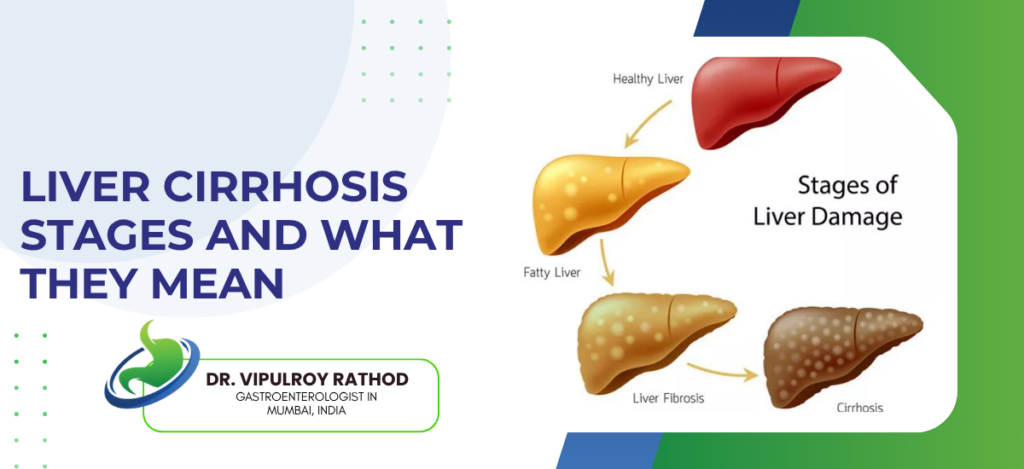
Liver cirrhosis stages range from early scarring (compensated) to severe liver failure (decompensated). It progresses from mild inflammation to advanced fibrosis, causing permanent damage and symptoms like fatigue, yellowing skin (jaundice), abdominal fluid buildup (ascites), and mental confusion. Early detection is crucial, as treatment can slow progression.
According to Dr. Vipulroy Rathod, an experienced Gastroenterologist in Mumbai, “Most patients don’t realise they have cirrhosis until complications force them into a hospital, which is why staging matters so much because what we can do at stage one is completely different from what’s possible by stage four.”
What do compensated and decompensated cirrhosis actually mean?
Whole thing boils down to whether the liver is still holding its own or whether it’s started losing ground, and that one distinction between compensated and decompensated splits the entire disease into two very different realities for the patient.
- Compensated without varices: Scarring exists but the liver is still managing its workload with maybe some blood test abnormalities and zero symptoms, so most patients only find out by accident when imaging done for a completely different reason happens to pick it up which is actually the luckiest way to get this diagnosis.
- Compensated with varices: Portal pressure has climbed high enough that veins in the oesophagus or stomach are starting to balloon up, and even though the liver is still getting by day to day this is typically when a gastroenterologist catches it on a screening scope and gets preventive banding going before any of those swollen veins get a chance to pop.
- Decompensated: The crossing point where the liver simply can’t keep up anymore and you know it because fluid pools in the belly, skin and eyes go yellow, brain turns foggy from toxins that used to get cleared but don’t anymore, and suddenly the whole treatment approach flips from trying to slow damage to actively chasing complications that are already happening in real time.
- End-stage organ involvement: Varices have bled or won’t stop, kidneys are taking hits, infections keep circling back harder each time, and the only realistic conversation left at this point is transplant because no combination of drugs and scopes can substitute for a liver that’s lost this much functional capacity.
If you’ve been diagnosed anywhere along this spectrum, our liver cirrhosis treatment page lays out what medical and endoscopic options actually look like depending on where your liver currently sits.
Why does catching cirrhosis early change everything?
What stage you’re sitting at when the diagnosis first lands basically writes the entire script for what happens next, and the gap between early and late is so massive it genuinely feels like two separate diseases when you compare what treatment can realistically pull off at each end.
- Early means real options: Patients caught at compensated stages can go years or sometimes decades living mostly normally because the liver still has enough reserve that medications can go after the root cause while endoscopic surveillance keeps varices in check before they ever become an emergency.
- Late means firefighting: Once decompensation kicks in with fluid buildup or jaundice or encephalopathy the survival numbers take a real dip, hospital admissions become part of the routine, and the whole game pivots from prevention to managing crises that have already set in which is a fundamentally harder place to treat from.
- Root cause runs the show: Alcohol damage needs total permanent abstinence as the non-negotiable starting line while hepatitis needs antivirals, fatty liver needs sustained weight loss and metabolic cleanup, and autoimmune causes need immunosuppression, with each pathway moving at its own pace depending entirely on how quickly the right treatment got started.
- Screening over symptom-waiting: Early cirrhosis is notoriously quiet where absolutely nothing hurts and nothing looks off to the patient, which is exactly why anyone carrying known risk factors like chronic hepatitis or years of heavy drinking or longstanding fatty liver really needs to be doing regular blood panels and imaging instead of sitting around hoping for the best since symptoms almost always mean decompensation has already arrived.
Digestive complaints that seem minor can sometimes be the liver or gut quietly waving a flag worth paying attention to, and our indigestion after every meal blog gets into when those persistent issues deserve a proper investigation rather than being chalked up to something you ate.
Why choose Dr. Vipulroy Rathod for liver cirrhosis management?
Dr. Vipulroy Rathod has spent over 30 years across gastroenterology and hepatology with more than 80,000 endoscopic procedures done at Mumbai’s top hospitals, managing cirrhosis patients through everything from early compensated disease all the way through variceal banding, ascites drainage, and transplant team coordination when things have gone past what any amount of medication can realistically hold together.
What patients here keep bringing up is that staging, imaging, labs, and endoscopic findings all get pulled into one coherent plan by one team instead of being scattered across departments that aren’t on the same page, which is unfortunately how things play out at a lot of centres and tends to leave patients walking out more confused about their situation than they were walking in.
Book your consultation today with one of India’s most experienced specialists for liver cirrhosis evaluation.
Frequently Asked Questions
Early-stage fibrosis can sometimes improve if the underlying cause is treated aggressively, but once true cirrhosis with established scarring has set in the damage is generally permanent though progression can be slowed significantly.
Early cirrhosis often has no symptoms at all and gets picked up incidentally through blood tests or imaging, while later stages show fatigue, easy bruising, swollen abdomen, and yellowing of the skin.
Staging involves a combination of blood tests, imaging like fibroscan or ultrasound, endoscopy to check for varices, and clinical assessment of whether complications like ascites or encephalopathy are present.
Compensated cirrhosis patients can live for many years with proper management, while decompensated cirrhosis carries a shorter prognosis that depends heavily on how well complications are controlled and whether transplant becomes an option.
Reference links-
- Cirrhosis Management Guidelines — American Association for the Study of Liver Diseases
- Liver Disease Staging and Prognosis — National Library of Medicine
