

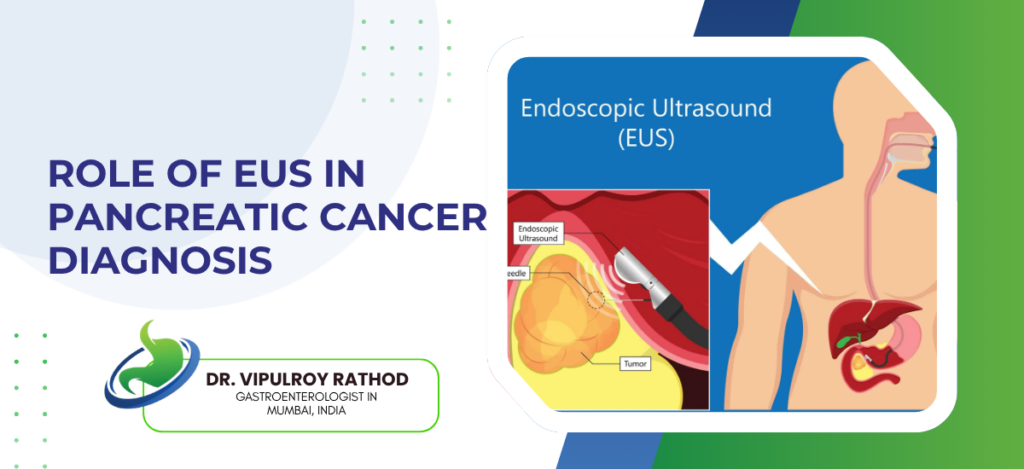
EUS is the most accurate single tool we have for diagnosing pancreatic cancer because the imaging probe sits within millimetres of the pancreas, picking up tumours under 2 cm that CT and MRI miss while letting us biopsy the same lesion in the same session. It changed pancreatic cancer diagnosis fundamentally because external scans on their own simply cannot deliver the kind of detail or tissue sampling early-stage decisions actually depend on.
According to Dr. Vipulroy Rathod, Gastroenterologist in Mumbai, “EUS is not just another imaging option in pancreatic cancer, it is often the difference between catching a small resectable tumour and finding the same disease six months later when the window for cure has already closed.”
What Role Does EUS Play in Pancreatic Cancer Diagnosis?
EUS does several things in one session that no other modality can deliver together, which is exactly why it sits at the centre of how pancreatic cancer actually gets diagnosed in practice.
- Detection: EUS picks up pancreatic lesions under 2 cm with sensitivity that consistently beats CT and MRI for small tumours, finding disease at the stage where surgical resection still offers a real chance of cure rather than catching it months later when the options have already started narrowing.
- Biopsy: EUS-guided fine needle aspiration samples the tumour directly through the stomach or duodenal wall in the same session as imaging, which matters because pancreatic cancer treatment is far too aggressive to start without proper biopsy proof and external scans can only suggest rather than confirm what’s there.
- Cysts: EUS evaluates pancreatic cystic lesions and tells benign serous cysts apart from premalignant mucinous cysts and IPMNs through fluid sampling and morphology assessment, picking up subtle features CT cannot show and changing surveillance decisions in a meaningful percentage of patients.
- Vessels: EUS shows the relationship between tumour and major vessels with millimetre accuracy that decides surgical resectability, which is why patients who looked unresectable on CT sometimes turn out to be operable after EUS clarifies what’s actually happening at the vascular interface.
EUS gives information no external scan can replicate, and specialist in endoscopic ultrasound treats it as the primary diagnostic tool rather than an optional add-on after CT and MRI have already finished guessing.
When Should EUS Be Used in the Pancreatic Cancer Workup?
EUS belongs in the workup at specific decision points where its accuracy genuinely changes the management plan, not as a routine box-tick for every patient walking through the door.
- Suspicion: Patients with worrying symptoms and inconclusive CT or MRI findings need EUS to either confirm or rule out pancreatic disease, because vague upper abdominal pain alongside a normal external scan still leaves the question wide open and the only way to close it properly is direct visualisation.
- Cysts: Any pancreatic cyst found incidentally on CT or MRI deserves EUS evaluation to characterise it accurately, because surveillance decisions hinge on cyst type and external scans cannot reliably tell the benign cysts from the ones with real malignant potential underneath.
- Staging: Confirmed pancreatic cancer needs EUS-based staging alongside CT and MRI because tumour size, vascular involvement, and nodal disease all get measured more accurately on EUS, which directly affects whether surgery, neoadjuvant chemotherapy, or palliative care becomes the right pathway.
- High Risk: BRCA2 carriers, patients with familial pancreatic cancer history, and those with hereditary pancreatitis benefit from annual EUS surveillance because finding small lesions before symptoms develop is the only realistic way to catch this cancer at curable stage in genetically predisposed patients.
EUS earns its place in pancreatic cancer workup at every point where the answer actually matters for treatment. Read more on neurolysis to see how the same EUS technology delivers therapeutic intervention beyond just diagnosis when disease is already advanced.
Why choose Dr. Vipulroy Rathod to understand the role of EUS in diagnosis of pancreatic cancer ?
Dr. Vipulroy Rathod has spent over 30 years performing diagnostic and therapeutic EUS in pancreatic disease at Fortis Hospital Mulund, finding small resectable tumours that external scans had labelled normal and providing tissue diagnosis that changed the entire treatment plan for patients whose CT findings stayed inconclusive, and has trained physicians from 35 countries in this exact diagnostic pathway.
Most patients arrive having been told something pancreatic was uncertain on CT, and many leave with a clear answer based on EUS imaging and biopsy that either confirmed cancer at a stage where treatment still works or ruled it out properly so the search could continue elsewhere instead of getting stuck in repeat scans that never settle the question.
Book your consultation today with one of India’s most experienced specialists for understanding EUS diagnosis for pancreatic cancer
Frequently Asked Questions
Yes, EUS detects pancreatic tumours under 2 cm and provides tissue biopsy in the same session, outperforming CT for small lesion detection.
Yes, EUS-guided fine needle aspiration provides histological tissue confirmation that is essential before starting any pancreatic cancer treatment.
EUS is performed under sedation and patients typically experience minimal discomfort during and after the procedure.
EUS with fine needle biopsy for pancreatic cancer typically takes 30 to 60 minutes including sedation and recovery time.
Reference links-
- EUS in Pancreatic Cancer Diagnosis — American Society for Gastrointestinal Endoscopy
- Pancreatic Cancer EUS Guidelines — World Gastroenterology Organisation
