
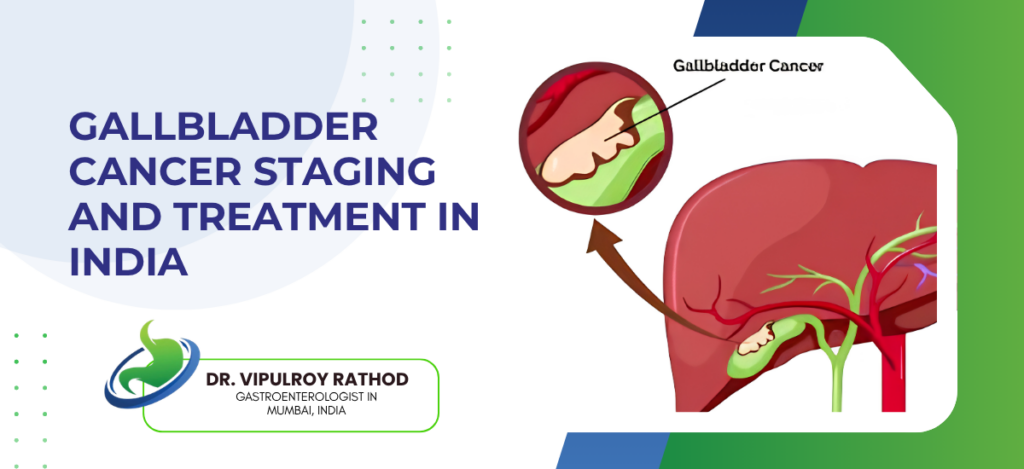
Whether gallbladder cancer can be cured depends almost entirely on the stage at which it’s caught, which is why staging drives every treatment decision that follows. India carries one of the highest gallbladder cancer burdens in the world, particularly across the northern and eastern states, yet a large share of cases surface late or incidentally after gallstone surgery. Once the disease is identified, the TNM system maps how far it has spread, and that map determines whether surgery offers a cure or whether treatment shifts toward controlling the disease.
According to Dr. Vipulroy Rathod, Gastroenterologist in Mumbai, “Staging is everything in gallbladder cancer. A tumour confined to the inner wall has a completely different outlook from one that’s reached the lymph nodes, and the treatment plan changes accordingly. Accurate staging upfront is what prevents both undertreating a curable cancer and overtreating one that’s already advanced.”
How Is Gallbladder Cancer Staged?
The TNM system grades three things: how deep the tumour has grown, whether nodes are involved, and whether it has spread.
Stage | What It Indicates |
Stage 0 | Cancer confined to inner lining |
Stage I | Invading muscle layer, no spread |
Stage II | Through muscle into connective tissue |
Stage III | Lymph nodes or nearby organs involved |
Stage IV | Distant metastasis present |
Assessing tumour depth (T) establishes how far the cancer has grown through the gallbladder wall, which is the single biggest factor in whether curative surgery remains possible.
Checking the regional nodes (N) determines whether the disease has reached nearby lymph nodes, a finding that moves a patient into a more advanced stage and reshapes the treatment plan entirely.
Looking for distant spread (M) through CT or PET imaging confirms whether the cancer has reached the liver, lungs, or peritoneum, which separates operable disease from inoperable.
Where imaging stays unclear, EUS adds precise local staging and allows tissue sampling, settling questions that surface scans alone can’t answer.
Getting this assessment right is where a gallbladder cancer specialist combines imaging and endoscopic staging into a single accurate picture before any treatment begins.
What Are the Treatment Options by Stage?
Treatment follows the stage directly, ranging from curative surgery to disease control.
For early-stage disease, surgical removal offers the best chance of cure, and cancers found incidentally after gallbladder removal sometimes need a second, extended resection to clear all involved tissue.
Once the cancer reaches stage II or III, treatment usually combines extended surgery with chemotherapy, since clearing the tumour and affected nodes gives the strongest outcome at this point.
In advanced or stage IV disease, the focus shifts to chemotherapy, targeted therapy, and symptom control rather than cure, with treatment aimed at extending and improving quality of life.
When a tumour blocks the bile duct in inoperable cases, endoscopic biliary drainage relieves the jaundice and obstruction without surgery, which often makes systemic treatment possible.
Accurate staging through the right imaging is what makes all of this possible, and knowing where endoscopy outperforms CT in staging is worth understanding. Read more on endoscopy vs CT to see how EUS improves staging accuracy for GI cancers where CT alone falls short.
Why Choose Dr. Vipulroy Rathod for Gallbladder Cancer?
Dr. Vipulroy Rathod has been staging and managing gallbladder cancer at Fortis Hospital Mulund for over 30 years, in a region where the disease is far more common than global averages. His EUS practice since 1998 means local staging and tissue diagnosis happen accurately in the same workup, so treatment decisions rest on a complete picture rather than a partial one. Physicians from 35 countries have trained under his approach at Fortis.
Book your consultation today with one of India’s most experienced specialists for gallbladder cancer staging and treatment.
Frequently Asked Questions
Gallbladder cancer is staged using the TNM system, which assesses tumour depth into the gallbladder wall, lymph node involvement, and distant spread, guiding whether surgery or other treatment is appropriate.
Treatment depends on stage and includes surgical removal for early disease, chemotherapy and radiotherapy for advanced cases, and endoscopic biliary drainage to relieve obstruction in inoperable patients.
Yes. Gallbladder cancer confined to the inner layers and found early, often incidentally after cholecystectomy, can be cured with surgery, sometimes requiring an extended resection.
EUS provides accurate local staging by assessing tumour depth and regional lymph nodes, and allows fine needle aspiration for tissue diagnosis when imaging alone is inconclusive.
Disclaimer:
This blog is intended for informational and educational purposes only and should not be considered medical advice.
Please consult a qualified gastroenterologist or healthcare professional for personalized diagnosis and treatment.
