

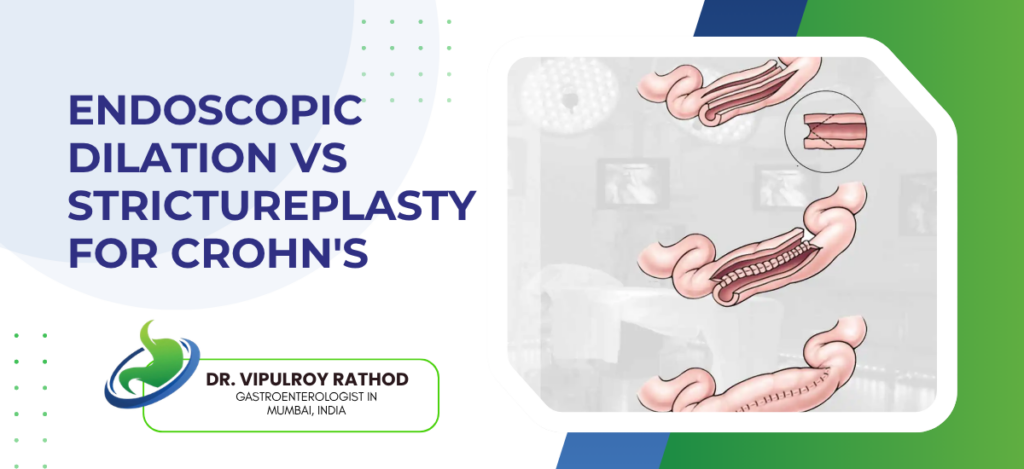
Crohn’s disease frequently narrows the bowel over time, and when a stricture starts causing obstruction, two main options exist to widen it without removing the segment. Endoscopic balloon dilation does this through the scope with no incision, while strictureplasty is a surgical procedure that reshapes the narrowed bowel to open it up. Both avoid resection and the bowel loss that comes with it, but they suit different strictures, and choosing correctly depends on the length, number, and location of the narrowing rather than a blanket preference for one approach.
According to Dr. Vipulroy Rathod, Gastroenterologist in Mumbai, “The goal in Crohn’s strictures is always to preserve bowel length, because these patients often face repeated narrowing over decades. Whether we dilate endoscopically or refer for strictureplasty comes down to the specific stricture, and matching the technique to it is what protects the patient from repeated resections down the line.”
How Do the Two Approaches Differ?
Each handles a stricture in a fundamentally different way.
Factor | Endoscopic Dilation | Strictureplasty |
Approach | Through the scope, no incision | Surgical, bowel reshaped |
Best stricture | Short, accessible | Longer or multiple |
Recovery | Same day | Surgical recovery |
Durability | May need repeat dilation | More durable result |
Anaesthesia | Sedation | General anaesthesia |
Inflating a balloon across the stricture is how endoscopic dilation works, widening short fibrotic narrowings within reach of the scope and letting the patient go home the same day.
Strictureplasty reshapes the narrowed segment surgically without removing it, opening up longer strictures or several close together that a balloon couldn’t address in one go.
Because dilation is repeatable, it suits patients likely to develop further strictures, though restenosis means some will need the procedure more than once over time.
Where the scope simply can’t reach a stricture or where multiple narrowings cluster along a segment, strictureplasty becomes the more practical and durable route.
Deciding between them needs accurate assessment of the stricture, which is where a specialist in IBD management weighs length, access, and number before choosing the approach.
Which Option Suits Which Patient?
The right choice maps the technique to the specific stricture rather than the other way around.
A single short stricture within reach is the clearest candidate for endoscopic dilation, sparing the patient surgery and an anaesthetic entirely.
Multiple strictures along one segment are better served by strictureplasty, which can address several narrowings in a single planned operation rather than repeated scope sessions.
For strictures the endoscope can’t access, particularly deeper in the small bowel, surgery often becomes necessary unless balloon-assisted enteroscopy can extend reach to them.
When dilation has already failed repeatedly at the same site, moving to strictureplasty offers a more durable solution than continuing to re-dilate a stricture that keeps narrowing.
Reaching strictures deep in the small bowel often depends on the type of scope used, and understanding how enteroscopy extends that reach is useful here. Read more on enteroscopy to see how it reaches small bowel strictures that a standard colonoscopy cannot.
Why Choose Dr. Vipulroy Rathod for Crohn's Strictures?
Dr. Vipulroy Rathod has been managing Crohn’s strictures endoscopically at Fortis Hospital Mulund for over 30 years, with balloon-assisted enteroscopy since well before it became widely available in India. That reach lets him dilate small bowel strictures other centres would refer straight to surgery, preserving bowel length in patients facing decades of disease. Physicians from 35 countries have trained under his approach at Fortis.
Book your consultation today with one of India’s most experienced specialists for Crohn’s stricture assessment and endoscopic dilation.
Frequently Asked Questions
Endoscopic balloon dilation widens a stricture through the scope without surgery, while strictureplasty is a surgical procedure that widens the narrowed segment by reshaping the bowel wall without removing it.
It depends on the stricture. Short accessible strictures suit endoscopic dilation, while longer or multiple strictures, or those the scope cannot reach, are better managed with strictureplasty.
Not always. Endoscopic balloon dilation is effective but restenosis can occur, often requiring repeat dilation, whereas strictureplasty tends to give a more durable result for suitable strictures.
Yes. Short fibrotic strictures within reach of the endoscope can be treated with balloon dilation, avoiding surgery, though longer or complex strictures may still require strictureplasty.
Disclaimer:
This blog is intended for informational and educational purposes only and should not be considered medical advice.
Please consult a qualified gastroenterologist or healthcare professional for personalized diagnosis and treatment.
