
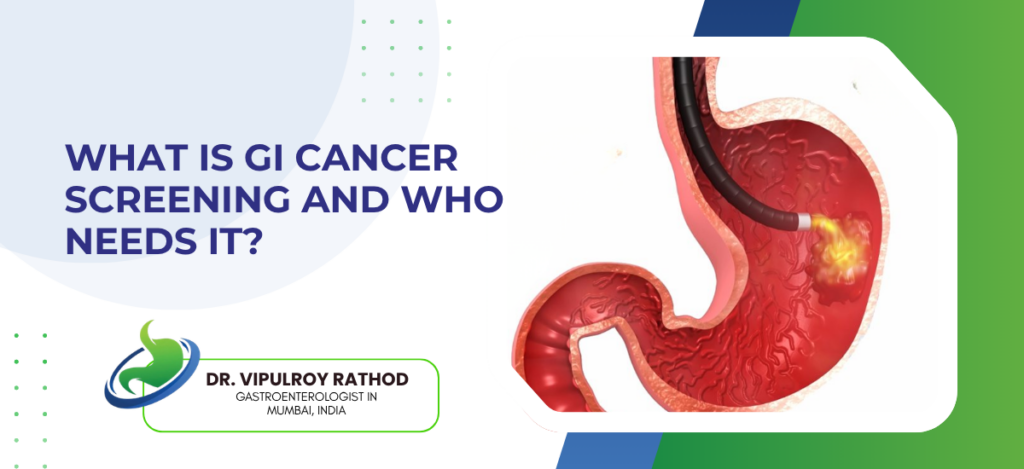
GI cancer screening is the use of tests to find gastrointestinal cancers before symptoms develop. The cancers it targets are colorectal, oesophageal, gastric, pancreatic, and liver. The aim is early detection at a stage where treatment is curative rather than palliative. Colonoscopy remains the most effective screening test. Upper GI endoscopy, FibroScan, ultrasound, and EUS are used selectively depending on risk. Stage one GI cancers have survival above ninety percent. That number falls sharply at later stages. That’s the whole point of screening.
According to Dr. Vipulroy Rathod, Gastroenterologist in Mumbai, “Most GI cancers stay silent. No early symptoms. By the time something appears, obstruction, bleeding, weight loss, the curative window has closed considerably. Screening exists to close that gap before the patient ever knows there’s one. The ones who screen do better. The ones who wait for symptoms usually arrive late.”
Which are the main GI cancer screening tests and what they detect?
Each test targets specific cancers. Choosing the right combination depends on the patient’s risk rather than applying a generic package.
- Colonoscopy. The single most effective screening test in GI medicine. Detects and removes precancerous polyps before they turn into cancer, and identifies colorectal cancer at stages where surgical cure is realistic.
- Upper GI endoscopy looks for oesophageal and gastric cancers along with Barrett’s oesophagus as a precursor. Used selectively, mostly in patients with reflux history or specific risk factors rather than universally.
- FibroScan and liver imaging. Identifies cirrhosis and high-risk metabolic liver disease. Cirrhotic patients then go on six-monthly ultrasound surveillance for hepatocellular carcinoma.
- EUS for pancreatic surveillance. Strong family history. Genetic syndromes. High-risk cystic lesions found on imaging.
The screening plan should fit the patient, not the other way around. Endoscopy in Mumbai services that can combine colonoscopy, upper GI endoscopy, and liver assessment in a single visit make screening practical for working adults who can’t take repeated time off for separate appointments.
Who needs GI cancer screening?
Not every adult needs every test. Risk factors and family history decide which tests, at what age, and how often.
- Average-risk colorectal screening. Starts at 45 to 50 depending on guideline, repeated every ten years if results stay normal. Patients with polyps on previous scopes follow shorter intervals.
- Family history changes the schedule. First-degree relative with colorectal cancer. Screening starts ten years before that relative’s age at diagnosis, or at 40, whichever comes first.
- Cirrhosis and chronic liver disease. Six-monthly ultrasound plus alpha-fetoprotein for hepatocellular carcinoma surveillance, regardless of what caused the underlying liver disease.
- Hereditary GI cancer syndromes need specific protocols. Lynch syndrome, FAP, hereditary diffuse gastric cancer. Earlier start, more frequent intervals, often guided by genetics services.
The benefit of screening depends on the right test reaching the right patient at the right time. Read more on digestive health screening after 50 for how the screening agenda evolves with age and risk factors.
Why choose Dr. Vipulroy Rathod for GI cancer screening?
Dr. Vipulroy Rathod has been doing GI cancer screening and surveillance work at Fortis Hospital Mulund since the late 1990s, with the kind of volume that builds pattern recognition for early cancers most clinicians never get a chance to develop. Screening plans get tailored to family history, metabolic risk, and previous findings rather than applied as a generic checkup package.
The bigger problem patients face isn’t access. It’s whether the right tests get ordered in the right order. Some arrive after years of generic wellness packages that never included a colonoscopy. Others arrive having had multiple stool tests when family history warranted a scope from the start. Matching the test to the patient is what makes screening actually save lives.
Book your consultation today with one of India’s most experienced specialists for GI cancer screening and surveillance.
Frequently Asked Questions
Average-risk colorectal screening begins at 45 to 50. Family history or specific risk factors mean starting earlier.
Yes, especially then.
Normal colonoscopy usually allows a ten-year gap. Polyps, family history, or other risk factors shorten the interval.
No. Tumour markers like CEA aren’t sensitive enough for screening, and colonoscopy and endoscopy remain the standard.
Reference links-
- Colorectal Cancer Screening Guidelines, American College of Gastroenterology — https://gi.org/guideline/colorectal-cancer-screening/
- GI Cancer Surveillance Standards, World Gastroenterology Organisation — https://www.worldgastroenterology.org/guidelines
