

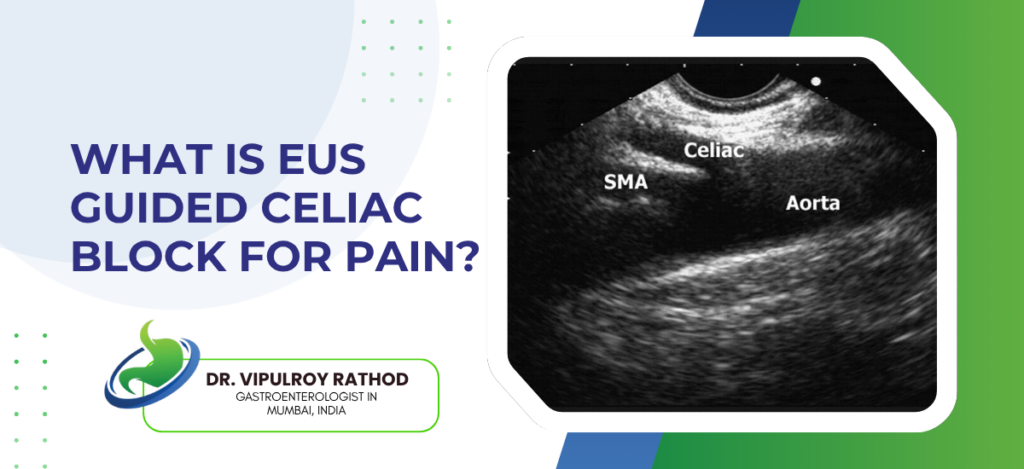
EUS-guided celiac plexus block is an endoscopic procedure that delivers a steroid and local anaesthetic injection, or sometimes a neurolytic agent, directly into the celiac plexus, the bundle of nerves carrying pain signals from the upper abdominal organs. It is used to control severe abdominal pain in patients with chronic pancreatitis and unresectable pancreatic cancer. The procedure replaces the need for escalating opioid doses in many patients, particularly those whose pain has stopped responding to standard medication. Done through endoscopic ultrasound rather than fluoroscopy or CT, the access is more direct and the targeting more precise than older percutaneous techniques.
According to Dr. Vipulroy Rathod, Gastroenterologist in Mumbai, “Pancreatic pain is a different category from other abdominal pain. It comes from deep visceral nerves, doesn’t respond well to standard painkillers, and gets worse as the disease progresses. Celiac block targets the wiring directly. It doesn’t fix the cause, but it interrupts the signal, and for the right patient that’s life-changing.”
Who benefits from EUS-guided celiac block?
The two main indications are chronic pancreatitis and unresectable pancreatic cancer, but the type of injection used differs between them.
- Chronic pancreatitis with severe pain. Patients whose pain has stopped responding to enzyme replacement, analgesia, and lifestyle changes. The injection here is usually a steroid plus local anaesthetic combination, called a celiac block rather than neurolysis, and the effect lasts weeks to months. Some patients need repeat injections every few months.
- Unresectable pancreatic cancer pain is where neurolysis becomes appropriate. Absolute alcohol is injected to permanently damage the nerves, and pain control often lasts the rest of the patient’s life. The trade-off is that neurolysis is permanent and can’t be reversed if complications develop.
- Failure of medical pain management. Patients on rising opioid doses who are getting side effects without proper pain control. Celiac block lets opioid doses come down, often substantially, while pain stays better managed than before.
- Selected cases of locally advanced disease awaiting chemotherapy response, where pain control is needed urgently while definitive treatment plays out over months.
The decision between block and neurolysis depends on the underlying disease and prognosis. Pancreatic cancer treatment planning in advanced disease almost always includes a conversation about pain management options, and celiac block fits early into that conversation rather than being a last resort after everything else has failed.
How the procedure works and what to expect?
EUS-guided celiac block is done under sedation, usually as a day-care procedure, taking around twenty to thirty minutes from start to finish.
A linear-array echoendoscope is passed through the mouth into the stomach, positioned to image the celiac axis and the bundle of nerves surrounding it. Under real-time ultrasound guidance, a fine needle is advanced through the stomach wall to the area just around the celiac plexus. The injection is given, usually divided between two sites on either side of the celiac axis for better coverage. Then the needle is withdrawn.
If you’re the patient, the experience is straightforward. You arrive in the morning, sedation goes in, you wake up in recovery an hour later, you go home by afternoon. Pain relief usually starts within twenty-four to forty-eight hours.
- Block (steroid plus anaesthetic) effects. Pain relief in around sixty to seventy percent of chronic pancreatitis patients, with effects lasting weeks to several months. Repeat injections work but with diminishing returns over multiple cycles.
- Neurolysis (alcohol injection) effects. Substantial pain relief in seventy to eighty percent of pancreatic cancer patients, with effects often lasting the duration of the illness. Some patients have no effect, and the lack of response is itself information about the source of the pain.
- Complications are uncommon but possible. Transient diarrhoea, hypotension after the procedure (from sympathetic blockade), occasional retroperitoneal bleed. Permanent paraplegia from spinal cord injury has been reported but is rare in EUS-guided cases compared to older posterior approaches.
- Repeat blocks are technically straightforward in chronic pancreatitis patients. Neurolysis, once done, is permanent and isn’t repeated.
So the choice of agent depends on whether you’re treating a long-term condition or a terminal one. Read more on pancreatic cancer detection for how pain management decisions fit into the broader pathway of unresectable pancreatic disease.
Why choose Dr. Vipulroy Rathod for EUS-guided celiac block?
Dr. Vipulroy Rathod has been performing EUS-guided celiac block and neurolysis at Fortis Hospital Mulund for over three decades, covering both chronic pancreatitis cases and unresectable pancreatic cancer pain management. Many patients arrive on high doses of opioid medication, struggling with side effects and inadequate pain control, having never been offered celiac block as an option earlier in their disease course.
The procedure isn’t a last resort. It works best when offered before pain becomes intractable, before opioid tolerance is fully established, before the patient’s quality of life has eroded too far. Timing matters as much as technique.
Book your consultation today with one of India’s most experienced specialists for EUS-guided pain management and pancreatic disease care.
Frequently Asked Questions
The procedure itself isn’t, because it’s done under sedation. Some patients have transient abdominal discomfort for a day or two afterwards, which settles on its own. Severe pain after the procedure is uncommon and would need assessment.
For chronic pancreatitis blocks, several weeks to several months, often with diminishing duration on repeat injections. For pancreatic cancer neurolysis, often the rest of the patient’s illness, though some patients need a second procedure if relief fades.
Steroid-based blocks for chronic pancreatitis can be repeated several times. Neurolysis with alcohol is generally a one-time procedure, though there are rare cases where it’s repeated when partial response occurred initially.
Diarrhoea and a drop in blood pressure are the most common, both usually mild and self-limiting. More serious complications like retroperitoneal bleeding or, very rarely, spinal cord injury, are uncommon in experienced hands using EUS guidance.
Reference links-
- EUS-Guided Therapeutic Procedures Guidelines, American Society for Gastrointestinal Endoscopy — https://www.asge.org/home/practice-support/guidelines
- Pain Management in Pancreatic Disease, World Gastroenterology Organisation — https://www.worldgastroenterology.org/guidelines
