

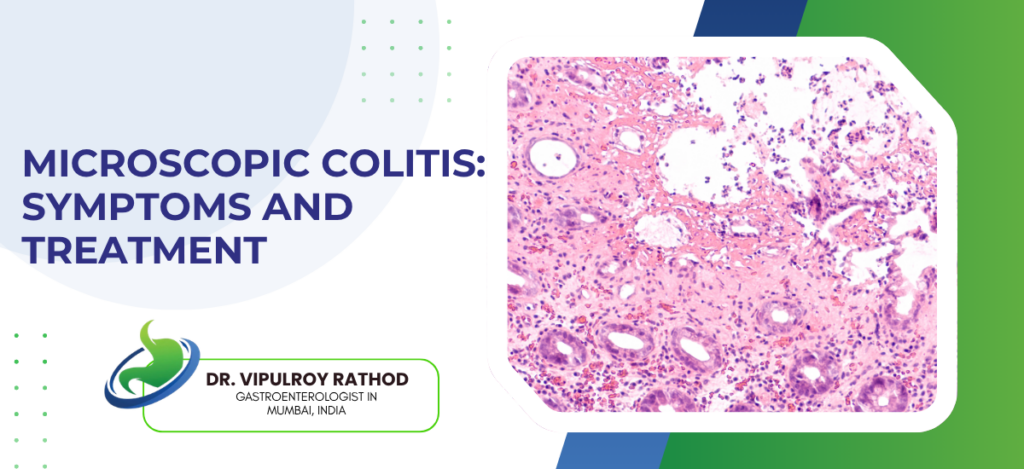
Microscopic colitis is one of the most commonly missed causes of chronic watery diarrhoea, largely because the colon looks completely normal during colonoscopy. The diagnosis only shows up when biopsies are examined under the microscope, which is exactly why patients spend months labelled with IBS before anyone takes the tissue samples that reveal what’s actually going on.
According to Dr. Vipulroy Rathod, Gastroenterologist in Mumbai, “The trap with microscopic colitis is that the scope looks clean, so it’s easy to reassure the patient and send them away with an IBS label. But if you don’t take biopsies from a normal-looking colon in someone with chronic watery diarrhoea, you miss it entirely. The biopsy is the whole diagnosis here, not the colonoscopy view.”
What Are the Symptoms of Microscopic Colitis?
The presentation overlaps heavily with IBS, which is a large part of why it goes undiagnosed for so long.
Chronic watery, non-bloody diarrhoea is the defining symptom, often persisting for weeks or months, and unlike IBS it frequently wakes patients at night rather than settling when they rest.
Abdominal pain and urgency come alongside it. The urgency in particular can be severe enough to disrupt work and daily routine well beyond what the diarrhoea alone would suggest.
Fatigue and weight loss appear in a meaningful proportion of patients as the ongoing diarrhoea affects nutrition and hydration, and these features push the picture away from simple IBS toward something that genuinely needs biopsy confirmation.
It’s more common than most expect in older women, with the risk rising notably after 50 and a clear female predominance, particularly for the collagenous subtype, which helps flag who should be biopsied even when the scope looks unremarkable.
Distinguishing this from other colitis types on tissue is exactly what a specialist in IBD management does when the clinical picture points toward inflammatory rather than functional bowel disease.
How Is Microscopic Colitis Diagnosed and Treated?
The gap between a normal-looking scope and a positive biopsy is where this diagnosis is won or lost.
Colonoscopy with biopsies is non-negotiable. The mucosa looks normal to the eye, so multiple biopsies taken from different segments of the colon are the only way to confirm lymphocytic or collagenous colitis, and skipping them in a patient with chronic watery diarrhoea is the single commonest reason the diagnosis gets missed.
Stopping the drugs that trigger it often improves symptoms on its own, because NSAIDs, PPIs, and certain antidepressants are strongly linked to microscopic colitis, and reviewing the medication list is one of the first and most useful steps.
Budesonide is the mainstay of treatment, a steroid that acts largely within the gut with limited systemic absorption, and it produces symptom remission in the majority of patients who take a proper course, though relapse after stopping is common enough that some need repeated or maintenance therapy.
Refractory cases have further options. Bile acid binders help when bile acid malabsorption coexists, and immunosuppressants are reserved for the small group who don’t respond to budesonide, which is where specialist management genuinely changes the outcome.
Telling microscopic colitis apart from the more familiar inflammatory bowel diseases matters because the treatment and prognosis differ. Read more on Crohn’s vs colitis to understand how the different colitis types are distinguished on colonoscopy and biopsy.
Why Choose Dr. Vipulroy Rathod for Microscopic Colitis?
Dr. Vipulroy Rathod has been diagnosing and treating colitis in all its forms at Fortis Hospital Mulund for over 30 years, and the instinct to biopsy a normal-looking colon in the right clinical context is exactly the kind of judgment that comes from scoping tens of thousands of patients. Those referred after months of an IBS label often finally get a microscopic colitis diagnosis and effective treatment here. Physicians from 35 countries have trained under his approach at Fortis.
Book your consultation today with one of India’s most experienced specialists for microscopic colitis diagnosis and treatment.
Frequently Asked Questions
It is a chronic inflammatory condition causing watery, non-bloody diarrhoea. The colon looks normal on colonoscopy, so diagnosis relies on biopsy showing inflammation.
The main symptom is chronic watery, non-bloody diarrhoea, often with abdominal pain, urgency, fatigue, and sometimes weight loss.
It requires colonoscopy with multiple biopsies, because the colon appears normal and only microscopic examination confirms lymphocytic or collagenous colitis.
Treatment usually starts with budesonide and stopping triggers like NSAIDs and PPIs, with bile acid binders or immunosuppressants used in refractory cases.
Reference
- Microscopic Colitis: Pathogenesis and Diagnosis — NCBI/PMC, https://www.ncbi.nlm.nih.gov/pmc/articles/PMC10342440/
- Chronic Diarrhoea Owing to Microscopic Colitis: Diagnostic Challenges — NCBI/PMC, https://www.ncbi.nlm.nih.gov/pmc/articles/PMC11507306/
