

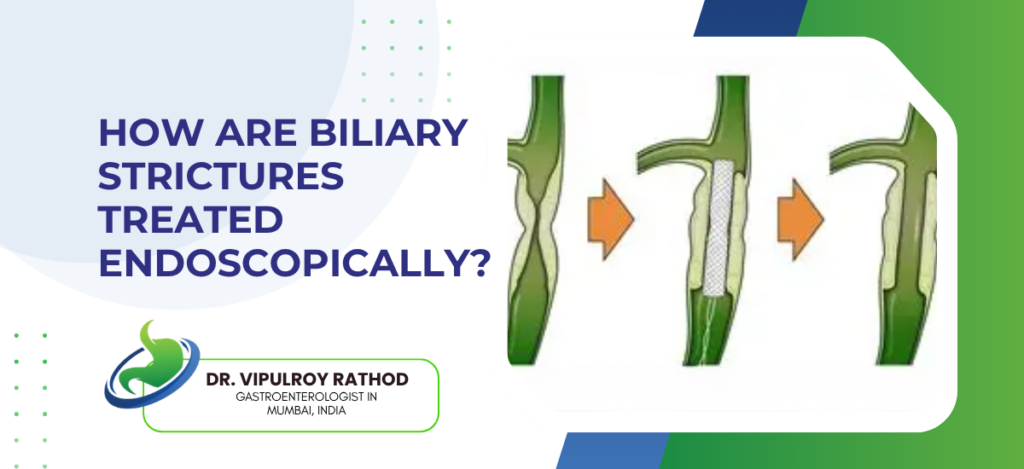
Biliary strictures are narrowings of the bile duct that obstruct bile flow. They are treated endoscopically through ERCP using balloon dilatation, plastic or metal stent placement, and increasingly with EUS-guided drainage when ERCP can’t reach. The approach depends on whether the stricture is benign or malignant, where it sits, and how the patient has responded to previous interventions. Most cases are managed without surgery, though malignant strictures often need long-term stenting alongside chemotherapy, and benign post-surgical strictures may need months of progressive dilatation before the duct stays open.
According to Dr. Vipulroy Rathod, Gastroenterologist in Mumbai, “Biliary strictures used to mean surgery. Now most cases are managed endoscopically. Balloon dilatation. Plastic stents. Fully covered metal stents. EUS-guided drainage when ERCP fails. Each option fits a specific clinical scenario, and choosing the right one upfront avoids the repeat procedures that come with the wrong choice.”
What are the types of biliary strictures and what causes them?
Strictures are classified as benign or malignant. The cause changes the approach and the duration of treatment.
- Benign post-surgical strictures. Most often follow cholecystectomy, liver transplant, or biliary surgery. Scar tissue develops at the anastomosis or injury site over months, causing progressive narrowing.
- Inflammatory strictures from chronic pancreatitis, primary sclerosing cholangitis, autoimmune cholangitis, and IgG4-related disease. These behave differently from post-surgical strictures and often need disease-specific treatment alongside endoscopy.
- Malignant strictures. Cholangiocarcinoma, pancreatic head cancer, gallbladder cancer, metastases compressing the bile duct. Often the first presentation is jaundice, and stenting relieves symptoms while allowing chemotherapy to start.
- Stones impacted in the bile duct cause functional strictures. These usually resolve once the stone is removed through ERCP, though long-standing impaction occasionally leaves residual narrowing that needs separate dilatation.
The cause dictates the treatment plan. Pancreatic and biliary stone extraction services that combine stone removal with stricture assessment in the same ERCP session avoid repeat procedures and allow simultaneous management when both problems coexist, which they often do.
How are biliary strictures treated endoscopically?
Endoscopic management runs on a sequence of steps, starting with the least invasive option that controls the problem.
- Balloon dilatation. A balloon catheter passed through the scope to the stricture and inflated to a controlled diameter. First-line for many benign strictures, with multiple sessions over months sometimes needed before the duct stays open.
- Plastic stent placement keeps the duct open after dilatation. Standard for benign strictures, with multiple stents placed alongside each other to maximise lumen diameter. Exchanged every three to six months until response is stable.
- Fully covered self-expanding metal stents. Used in malignant strictures and increasingly in benign refractory cases. Stay in place longer than plastic stents and produce larger lumen diameter, though cost and removability considerations vary by case.
- EUS-guided biliary drainage. Reserved for cases where ERCP has failed, often due to altered surgical anatomy or duodenal obstruction. The duct is accessed directly through the stomach or duodenum under ultrasound guidance.
Choosing between stent types and timing of exchanges is what separates successful from problematic outcomes. Read more on bile duct cancer for one of the more challenging causes of biliary stricture that often requires complex endoscopic management alongside oncology treatment.
Why choose Dr. Vipulroy Rathod for biliary stricture management?
Dr. Vipulroy Rathod has been doing biliary endoscopy at Fortis Hospital Mulund since the late 1990s. ERCP. EUS-guided drainage. Cholangioscopy. The difficult anatomy cases where standard approaches have already failed. Stricture management is one of the higher-volume areas of biliary endoscopy in the unit, with patients referred from across India and abroad for cases that haven’t responded to initial treatment elsewhere.
The challenge in stricture management isn’t usually the first dilatation. It’s the longer-term plan. Choosing the right stent. Knowing when to exchange. Knowing when to escalate to metal stents or surgical referral. Getting that sequence right is what avoids years of repeat procedures and incomplete relief.
Book your consultation today with one of India’s most experienced specialists for biliary stricture assessment and endoscopic management.
Frequently Asked Questions
Biliary strictures are often painful. The pain is typically a sharp or cramping ache in the upper right abdomen that can radiate to the back and right shoulder.
Most benign strictures need repeated procedures over six to twelve months. Malignant strictures are usually managed with longer-lasting metal stents, with exchanges every few months as needed.
Plastic stents need exchange every three to six months because they block over time. Metal stents can stay longer, sometimes indefinitely in malignant cases where the patient’s overall trajectory means the stent is functionally a permanent fixture rather than a temporary measure, particularly in palliative cholangiocarcinoma and pancreatic cancer management.
Surgery for a biliary stricture is typically reserved for cases where the narrowing is caused by a malignant tumor, the stricture is too severe to be managed by less invasive procedures, or non-surgical treatments have failed.
Disclaimer:
This blog is intended for informational and educational purposes only and should not be considered medical advice.
Please consult a qualified gastroenterologist or healthcare professional for personalized diagnosis and treatment.
