
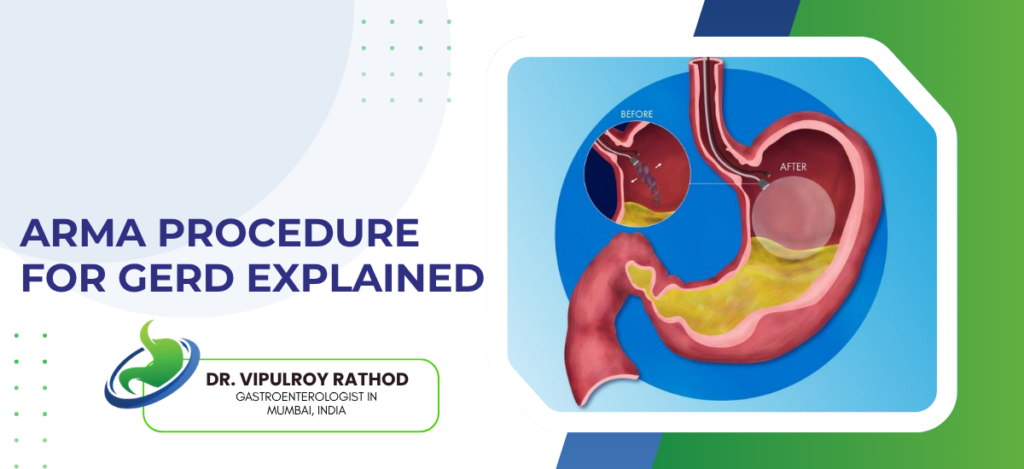
ARMA stands for Anti-Reflux Mucosal Ablation. It’s an endoscopic procedure for patients with gastroesophageal reflux disease who aren’t getting enough relief from medications or want an alternative to surgical fundoplication. The procedure works by ablating a crescent of tissue at the gastroesophageal junction, which tightens the valve mechanism as it heals and reduces acid reflux without any external incisions or permanent implants.
According to Dr. Vipulroy Rathod, an experienced Gastroenterologist in Mumbai, “ARMA fills a real gap for GERD patients who are stuck between PPIs that aren’t working well enough and surgery that feels like too big a step, because it tightens the reflux barrier from the inside without cutting anything open.”
How does the ARMA procedure actually work?
Concept is simple even though the execution needs a trained hand, because you’re essentially creating controlled scarring at the valve between stomach and oesophagus so acid stops coming back up the way it has been.
- Endoscopic access: Whole thing goes through a standard endoscope via the mouth with no cuts anywhere on the body, patient is sedated, procedure runs about 30 to 45 minutes depending on how much tissue needs treating, and most patients head home the same day.
- Mucosal ablation: Using argon plasma coagulation or a similar tool the doctor burns a crescent-shaped strip of tissue right at the gastroesophageal junction which is the flap valve area, and the zone is very precisely chosen because this is controlled targeted work rather than anything random.
- Healing and scarring: Over the next few weeks the ablated area heals and scar tissue forms which physically tightens the junction so the valve that was letting acid through gets narrower, with most patients noticing reflux improvement somewhere around 4 to 8 weeks after the procedure.
- No implants: Big differentiator from other endoscopic reflux procedures because there are no magnets left inside, no beads, no stitches that could erode later, and the tightening comes purely from the body’s own scarring response which means nothing foreign stays behind.
If you want the full rundown on how ARMA fits into the broader treatment picture, our ARMA procedure page covers candidacy, preparation, and what kind of outcomes patients are actually seeing.
Who is a good candidate for ARMA?
Not everyone with reflux qualifies for this and ARMA sits in a very specific niche between pills and surgery, where the patients who do well with it tend to share a pretty recognisable profile that any experienced gastroenterologist can spot during evaluation.
- PPI-dependent patients: Years on proton pump inhibitors where stopping means symptoms come roaring right back, and ARMA gives these patients a realistic shot at cutting down or dropping their medication entirely rather than staying on pills indefinitely.
- Incomplete PPI response: Some people take PPIs every single day and still deal with breakthrough reflux where food comes up and night symptoms wreck sleep, because PPIs reduce acid but they don’t fix the valve and ARMA goes after that mechanical problem directly.
- Avoiding surgery: Fundoplication works and nobody disputes that, but it’s general anaesthesia with abdominal incisions and weeks of dietary restrictions afterwards, so older patients or those with other health conditions often prefer something with a lighter footprint which is exactly the gap ARMA fills.
- Confirmed GERD on testing: This one’s non-negotiable because pH monitoring and endoscopy need to objectively confirm a mechanical valve problem exists before anyone ablates tissue, since symptoms alone aren’t enough to justify the procedure and proper testing always comes first.
Endoscopic approaches keep reshaping how GI conditions get managed across the board, and our colon cancer screening in India blog covers another area where the right diagnostic approach at the right time can catch serious problems early before they progress into something far more complicated and expensive to treat.
Why choose Dr. Vipulroy Rathod for the ARMA procedure?
Dr. Vipulroy Rathod has been at advanced endoscopy for over 30 years with more than 80,000 procedures behind him, and ARMA specifically needs a level of comfort with ablation tools and GE junction anatomy that only builds through high-volume practice because getting the ablation zone exactly right is what separates patients who get solid reflux control from those who end up needing another go at it.
What patients actually get here starts well before the procedure itself with proper pre-assessment confirming ARMA is genuinely the right fit, realistic expectations set upfront so nobody is caught off guard, and then proper follow-up tracking how the healing translates into symptom improvement over the weeks that follow rather than just doing the procedure and hoping for the best.
Book your consultation today with one of India’s most experienced specialists for the ARMA procedure.
Frequently Asked Questions
ARMA is an endoscopic procedure that ablates tissue at the gastroesophageal junction to tighten the valve and reduce acid reflux without surgery or implants.
The procedure typically takes 30 to 45 minutes and most patients go home the same day since it’s done through the mouth under sedation without any surgical incisions.
Most patients see significant and lasting improvement in reflux symptoms, though some may still need a low dose of medication and long-term follow-up helps track results.
Patients with large hiatal hernias, severe oesophagitis, or Barrett’s esophagus may not be ideal candidates and need evaluation for other treatment options instead.
Reference links-
- Anti-Reflux Mucosal Ablation Clinical Evidence — National Library of Medicine
- GERD Management Guidelines — American College of Gastroenterology
