
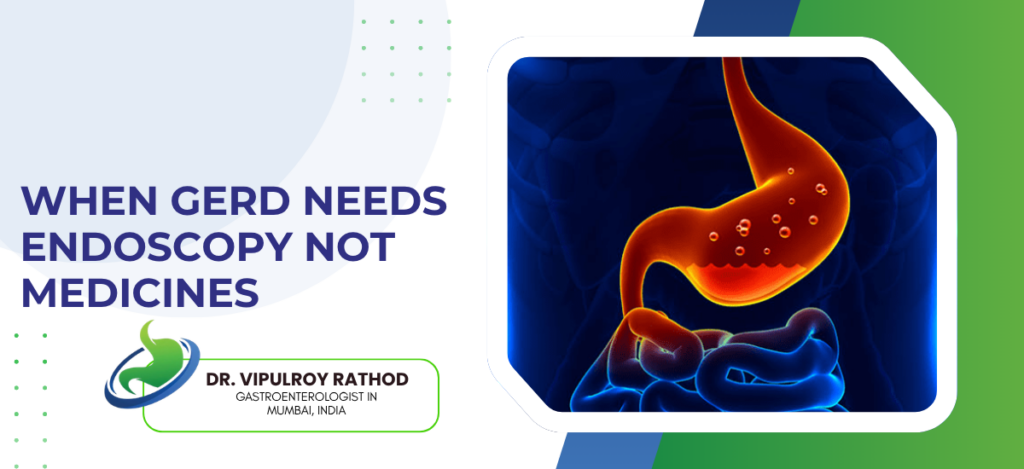
Most GERD patients manage fine on proton pump inhibitors and lifestyle changes. But there’s a point where pills stop being enough. When reflux symptoms persist despite proper medication, or when warning signs like difficulty swallowing, unexplained weight loss, or bleeding show up, an endoscopy becomes necessary to see what’s actually happening inside the oesophagus and rule out complications like strictures, Barrett’s, or early cancer.
According to Dr. Vipulroy Rathod, an experienced Gastroenterologist in Mumbai, “Medicines control acid but they don’t fix the valve, and patients who’ve been on PPIs for years without real improvement need someone to actually look inside and figure out why the reflux isn’t responding the way it should.”
What are the signs that GERD needs more than medication?
PPIs do their job for a lot of people and nobody’s arguing that, but when they stop working or when symptoms start looking different from regular reflux the conversation changes completely.
- Symptoms despite medication: You’re on PPIs daily, following the diet, sleeping propped up, doing everything right, and the reflux still pushes through which is exactly where endoscopy steps in because something beyond acid is clearly driving it at that point.
- Difficulty swallowing: Food sticking on the way down isn’t normal reflux behaviour and could mean a stricture from years of acid damage or something else entirely, but nobody can tell without a scope going in to look which is why sitting on this symptom for months only delays finding out what’s behind it.
- Alarm symptoms: Weight dropping without trying, blood showing up in vomit or dark tarry stools, pain that feels different from the usual burn, any of these alongside GERD and the conversation shifts from “should we scope” to “when can we scope” because these genuinely don’t wait.
- GERD over 5 years: Reflux hanging around that long carries a small but real Barrett’s risk especially in men past 50 with longstanding heartburn, and at least one screening endoscopy to check the oesophageal lining makes sense even if symptoms feel manageable because the lining can be changing without you feeling any different at all.
If reflux has reached the point where medicines aren’t cutting it, our endoscopic treatment for GERD page covers what minimally invasive options look like beyond just adjusting prescriptions.
What can endoscopy do for GERD that medicines can't?
Medicines handle acid and that’s pretty much where their job description ends, but structural issues, tissue changes, and narrowing don’t respond to any pill which is exactly where endoscopy picks up what medication physically cannot address.
- Direct visualisation: Scope goes in and the doctor sees the oesophageal lining in real time with erosions, ulcers, narrowing, and Barrett’s changes all visible right there on the screen instead of being guessed at from symptoms or relying on scans that show walls but miss mucosal detail.
- Biopsy: Tissue samples come out during the same sitting for Barrett’s confirmation, eosinophilic oesophagitis detection, and dysplasia grading, and these diagnoses literally cannot be made without putting tissue under a microscope which means they can only come from a scope.
- Same-session treatment: Stricture found during the scope gets dilated right there, Barrett’s with dysplasia gets ablated in the same sitting, ARMA for a weak valve gets done through the scope, so diagnosis and treatment happen in one go instead of separate visits stretched out over weeks.
- Surveillance planning: Once the scope establishes what the baseline looks like inside, the gastroenterologist can set a proper monitoring schedule for how often to re-check, what to watch for, and when to act versus when to hold, because that plan simply can’t exist without someone having looked inside first.
Picking the right diagnostic approach matters in GI care, and our bile leakage after gallbladder surgery blog covers another situation where endoscopic intervention plays a critical role in diagnosing and managing complications that medication alone can’t resolve.
Why choose Dr. Vipulroy Rathod when GERD needs endoscopy?
Dr. Vipulroy Rathod has been at advanced endoscopy for over 30 years with more than 80,000 procedures behind him, and a massive portion of that work has been upper GI endoscopy for reflux patients where the judgment call between “this just needs better medical management” and “this oesophagus needs a scope now” is something that sharpens over thousands of cases rather than something anyone picks up from a textbook alone.
Nobody gets scoped here without a proper reason and nobody who actually needs scoping gets told to try another round of medicines first when the clinical picture says otherwise, because findings get explained clearly, the plan gets laid out in full, and the patient knows exactly where things stand before walking out the door.
Book your consultation today with one of India’s most experienced specialists for GERD evaluation.
Frequently Asked Questions
When symptoms persist despite proper medication, alarm signs appear, or reflux has been present for over 5 years especially in patients over 50 with additional risk factors.
Endoscopy can treat GERD through procedures like ARMA or dilation of strictures, though the right approach depends on what the scope finds and not every patient needs intervention beyond diagnosis.
The procedure is done under sedation so patients feel nothing during it, and most experience only mild throat discomfort afterwards that settles within a day.
Frequency depends on findings from the first scope, with Barrett’s patients needing regular surveillance and patients with normal findings rarely needing another unless symptoms change.
Reference links-
- GERD Management and Endoscopy Indications — American College of Gastroenterology
- Upper GI Endoscopy Guidelines — American Society for Gastrointestinal Endoscopy
