

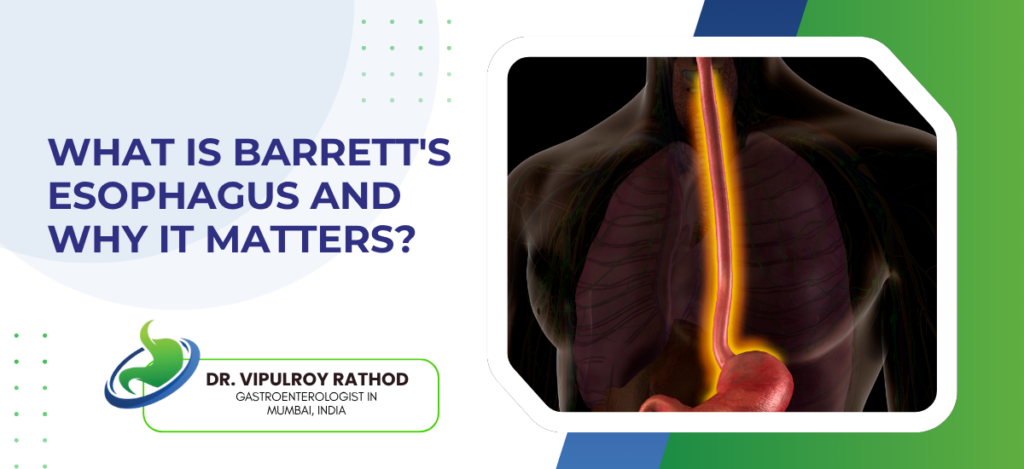
Barrett’s oesophagus is what years of unchecked acid reflux does to the lower oesophageal lining. The normal cell type is replaced by intestinal-type cells that carry a higher cancer risk, and the patients who end up with oesophageal adenocarcinoma are almost always the ones who either didn’t know they had it or didn’t follow through on surveillance.
According to Dr. Vipulroy Rathod, Gastroenterologist in Mumbai, “Barrett’s is a condition where the risk is real but manageable, and the patients who end up with oesophageal cancer are usually the ones who either didn’t know they had it or knew and didn’t follow through on surveillance. The endoscopic tools we have now let us treat dysplasia before it becomes invasive, but only if we find it in time.”
How Is Barrett's Esophagus Diagnosed and Managed?
Everything runs through the endoscope, and the biopsy result is what sets the entire surveillance and treatment plan.
A scope and biopsy is the only way to confirm it. No blood test, no scan, and no symptom pattern can tell you whether the lining has changed, which is exactly why high-risk patients with years of reflux need at least one scope regardless of how manageable their symptoms feel.
When no dysplasia is found, surveillance every three to five years is evidence-based and not as infrequent as it sounds, because progression in the absence of dysplastic change is genuinely slow and the annual cancer risk is very low.
Low-grade dysplasia sits in more uncomfortable territory because the risk of progression is real enough that some gastroenterologists recommend ablative treatment at this stage rather than tighter surveillance, and that conversation needs a clinician who sees enough Barrett’s to read the individual picture rather than applying a generic protocol.
High-grade dysplasia gets treated. Radiofrequency ablation combined with EMR removes the abnormal segment through the scope, without surgery and with outcomes that compare well to resection for appropriately staged early disease.
A specialist in oesophageal cancer manages the step from surveillance into active treatment when dysplasia reaches the point where watching is no longer the right call.
Why Does Barrett's Oesophagus Develop?
Acid doesn’t have to produce severe symptoms to damage the oesophageal lining, and the change from normal to Barrett’s often happens quietly over years.
Long-standing GERD is behind most cases. Duration matters more than severity, and patients with a decade of reflux on and off PPIs often have no idea their lining has changed because the symptoms haven’t told them anything useful.
The risk is much higher in men over 50. That demographic profile, combined with longstanding heartburn, is the combination that most clearly calls for a screening scope before waiting for something worse to develop.
Central obesity worsens acid exposure at the gastro-oesophageal junction and raises Barrett’s risk independently of reflux symptoms, which is why metabolic disease and GERD so frequently appear together in the same patient.
Smoking raises the risk, but here’s the twist — it doesn’t always produce more heartburn, so smokers with GERD often underestimate how much their combination of habits is doing to the oesophageal lining versus non-smokers with the same reflux pattern.
Knowing when longstanding GERD has passed the point where medication alone is enough is where high-risk patients should be looking. Read more on GERD and endoscopy to understand when acid reflux crosses the threshold that requires direct oesophageal assessment.
Why Choose Dr. Vipulroy Rathod for Barrett's Oesophagus?
Dr. Vipulroy Rathod has been diagnosing and managing Barrett’s oesophagus at Fortis Hospital Mulund for over 30 years, with NBI endoscopy and EUS allowing him to detect dysplastic change and assess early invasion with a level of precision that standard white-light endoscopy alone does not provide. Patients referred with longstanding GERD who have never been scoped frequently turn out to have Barrett’s on their first scope, which is the entire argument for not waiting. Physicians from 35 countries have trained under his approach at Fortis.
Book your consultation today with one of India’s most experienced specialists for Barrett’s oesophagus surveillance and endoscopic treatment.
Frequently Asked Questions
It is a condition where the normal oesophageal lining is replaced by intestinal-type cells due to chronic acid exposure, raising the risk of oesophageal adenocarcinoma.
No. Most patients with Barrett’s never develop cancer, but the condition requires regular surveillance endoscopy to detect dysplasia before it progresses.
Low-grade dysplasia is monitored with surveillance endoscopy, while high-grade dysplasia or early cancer is treated with radiofrequency ablation or endoscopic mucosal resection.
Men over 50 with long-term acid reflux, obesity, smoking, and a family history of Barrett’s or oesophageal cancer carry the highest risk.
Reference
- Barrett’s Oesophagus: Epidemiology, Risk Factors and Pathogenesis — NCBI/PMC, https://www.ncbi.nlm.nih.gov/pmc/articles/PMC3178260/
- Endoscopic Management of Barrett’s Oesophagus and Early Oesophageal Cancer — NCBI/PMC, https://www.ncbi.nlm.nih.gov/pmc/articles/PMC6197218/
