 Skip to content
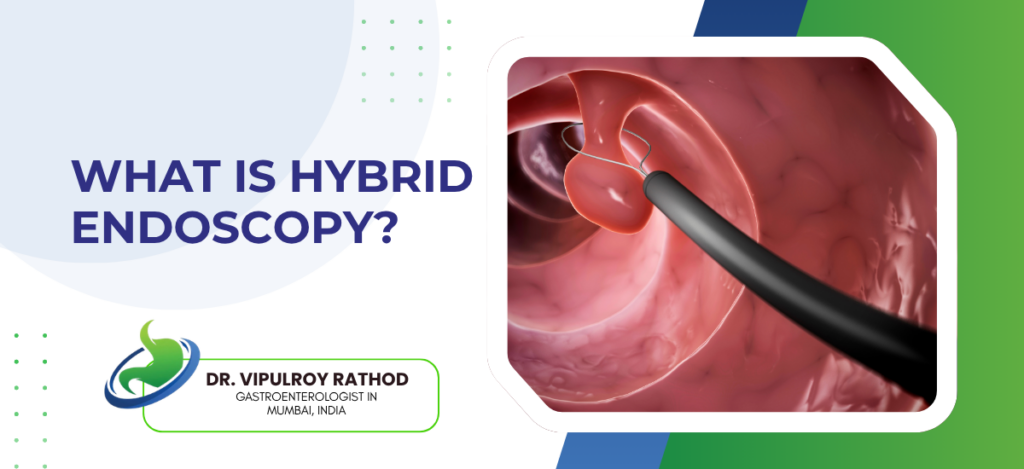
When a lesion is too large for a clean EMR but doesn’t justify the time and risk of a full ESD, hybrid endoscopy offers a middle path. It combines techniques in a single procedure, typically using a partial submucosal dissection to free the difficult edges of a lesion before snaring the rest, which captures the strengths of both methods at once. The aim is a more complete removal than EMR can manage on its own, achieved faster and with less risk than committing to ESD across the entire lesion.
According to Dr. Vipulroy Rathod, Gastroenterologist in Mumbai, “Hybrid endoscopy exists because not every lesion fits neatly into one technique. Some are too big for a tidy snare resection but don’t need a full dissection either. Combining the two lets us remove the lesion completely without exposing the patient to unnecessary procedure time or perforation risk.”
How Does Hybrid Endoscopy Work?
The technique borrows the most useful parts of EMR and ESD and applies each where it does the most good.
Dissecting only the difficult margins with an ESD knife frees the edges of a lesion that a snare alone couldn’t capture cleanly, which is where the hybrid approach earns its advantage.
The bulk of the lesion then comes out through standard snare resection after a submucosal lift, keeping the procedure considerably faster than dissecting the entire area.
Because the hardest part is handled by precise dissection, the overall perforation risk drops compared to attempting a difficult EMR on a lesion that was never well suited to snaring.
For lesions in the 2 to 3 cm range that sit awkwardly between techniques, this combined route often delivers the most complete removal without overcommitting to a lengthy full dissection.
Deciding whether a lesion suits this approach needs accurate assessment, which is where a specialist in hybrid endoscopy evaluates size, depth, and position before choosing the technique.
When Is Hybrid Endoscopy the Right Choice?
It isn’t a default, and the decision comes down to matching the lesion to what each technique does best.
Lesions that fall between EMR and ESD territory are the clearest candidates, being too large for confident piecemeal snaring yet not complex enough to warrant a full dissection from edge to edge.
Where en bloc removal matters but isn’t fully achievable, hybrid technique improves completeness over EMR without demanding the time and skill ceiling that complete ESD requires.
If a lesion sits in a technically awkward location, combining methods can reach margins that a single technique would struggle with, which keeps the patient out of surgery.
Once EUS staging confirms the lesion is mucosal and hasn’t invaded deeper layers, hybrid resection becomes a reasonable option rather than a referral for surgical removal.
Understanding how any of these endoscopic procedures actually unfolds for the patient helps put the technique in context. Read more on endoscopy steps to understand what happens during an endoscopic procedure from start to finish.
Why Choose Dr. Vipulroy Rathod for Hybrid Endoscopy?
Dr. Vipulroy Rathod has been performing advanced therapeutic endoscopy at Fortis Hospital Mulund for over 30 years, and combining techniques like EMR and ESD demands exactly the kind of judgment that comes from that volume. His EUS practice since 1998 means lesions are staged accurately before any resection decision, so the technique chosen actually fits the lesion in front of him. Physicians from 35 countries have trained under his approach at Fortis.
Book your consultation today with one of India’s most experienced specialists for hybrid endoscopy and advanced endoscopic lesion removal.
Frequently Asked Questions
Hybrid endoscopy combines two or more endoscopic techniques, such as EMR and ESD, in a single procedure to remove complex lesions more safely and efficiently than either method alone.
Hybrid endoscopy is used for large or technically difficult lesions where a single technique would be slower, riskier, or less complete, combining the strengths of different methods in one session.
For suitable lesions, hybrid endoscopy can reduce procedure time and perforation risk compared to full ESD while still achieving more complete removal than EMR alone.
Hybrid endoscopy should be performed by an experienced therapeutic endoscopist, as combining techniques requires advanced skill and accurate lesion assessment before the procedure.
Disclaimer:
This blog is intended for informational and educational purposes only and should not be considered medical advice.
Please consult a qualified gastroenterologist or healthcare professional for personalized diagnosis and treatment.
