 Skip to content
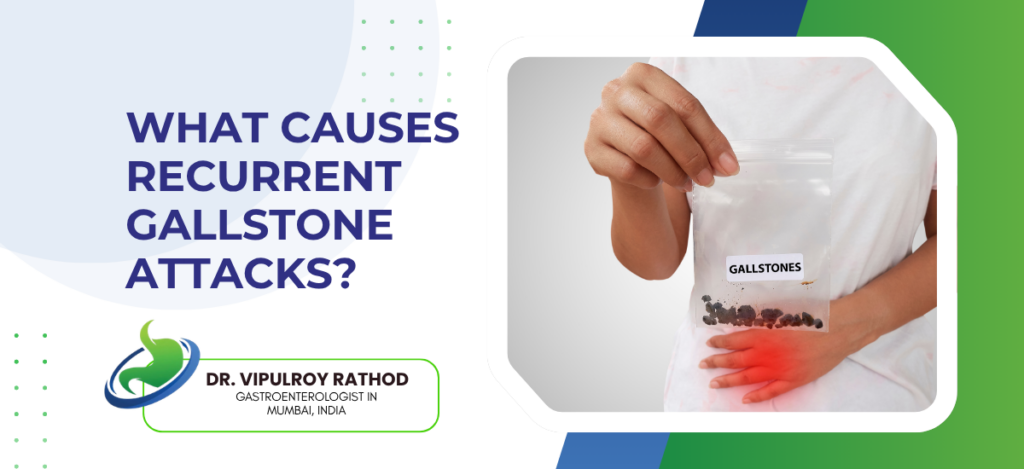
Recurrent gallstone attacks happen when stones in the gallbladder repeatedly block the cystic duct or migrate into the common bile duct, causing episodes of biliary colic, cholecystitis, or cholangitis. The underlying cause is usually unchanged anatomy and physiology, the same gallbladder, the same stones forming for the same reasons, with each attack carrying its own risk of complications. Definitive treatment is cholecystectomy, because medical management of attacks doesn’t address why the stones formed in the first place. Patients with recurrent episodes shouldn’t wait for the next one to plan surgery.
According to Dr. Vipulroy Rathod, Gastroenterologist in Mumbai, “Patients often manage one or two gallstone attacks and wait, hoping the next one won’t come. It usually does. Each attack carries its own risk. Pancreatitis. Cholangitis. Gangrenous gallbladder. The mistake isn’t having stones. It’s waiting for the third or fourth episode to do something definitive, when surgery after the first attack would have prevented all the ones that followed.”
What conditions drive recurrent gallstone attacks?
The cause is rarely random. Specific patient factors, stone characteristics, and behavioural patterns drive the cycle.
- Multiple small stones. Small stones are more likely to migrate from the gallbladder into the cystic or common bile duct, causing repeated obstruction. Large solitary stones tend to stay put, but small ones travel.
- Female sex, age above 40, obesity, rapid weight loss, and pregnancy all raise the underlying risk of stone formation and recurrence. These factors don’t go away between attacks, so the gallbladder keeps producing stones at the same rate.
- Cholesterol supersaturation in bile. Most gallstones are cholesterol-based, formed when bile becomes oversaturated with cholesterol relative to bile salts and lecithin. The supersaturation continues after each attack unless the gallbladder is removed.
- Conditions like haemolysis, cirrhosis, ileal disease, and certain medications produce pigment stones rather than cholesterol stones. The underlying disease keeps driving stone formation regardless of how many attacks have been managed.
The cycle continues until the gallbladder is removed. Pancreatic and biliary stone extraction services that combine ERCP for common bile duct stones with planned cholecystectomy avoid the gap where patients are managed for each attack separately while the underlying problem remains untreated.
How are recurrent gallstone attacks treated definitively?
Definitive treatment means removing the source. Symptom management treats the attack but not the cause.
- Laparoscopic cholecystectomy. The standard treatment for recurrent symptomatic gallstones. Removes the gallbladder along with all stones inside, preventing future attacks completely in the large majority of patients.
- ERCP with stone extraction is needed alongside surgery when stones have migrated into the common bile duct. The combination of ERCP followed by cholecystectomy is the standard approach for patients presenting with choledocholithiasis.
- Timing of surgery matters. Cholecystectomy during the index admission for cholecystitis or pancreatitis is now preferred over delayed surgery, with better outcomes and shorter overall recovery in most patient groups.
- Patients unfit for surgery may need percutaneous cholecystostomy as a temporary measure, with later interval cholecystectomy when fitness allows or long-term tube management in patients who can’t safely undergo any operation.
Surgery prevents future attacks reliably in most patients. Read more on gallstone pancreatitis for one of the more serious complications of recurrent gallstones that can develop without warning when a stone migrates at the wrong moment.
Why choose Dr. Vipulroy Rathod for recurrent gallstone management?
Dr. Vipulroy Rathod has been managing recurrent gallstone disease at Fortis Hospital Mulund since the late 1990s, with coordinated care across gastroenterology and surgical teams that makes timely cholecystectomy possible for patients who arrive mid-flare. Many patients arrive after multiple admissions for biliary colic, cholangitis, or pancreatitis, when earlier surgery would have prevented the cumulative damage that built up across episodes.
The mistake patients usually make is treating each attack as an isolated event rather than part of a pattern. Definitive surgery isn’t a last resort. It’s the appropriate treatment for recurrent symptomatic gallstones, with low complication rates and a high success rate when done laparoscopically in experienced hands.
Book your consultation today with one of India’s most experienced specialists for recurrent gallstone assessment and treatment planning.
Frequently Asked Questions
Ursodeoxycholic acid dissolves some small cholesterol stones over many months, but stones usually return after stopping treatment. Surgery is more reliable.
No. Diet may reduce attack frequency in some patients, but the underlying stone formation continues regardless of dietary changes.
Yes. Bile flows directly from the liver into the intestine after cholecystectomy, and most patients have no long-term symptoms. A small minority develop mild diarrhoea or bile acid malabsorption that responds to treatment.
Increasingly urgent. Current guidelines favour cholecystectomy during the index admission for cholecystitis or pancreatitis rather than delayed surgery weeks later, because outcomes are better and the risk of further attacks during the waiting period is real.
Disclaimer:
This blog is intended for informational and educational purposes only and should not be considered medical advice.
Please consult a qualified gastroenterologist or healthcare professional for personalized diagnosis and treatment.
