

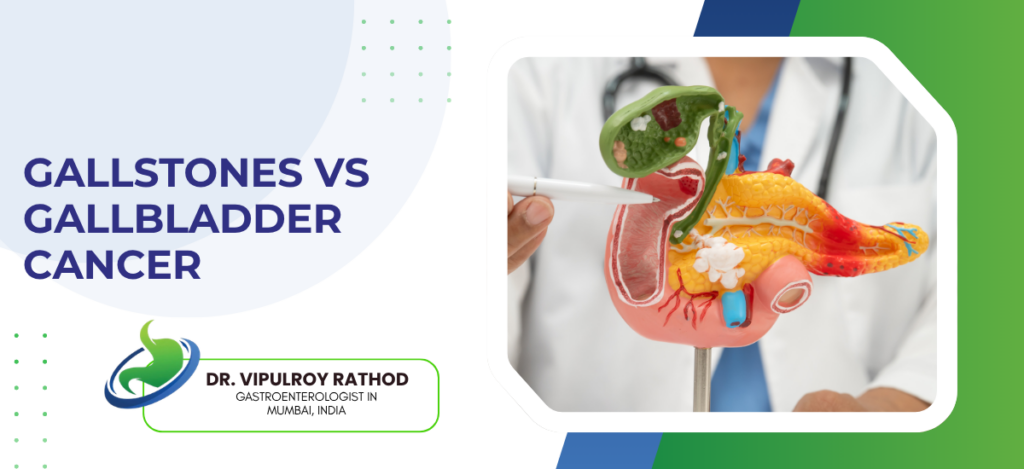
Gallstones are extremely common and almost always benign while gallbladder cancer is rare but aggressive, and the tricky part is that early gallbladder cancer can sit quietly behind gallstones without producing any symptoms that would make either the patient or the doctor suspect something more serious is going on until it’s already advanced.
According to Dr. Vipulroy Rathod, an experienced Gastroenterologist in Mumbai, “The overlap between gallstone symptoms and early gallbladder cancer is what makes this dangerous because patients assume their pain is just stones and by the time cancer gets picked up incidentally during surgery or on imaging the window for curative treatment has often already narrowed significantly.”
How are gallstones and gallbladder cancer different?
They hit the same organ but that’s where the overlap stops, because one is basically a plumbing issue that millions of people carry around their whole lives without it ever becoming a problem and the other is a malignancy that needs catching early or your options dry up scarily fast.
- What they are: Gallstones are hardened bile deposits sitting inside the gallbladder from cholesterol or bilirubin getting out of whack, while gallbladder cancer is abnormal cell growth in the gallbladder wall that can chew into surrounding tissue and spread to other organs if nobody catches it in time.
- How common: Gallstones turn up in roughly 10 to 15 percent of adults and the vast majority never cause a day of trouble, while gallbladder cancer is genuinely rare but that rarity is part of what makes it nasty because nobody goes looking for it until it decides to make itself known.
- Symptoms: Both can cause upper belly pain, nausea, and bloating which is exactly why they get mixed up, but cancer throws in red flags like weight dropping for no reason, pain that won’t quit and doesn’t come and go like typical stone attacks, jaundice without a duct stone explaining it, and a hard lump up top that has no business being there.
- Connection: Large stones especially over 3 cm, porcelain gallbladder where the wall calcifies, and stones that have been hanging around for decades all nudge cancer risk upward, which is one reason some surgeons push for taking the gallbladder out even when stones aren’t actively causing grief if these risk factors are sitting there.
If persistent upper belly symptoms have you wondering what’s going on, our advanced endoscopic procedures page covers the full range of what can be investigated and treated through a scope without anyone needing to pick up a scalpel.
How are they diagnosed and treated differently?
Couldn’t be more different in how they get found and dealt with, because gallstones are usually a quick ultrasound followed by keyhole surgery and done, while gallbladder cancer drags in staging scans, biopsies, tumour boards, and a whole team figuring out whether curative surgery is even still an option at that point.
- Diagnosis: Stones get caught on a basic ultrasound that takes minutes and costs next to nothing, while cancer often needs contrast CT, MRI, sometimes EUS with a needle biopsy, and occasionally PET scanning to map out how far things have spread and whether the tumour can still be cut out.
- Treating stones: Symptomatic gallstones get sorted with laparoscopic cholecystectomy which is keyhole surgery to whip the gallbladder out, most patients go home same day or next morning, recovery takes days not weeks, and the problem is permanently gone once that gallbladder is out of the picture.
- Treating cancer: Early cancer caught by accident during cholecystectomy might already be cured by the surgery that just happened, but anything past the earliest stage needs extended surgery taking part of the liver and nearby lymph nodes with it, and advanced cases that have spread may only qualify for chemo or palliative care rather than anything that’s going to fix the problem.
- Why catching it early matters: Stage one gallbladder cancer has a dramatically better survival rate than stage three or four, and since most early cases get discovered accidentally during gallstone surgery the argument for not sitting on symptomatic gallstones gets considerably stronger when you factor in the small but very real chance that something worse has been quietly hiding behind them the whole time.
Biliary complications can crop up after various GI procedures, and our bile leakage after gallbladder surgery blog covers one of the post-surgical biliary headaches where endoscopic management ends up doing the heavy lifting in both working out what went wrong and actually fixing it.
Why choose Dr. Vipulroy Rathod for gallbladder evaluation?
Dr. Vipulroy Rathod has over 30 years in advanced gastroenterology with more than 80,000 endoscopic procedures behind him including serious EUS work evaluating gallbladder wall abnormalities and suspicious masses, and that matters because telling the difference between a wall that’s thickened from years of chronic stones and one that’s got an early malignancy hiding inside it is exactly the kind of call you don’t want made by someone who’s only seen a handful of these.
What patients get here is a workup that doesn’t just confirm gallstones and call it a day, because when risk factors for something worse are sitting there or imaging throws up anything even slightly off the evaluation digs deeper rather than assuming stones explain the whole picture and rushing everyone into a standard cholecystectomy without properly checking what else might be lurking underneath.
Book your consultation today with one of India’s most experienced specialists for gallbladder evaluation.
Frequently Asked Questions
Stones don’t actually transform into cancer themselves but carrying them long-term especially big ones over 3 cm or having a calcified gallbladder wall bumps up the risk of cancer eventually developing in the same organ over time.
Ultrasound catches stones easily enough but cancer usually needs CT, MRI, or EUS with biopsy to nail down, and red flags like weight dropping for no reason, pain that won’t quit, and jaundice without a duct stone point more toward something malignant than plain old stones.
Most quiet gallstones can be left alone safely, but taking the gallbladder out gets recommended more strongly when cancer risk factors are in the picture like very large stones, porcelain gallbladder, or certain ethnic and geographic profiles that carry higher baseline risk.
Caught early and incidentally during cholecystectomy the cure rate is genuinely good, but by the time cancer has pushed past the gallbladder wall the prognosis drops off hard and treatment options narrow down to chemo or palliative care rather than anything curative.
Reference links-
- Gallbladder Cancer Diagnosis and Management — National Library of Medicine
- Gallstone Disease Guidelines — American College of Gastroenterology
