 Skip to content
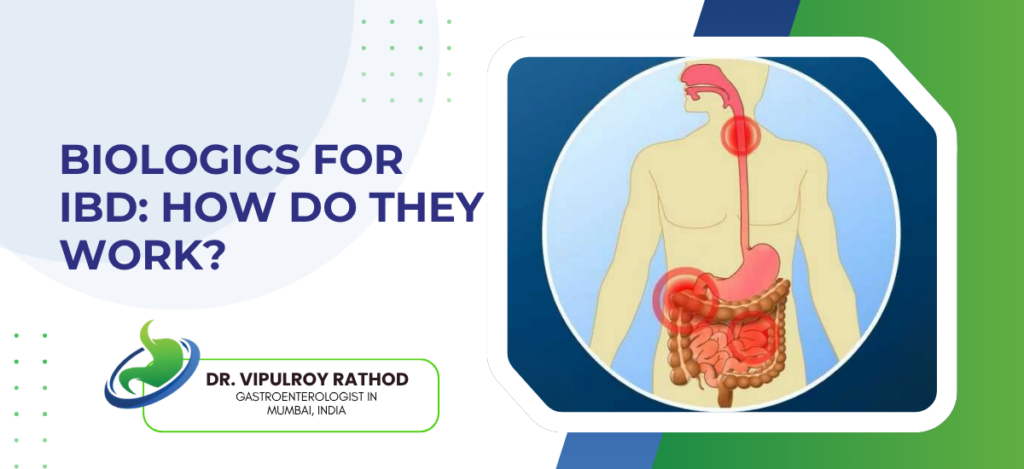
Biologics are large protein molecules, usually antibodies, designed to block specific inflammatory pathways that drive Crohn’s disease and ulcerative colitis. Unlike steroids or immunosuppressants which suppress the immune system broadly, biologics target one molecule, one cytokine, one cell type, leaving the rest of the immune system mostly intact. They’ve transformed IBD treatment over the last two decades. Patients who would have ended up with surgery or chronic steroid use now achieve sustained remission on infusions or injections every few weeks. The trade-off is cost and complexity.
According to Dr. Vipulroy Rathod, Gastroenterologist in Mumbai, “When biologics work, they really work. Patients on infliximab or vedolizumab who failed years of steroids and immunosuppressants achieve mucosal healing and stay in remission for years. The challenge is matching the right drug to the right patient, and starting it early enough to change the disease course rather than waiting until damage has already accumulated.”
How biologics actually work in IBD?
The fundamental idea behind biologic therapy is that IBD inflammation is driven by specific molecules in the immune system, and blocking those molecules controls the disease without shutting down everything else.
- Anti-TNF agents. Infliximab, adalimumab, golimumab. These block tumour necrosis factor alpha, one of the central pro-inflammatory cytokines in IBD. The oldest class of biologics, used since the late 1990s, with the most evidence behind them. Effective in both Crohn’s and ulcerative colitis.
- Anti-integrin agents work by stopping inflammatory immune cells from entering the gut. Vedolizumab is the main example, gut-selective, with a strong safety profile because it doesn’t affect immune surveillance elsewhere in the body. Particularly useful in patients with infection risks or comorbidities that make broader immunosuppression dangerous.
- Anti-IL-12/23 and anti-IL-23 agents. Ustekinumab and risankizumab. These block interleukin signalling pathways involved in chronic gut inflammation. Useful in patients who haven’t responded to anti-TNF, with a different side-effect profile and good evidence in both Crohn’s and increasingly in ulcerative colitis.
- JAK inhibitors are technically small molecules rather than biologics, but they’re often grouped with them because they sit in the same advanced therapy category. Tofacitinib and upadacitinib block intracellular signalling involved in cytokine response. Oral, fast-acting, with their own risk profile that needs careful patient selection.
Choosing the right biologic depends on disease subtype, severity, location, and previous treatment response. IBD treatment decisions today usually involve mapping each patient’s disease pattern against the specific biologic profile rather than trying drugs in a fixed sequence. The era of “anti-TNF first, then see what happens” is fading.
Who benefits from biologic therapy?
Biologics aren’t for every IBD patient, but the threshold for starting them has lowered significantly as evidence accumulates for early aggressive treatment.
The clearest indication is moderate-to-severe disease that hasn’t responded adequately to steroids and conventional immunomodulators like azathioprine or methotrexate. Patients in this group often spend years on cycles of steroids with relapses between courses, accumulating side effects without achieving stable remission. Biologics break that cycle for most of them.
A second group is patients with high-risk disease features at diagnosis. Extensive Crohn’s involvement, deep ulcers, perianal disease, young age at onset, or evidence of structural damage on imaging. Starting biologics early in these patients, sometimes immediately rather than after step-up failure, is increasingly supported by trial evidence showing better long-term outcomes.
The third is patients with extraintestinal manifestations driving morbidity. Joint disease, skin involvement, eye inflammation, primary sclerosing cholangitis. Some of these respond preferentially to specific biologics, and the choice gets influenced by what’s happening outside the gut as much as inside.
Finally, there are the patients who simply can’t continue on steroids without unacceptable side effects. Diabetes, hypertension, osteoporosis, mood disturbance, cataracts. For these patients, biologics offer a steroid-sparing strategy that’s been transformative even when the disease itself is only moderately severe. Read more on what IBD is and how it’s diagnosed for how the underlying conditions are characterised before treatment decisions are made.
Why choose Dr. Vipulroy Rathod for IBD management?
Dr. Vipulroy Rathod has been managing inflammatory bowel disease at Fortis Hospital Mulund for over three decades, through the transition from steroids and immunomodulators as the only options to the current era where biologic and small molecule therapy are standard for moderate to severe disease. The judgment that experience builds in this area is mostly about timing, which patients benefit from early aggressive treatment, which can be managed with simpler approaches, and which need surgery alongside medical therapy.
The mistakes that hurt IBD patients most aren’t usually about choosing the wrong biologic. They’re about waiting too long to escalate, missing the window where the disease was modifiable, or under-dosing therapy that would have worked if optimised properly. Modern IBD care requires drug level monitoring, regular endoscopic reassessment, and active management rather than a set-and-forget approach.
Book your consultation today with one of India’s most experienced specialists for IBD assessment and biologic therapy management.
Frequently Asked Questions
For most patients, yes. Infection risk is the main concern, particularly tuberculosis reactivation in Indian patients, which is why screening before starting biologics is essential. Malignancy risk exists but is small with most modern agents.
Indefinitely, in most cases. Stopping biologics in patients who’ve achieved remission usually leads to flares within months. Some patients can taper to lower frequency or stop after years of stable remission, but this is the exception rather than the standard.
No. They control inflammation effectively, achieve mucosal healing, and maintain remission, but the underlying disease remains. Stopping treatment usually means symptoms return.
Cost has come down significantly with biosimilars now widely available. Infliximab biosimilars in particular are now meaningfully cheaper than the originator drugs, making biologic therapy accessible to many more patients than five years ago.
Reference links-
- IBD Clinical Care Pathway, American Gastroenterological Association — https://gastro.org/clinical-guidance/management-of-moderate-to-severe-ulcerative-colitis/
- ECCO Guidelines on Crohn’s Disease and Ulcerative Colitis, European Crohn’s and Colitis Organisation — https://www.ecco-ibd.eu/publications/ecco-guidelines.html
