

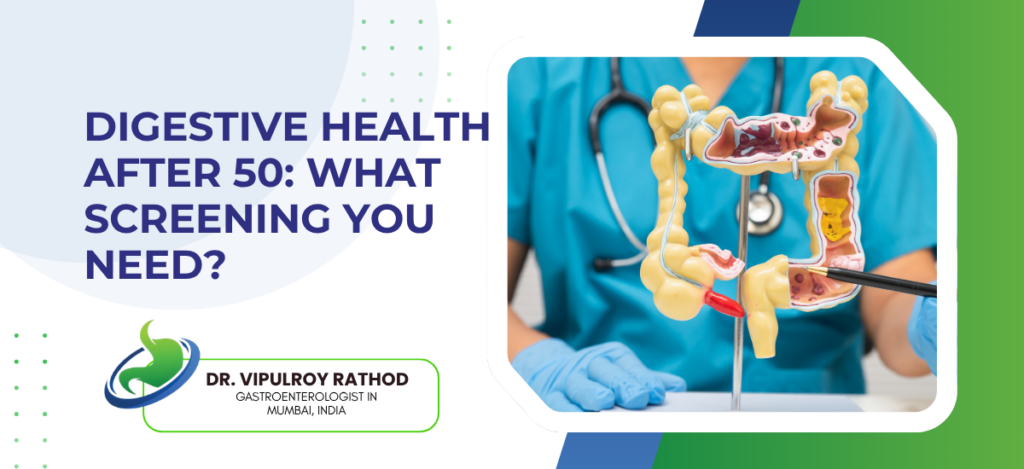
Turning 50 is the age at which several digestive system cancers and chronic conditions start becoming meaningfully more common, and the screening landscape shifts from optional to standard practice. Colorectal cancer is the headline reason, but it isn’t the only one. Liver disease, gallbladder pathology, and upper GI cancers all rise in incidence from this decade onwards. Most patients only get tested once symptoms appear, which is often too late for the kind of early-stage disease that screening exists to catch.
According to Dr. Vipulroy Rathod, Gastroenterologist in Mumbai, “The whole point of screening is to catch something before it announces itself. Colorectal cancer at stage one has a survival rate above ninety percent. At stage four it falls to under fifteen. The difference between those two numbers is usually a colonoscopy that happened, or didn’t, in someone’s fifties. Patients underestimate how much that one test changes the trajectory.”
Which screening tests actually matter after 50?
Not every test marketed as a wellness package is worth doing. The screening that genuinely changes outcomes falls into a handful of clear categories.
- Colonoscopy. The single most important GI screening test after 50. One colonoscopy with no polyps means the next one can usually wait ten years. Polyps found and removed reset that schedule, but they also remove the precursor lesions that would have become cancer. This is the test most likely to save a life in this age group.
- Upper GI endoscopy is selectively useful, not routine for everyone. Patients with longstanding reflux, Indian patients with risk factors for stomach cancer, or anyone with persistent dyspepsia, anaemia, or weight loss should have one. Routine universal upper GI screening isn’t recommended even after 50 unless risk factors are present.
- FibroScan and liver assessment. Metabolic liver disease affects nearly a third of urban Indian adults over 50, and most patients have no idea. A FibroScan with basic blood tests stages the disease properly and identifies which patients need active management versus reassurance.
- Stool-based tests as adjuncts, not replacements. FIT (faecal immunochemical test) annually is reasonable for patients who decline colonoscopy outright. Stool DNA tests are available too but currently underused in India. Neither is as sensitive as colonoscopy, both miss meaningful disease.
What patients commonly skip is the assessment that builds on the screening results. Endoscopy in Mumbai services that combine colonoscopy and upper GI endoscopy with FibroScan and metabolic workup in the same appointment slot make screening practical for working adults who can’t take time off repeatedly for separate tests.
What are the Risk factors that change the screening schedule?
Standard screening intervals are designed for average-risk patients. Specific risk factors shift the schedule earlier, more frequently, or to different tests entirely.
The first situation is family history. A first-degree relative with colorectal cancer means screening should start ten years earlier than their age at diagnosis, or at 40, whichever comes first. Two or more affected relatives, or any with diagnosis under 50, raises the bar to genetic counselling and consideration of inherited syndromes like Lynch syndrome.
The second is personal history of polyps, inflammatory bowel disease, or previous GI cancer. These patients are on surveillance schedules rather than standard screening intervals, often with colonoscopy every one to three years depending on the previous findings.
The third is metabolic risk. Diabetes, obesity, fatty liver, and metabolic syndrome significantly raise the risk of multiple GI cancers and chronic liver disease. These patients benefit from earlier and more comprehensive screening, including FibroScan, lipid profile, and HbA1c alongside the standard tests.
Finally, there are the symptom-driven indications that aren’t really screening at all, they’re diagnostic workup. Any patient with unexplained weight loss, anaemia, persistent change in bowel habit, rectal bleeding, or significant dyspepsia after 50 needs full GI evaluation regardless of when their last screening was. Read more on colonoscopy and what it detects for how the most important single test in this group is actually performed and interpreted.
Why choose Dr. Vipulroy Rathod for digestive health screening?
Dr. Vipulroy Rathod has been performing GI screening, surveillance, and complex endoscopy at Fortis Hospital Mulund for over three decades, with the volume of colonoscopies and upper GI endoscopies that builds the pattern recognition needed to spot early disease. The screening agenda for any individual patient gets tailored to family history, metabolic risk, and previous findings rather than applied as a generic protocol.
The bigger issue most patients face isn’t access to screening, it’s getting the right tests rather than the wrong ones. Some arrive having spent significantly on full-body checkup packages that didn’t include a colonoscopy. Others arrive after years of stool tests when their family history warranted a scope from the start. Matching the test to the patient is what makes screening actually work.
Book your consultation today with one of India’s most experienced specialists for digestive health screening after 50.
Frequently Asked Questions
Standard average-risk screening starts at 45 to 50 depending on guideline. Patients with family history or other risk factors should start earlier, sometimes as young as 40.
A normal colonoscopy with no polyps usually means the next one is in ten years. Polyps found, IBD, or family history shorten the interval considerably.
Better than no screening, not as good as colonoscopy. FIT misses around twenty to thirty percent of significant polyps and a meaningful proportion of cancers. Reasonable for patients who refuse a scope, not the first choice.
Upper GI endoscopy when symptoms or risk factors are present. FibroScan for metabolic liver disease in patients with obesity, diabetes, or dyslipidaemia. Routine ultrasound for the gallbladder in selected patients with risk factors.
Reference links-
- Colorectal Cancer Screening Guidelines, American College of Gastroenterology — https://gi.org/guideline/colorectal-cancer-screening/
- Cancer Screening Recommendations, World Health Organization — https://www.who.int/health-topics/cancer
