

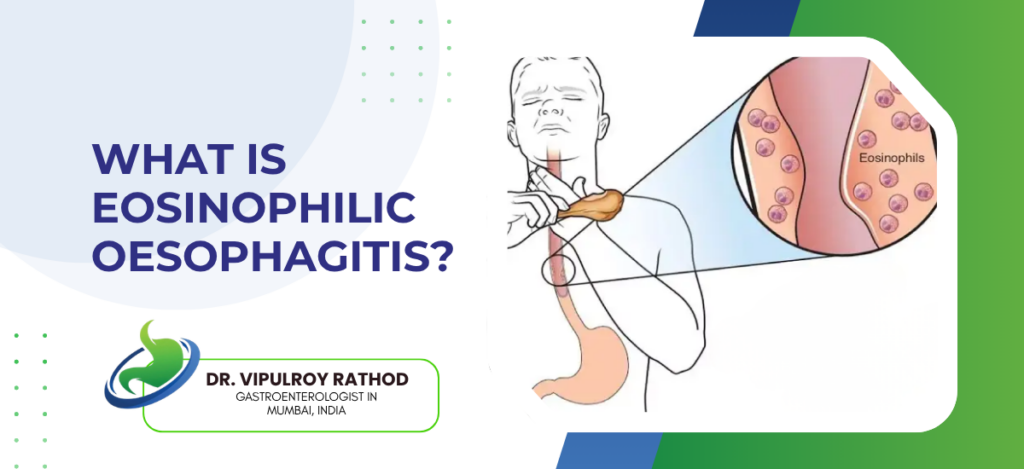
Eosinophilic oesophagitis (EoE) is a chronic, allergy-driven inflammation of the oesophagus where eosinophils, a type of white blood cell, build up in the lining and cause swelling, scarring, and difficulty swallowing. It is increasingly recognised as a major cause of dysphagia and food impaction in younger adults. The condition often gets misdiagnosed as reflux for years before someone takes a biopsy and counts the eosinophils, which is the only way to actually make the diagnosis. EoE isn’t life-threatening, but untreated it progressively narrows the oesophagus and reduces quality of life significantly.
According to Dr. Vipulroy Rathod, Gastroenterologist in Mumbai, “Patients with EoE often come to us after years of being treated for reflux that never quite settled. They’ve tried PPIs, lifestyle changes, sometimes even surgery for hiatus hernia. The clue is usually food sticking, particularly meat and bread, in young or middle-aged patients. Once we look properly with biopsy, the diagnosis becomes obvious.”
How EoE develops and how it's diagnosed?
EoE is allergy-driven but the allergy lives in the food pipe rather than anywhere else, which is what makes it so easy to miss.
- Food triggers, mostly. Cow’s milk and wheat lead the list. Eggs, soy, and nuts after that. Some patients also have aeroallergen triggers, pollen and dust mites, especially if they have asthma or eczema in the background.
- The symptom that should make any doctor think of EoE is solid food sticking. Bread, dry meat, rice. The patient stops, drinks water, the food eventually clears. Many patients have developed elaborate coping strategies over years, obsessive chewing, drinking water with every bite, avoiding certain foods entirely, without ever realising they’re managing an undiagnosed disease.
- Endoscopy with biopsy is non-negotiable. Looking at the oesophagus alone tells you something. Rings, furrows, white plaques, narrowing. But the diagnosis only becomes official when biopsies from multiple levels show more than fifteen eosinophils per high-power field on the histology report.
- Allergy blood tests and skin prick testing? Less useful than they sound. They don’t reliably predict which foods are driving any individual patient’s disease, and elimination diets work better when designed by trial rather than by lab result.
Getting EoE diagnosed properly changes the management completely. Endoscopy in Mumbai services should be the first stop for anyone with persistent dysphagia or food impaction, because the multi-level biopsies needed to confirm or rule out EoE can’t be done without the right scope and a willingness to biopsy even a normal-looking oesophagus.
How EoE is treated?
Three angles to treatment. Calm the inflammation, find and remove the trigger food, open up any narrowing that’s already developed.
- Topical steroids. Swallowed budesonide or fluticasone, formulated to coat the oesophagus rather than get absorbed into the bloodstream. Works in most patients. Response confirmed at eight to twelve weeks with repeat biopsy.
- High-dose proton pump inhibitors actually treat a meaningful subset of EoE patients on their own. The mechanism isn’t only acid suppression, PPIs have a direct anti-inflammatory effect on eosinophils that wasn’t recognised for years. Around thirty to forty percent of patients respond to PPI monotherapy.
- Elimination diets. Six-food elimination is the classical approach, removing the six commonest trigger food groups, then reintroducing them one by one with repeat endoscopy to identify the actual culprit. Four-food and two-food versions exist for patients who can’t tolerate the full elimination.
- Endoscopic dilatation for established strictures. EoE patients sometimes develop tight rings or fixed narrowings after years of inflammation, and dilatation reopens them mechanically. Always combined with continued medical treatment to prevent the inflammation from coming back.
So treatment is rarely one thing. Read more on reflux vs other GI Conditions for how EoE fits into the differential diagnosis of long-standing oesophageal symptoms.
Why choose Dr. Vipulroy Rathod for EoE diagnosis and management?
Dr. Vipulroy Rathod has been diagnosing and managing eosinophilic oesophagitis at Fortis Hospital Mulund for over three decades, and the difference experience makes here is mostly about recognition. EoE looks subtle on endoscopy, the rings and furrows are easy to dismiss as normal variation, and without a low threshold for biopsying patients with dysphagia or food impaction, the diagnosis gets missed. Patients arrive having had multiple scopes elsewhere where the diagnosis wasn’t even considered, sometimes after years of PPI treatment for reflux that wasn’t actually reflux, occasionally after hiatus hernia surgery that didn’t fix the problem because the problem was never reflux to begin with.
Book your consultation today with one of India’s most experienced specialists for swallowing problems and EoE assessment.
Frequently Asked Questions
No. Different cause, different treatment, but they can coexist in the same patient.
Endoscopy plus biopsies from multiple oesophageal levels. More than fifteen eosinophils per high-power field is the threshold.
Controlled, not cured. Stopping treatment usually means the inflammation returns within months.
Not in the short term. Long-term, untreated EoE narrows the oesophagus and causes recurrent food impactions, which is a real quality-of-life problem and occasionally an emergency.
Reference links-
- Eosinophilic Oesophagitis Guidelines, American College of Gastroenterology — https://gi.org/guideline/eosinophilic-esophagitis/
- AGREE Conference Updates on EoE, World Gastroenterology Organisation — https://www.worldgastroenterology.org/guidelines
