

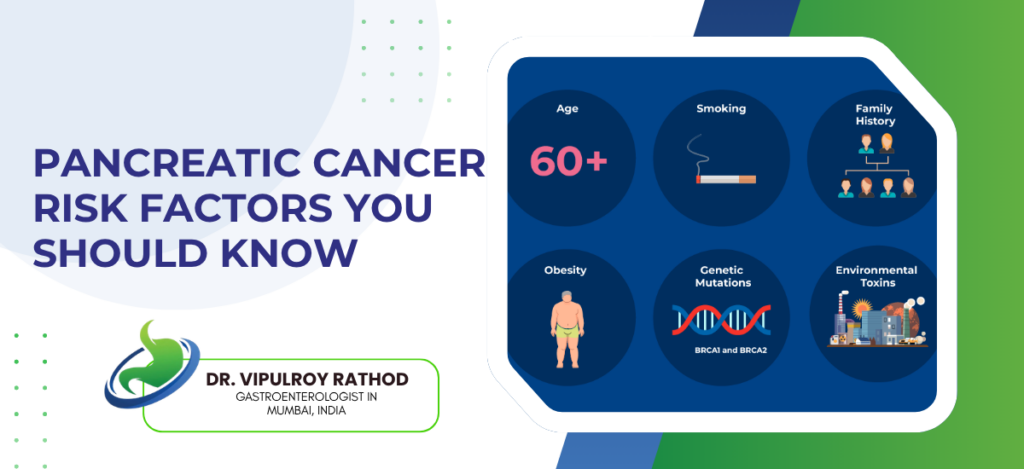
Pancreatic cancer risk factors include smoking, long-standing diabetes, obesity, chronic pancreatitis, family history, certain gene mutations like BRCA2 and PALB2, these are the big ones. Most patients we diagnose carried two or three of these for years and nobody put them together into a risk picture that warranted investigation. That gap between having identifiable risk factors and someone actually acting on them is where most late diagnoses come from.
According to Dr. Vipulroy Rathod, Gastroenterologist in Mumbai, “Most patients diagnosed with pancreatic cancer had at least two identifiable risk factors that nobody connected together early enough to trigger proper investigation, and that pattern repeats itself in clinical practice far more often than it should.”
What Are the Major Risk Factors for Pancreatic Cancer?
Some you can change. Some you can’t. But knowing what you carry changes how seriously vague symptoms should be taken when they show up.
- Smoking: Doubles lifetime risk, roughly. About 25% of all pancreatic cancers trace back to this. Even after quitting the risk stays elevated for 10 to 15 years before it starts coming down, so if you smoked for 20 years and quit 5 years ago and now you have persistent upper abdominal pain, you’re not in the same category as someone who never touched a cigarette.
- Diabetes: Two different stories here. Long-standing Type 2 carries elevated risk through years of insulin resistance. But new onset diabetes after 50 in someone who isn’t overweight and has no metabolic reason for it, that’s a red flag most doctors miss because they start metformin and move on without ever imaging the pancreas to check what’s actually going on underneath.
- Obesity: BMI above 30 bumps up risk by 20 to 30%. Visceral fat drives the link through inflammatory mediators that damage tissue over time. Stack central obesity with diabetes and smoking in the same patient and you’ve got a compounded risk profile that nobody mentions during a routine check-up because nobody is thinking about the pancreas.
- Pancreatitis: Chronic pancreatitis raises lifetime risk 8 to 10 fold. Hereditary pancreatitis goes higher still. Problem is, pancreatitis pain and early pancreatic cancer pain feel identical to the patient, so the cancer hides inside a condition that already explains the symptoms.
These rarely exist alone. Most patients carry two or three. A pancreatic cancer treatment specialist maps the full profile and decides investigation thresholds from there.
What About Genetic and Family Risk?
Not all pancreatic cancer is random. Around 10% have a hereditary component and these families need a completely different approach to surveillance.
- Family: One first-degree relative with pancreatic cancer, roughly double your risk. Two or more, 6 to 12 times baseline. These patients should be on annual EUS from age 50 or 10 years before the youngest family diagnosis, whichever hits first, and most of them have never been told this.
- BRCA2: 3 to 10 fold elevated risk depending on family history. Structured EUS surveillance catches small lesions before they produce symptoms. If you know you carry BRCA2 and nobody has mentioned pancreatic screening, that’s a conversation you need to start yourself because it won’t come to you automatically.
- PALB2: Less talked about than BRCA2 but the pancreatic cancer risk is comparable. Same surveillance category, same annual EUS, same urgency. Most PALB2 carriers have no idea pancreatic screening should even be on their radar.
- Lynch: Mismatch repair gene mutations. Usually these patients are already in surveillance for colorectal and endometrial cancer. Adding pancreatic screening to the same programme makes clinical sense. Rarely happens in practice though.
Genetic risk changes when surveillance starts and how aggressive it should be. Read more on detection to understand why finding this cancer before symptoms develop is the only approach that consistently changes what happens next for high-risk patients.
Why choose Dr. Vipulroy Rathod to identify and avoid pancreatic cancer risk factors ?
Dr. Vipulroy Rathod has spent over 30 years at Fortis Hospital Mulund managing pancreatic disease through EUS, fine needle aspiration, and structured high-risk surveillance. Risk factors sitting unconnected in patient records for years, finally mapped into a proper surveillance plan. Small lesions found in patients whose prior workups had missed the pancreas entirely. 35 countries worth of physicians trained in this specific approach.
Most patients walk in having never been told their combination of risk factors warranted active screening. Many walk out with a programme that actually watches for this cancer before it decides to announce itself.
Book your consultation today with one of India’s most experienced specialists for identifying risk factors and avoid pancreatic cancer.
Frequently Asked Questions
Yes, smoking roughly doubles lifetime pancreatic cancer risk and accounts for approximately 25% of all cases.
New onset diabetes after 50 in a non-obese patient with no metabolic risk factors can be an early signal of underlying pancreatic cancer.
BRCA2 and PALB2 carriers, patients with familial pancreatic cancer, hereditary pancreatitis, and Lynch syndrome benefit most from structured EUS surveillance.
Yes, chronic pancreatitis increases lifetime pancreatic cancer risk 8 to 10 fold and hereditary pancreatitis raises it even further.
Reference links-
- Pancreatic Cancer Risk Factor Guidelines — American Society for Gastrointestinal Endoscopy
- Hereditary Pancreatic Cancer Surveillance — World Gastroenterology Organisation
