 Skip to content
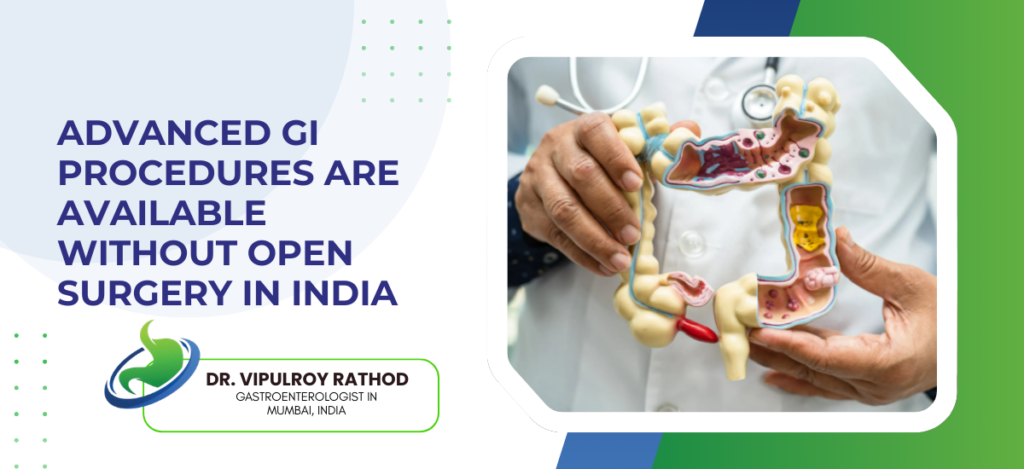
A lot of GI conditions that needed open surgery ten or fifteen years ago don’t need it anymore. The endoscope goes in through the mouth or a small access point, reaches the problem, and handles it often in a single sitting. No large wound. Hospital stay measured in hours, not weeks.
According to Dr. VipulRoy,
“In the last two decades, Advanced Endoscopic Procedures for Complex GI Conditions have replaced open surgery for a large number of patients. The outcomes hold up. But most patients don’t know these options exist until someone tells them.”
What Procedures Are Now Done Without Open Surgery?
More than most people realise. Here is what’s actually available at a proper therapeutic endoscopy centre.
- Endoscopic Ultrasound with drainage — Pancreatic cysts, abscesses, fluid collections after pancreatitis. All of these used to sit for weeks before a surgeon would touch them. Endoscopic Ultrasound guided drainage handles it far earlier with a needle placed under real-time imaging. Nothing cut from outside the body.
- ERCP for bile duct problems — Stones stuck in the bile duct, ducts narrowed by scarring or tumour, bile leaks after gallbladder removal. ERCP reaches all of it from inside the gut. Stones come out. Stents go in. As a gastroenterology specialist in Mumbai, Dr. Rathod has been doing this for over 30 years — including cases referred after failed attempts elsewhere.
- POEM for achalasia — The overactive muscle blocking the esophagus gets cut through a tunnel built inside the esophageal wall itself. Patients eat normally within a week. No scar. Most don’t miss more than two days of work.
- Endoscopic Submucosal Dissection — Early tumours and large polyps in the stomach, esophagus, or colon removed by cutting under the mucosal layer. What used to mean bowel resection surgery now means an overnight stay in most cases.
- Third Space Endoscopy — The broader category that includes POEM and ESD. Working inside the GI wall layers, not just on the surface. Technically demanding. Only a handful of centres in India do it at any real volume.
Who Actually Needs These and When?
These aren’t for every GI complaint. But for the right conditions, nothing else comes close.
- Blocked bile ducts — Jaundice with fever and right-sided abdominal pain usually means a stone in the bile duct. That combination moves fast toward sepsis if left alone. ERCP clears it without a surgical incision and most patients feel dramatically better within 24 hours.
- Pancreatic collections after pancreatitis — Fluid that builds up after a bad episode of pancreatitis used to wait for surgery. EUS-guided drainage gets to it sooner and with far less trauma for someone who is already unwell.
- Achalasia after dilation stops working — Balloon dilation and Botox injections buy time. When they stop holding, POEM is where most of these patients end up. Surgery is rarely needed anymore for this condition.
- Early GI cancers found on surveillance — Caught before they’ve spread, tumours in the esophagus and stomach can be removed entirely through the endoscope. You can explore our previous blog What Happens During an Endoscopy Step by Step? to understand how these findings are first picked up during a routine examination.
Why Choose Dr. Vipulroy Rathod for Advanced GI Procedures in Mumbai?
Most hospitals in India offer basic endoscopy. Third-space procedures, EUS-guided drainage, complex ERCP that’s a much shorter list. Dr. Vipulroy Rathod was among the first in South Asia to use EUS clinically, starting in the late 1990s when most centres here hadn’t heard of it. Three decades later he is still doing it at Fortis Hospital Mulund, including cases that came in after incomplete procedures at other centres. If you have been told surgery is your only option for a GI condition, that assessment is worth a second look.
Have a GI condition you were told needs surgery? Get a second opinion from a specialist first.
Frequently Asked Questions
Yes. Complication rates are low when performed by an experienced endoscopist with high procedure volume. Most patients are discharged within 24 to 48 hours with minimal post-procedure discomfort.
Most patients go home within 24 to 48 hours. A few days of restricted activity at home is typical. Open surgery for the same conditions usually means 5 to 10 days in hospital and several weeks before full recovery.
Advanced procedures like POEM, ESD, and EUS-guided drainage are available only at select centres with specialist training. Mumbai has one of the highest concentrations of experienced therapeutic endoscopists in India.
For early-stage GI cancers detected before any spread, endoscopic resection through ESD can be curative. Advanced or metastatic cancers still require surgery or combined treatment depending on the specific case and staging.
Reference links-
- Advanced Endoscopic Procedures Overview — American Society for Gastrointestinal Endoscopy
- Minimally Invasive GI Treatment Guidelines — American College of Gastroenterology
- Endoscopic Submucosal Dissection and POEM Data — National Library of Medicine
- Global Standards in Therapeutic Endoscopy — World Gastroenterology Organisation
