

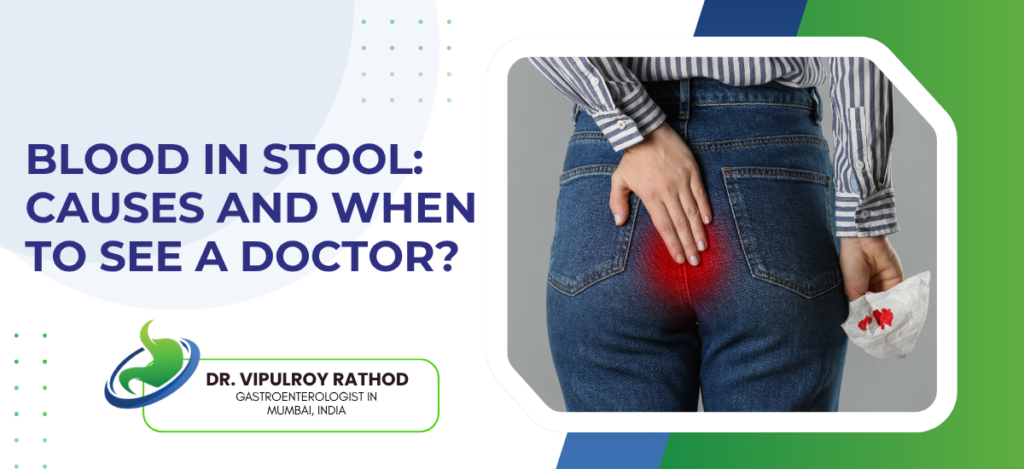
Blood in your stool is often caused by minor issues like hemorrhoids or anal fissures. However, it can also signal serious conditions like inflammatory bowel disease, polyps, or colorectal cancer. It is a symptom nobody should ignore, though its causes span the whole range from a minor anal fissure to colorectal cancer. Most cases turn out to be something benign like piles, but the only way to be sure is to have it properly assessed rather than assumed. The colour of the blood, whether it’s bright red or dark and tarry, offers a clue about where it’s coming from, but appearance alone can never rule out a serious cause.
According to Dr. Vipulroy Rathod, Gastroenterologist in Mumbai, “The biggest mistake patients make with rectal bleeding is deciding for themselves that it’s just piles. Often it is, but I’ve seen too many colorectal cancers that were dismissed as haemorrhoids for months. Any blood in the stool earns a proper look, because the ones we catch early are the ones that do well.”
What Causes Blood in the Stool?
The causes range from trivial to serious, and telling them apart is exactly why assessment matters.
Piles and anal fissures are the commonest causes by far. These produce bright red blood on the paper or coating the stool, usually with itching or pain around the anus, and while they’re benign they still shouldn’t be self-diagnosed.
Colorectal polyps can bleed silently. These growths on the bowel lining sometimes shed small amounts of blood before they ever cause other symptoms, and because some polyps turn cancerous over time, finding them matters.
Inflammatory bowel disease brings blood with other symptoms. Crohn’s and ulcerative colitis produce blood or mucus alongside diarrhoea, cramping, and urgency, often in younger patients with a longer history of gut trouble.
Colorectal cancer is the diagnosis nobody can afford to miss. It can cause bleeding that’s intermittent and easy to dismiss, which is precisely why persistent or unexplained rectal bleeding needs a colonoscopy rather than reassurance.
Finding exactly where the blood is coming from is what a colorectal cancer specialist establishes through direct examination of the bowel.
When Should You See a Doctor?
Any blood in the stool deserves assessment, but some situations make it urgent.
Blood with weight loss or a change in bowel habits needs prompt attention. This combination is one of the clearest warning signs of colorectal cancer and should never be watched at home.
Being over 40 lowers the threshold considerably. Rectal bleeding at this age carries a higher chance of a significant cause, so it warrants a colonoscopy rather than a trial of haemorrhoid cream.
Dark, tarry stools point to bleeding higher up. This appearance suggests blood from the stomach or small bowel rather than the anus, and it needs urgent investigation because the source is often more serious.
Heavy bleeding, dizziness, or breathlessness are emergencies. Significant blood loss with any of these symptoms needs immediate medical care rather than an outpatient appointment.
Knowing which scope reaches the source of bleeding matters, since the anus and lower bowel are only part of the picture. Read more on colonoscopy vs sigmoidoscopy to understand why a full colonoscopy is often needed to find the true source of rectal bleeding.
Why Choose Dr. Vipulroy Rathod for Rectal Bleeding?
Dr. Vipulroy Rathod has been investigating and treating the causes of rectal bleeding at Fortis Hospital Mulund for over 30 years, with the colonoscopy and endoscopic expertise to find the source accurately and, in many cases, treat it in the same session. Patients who assumed their bleeding was just piles sometimes turn out to have a polyp or early cancer that a timely scope caught in time. Physicians from 35 countries have trained under his approach at Fortis.
Book your consultation today with one of India’s most experienced specialists for rectal bleeding evaluation and colonoscopy.
Frequently Asked Questions
It can be caused by piles, anal fissures, colorectal polyps, inflammatory bowel disease, diverticular disease, and colorectal cancer, so causes range from minor to serious.
See a doctor promptly for any blood in the stool, especially with weight loss, a change in bowel habits, pain, or if you are over 40, as it can signal a serious cause.
Bright red blood often comes from the lower bowel or anus, such as piles, while dark tarry stools suggest bleeding higher up, but appearance alone cannot rule out cancer.
Investigation usually involves a colonoscopy to examine the bowel directly, along with examination and sometimes upper endoscopy, to find exactly where the bleeding is coming from.
Reference
- Rectal Bleeding: Evaluation and Management — NCBI/PMC, https://www.ncbi.nlm.nih.gov/pmc/articles/PMC7233078/
- Colorectal Cancer Presenting Symptoms and Rectal Bleeding — NCBI/PMC, https://www.ncbi.nlm.nih.gov/pmc/articles/PMC5624250/
