

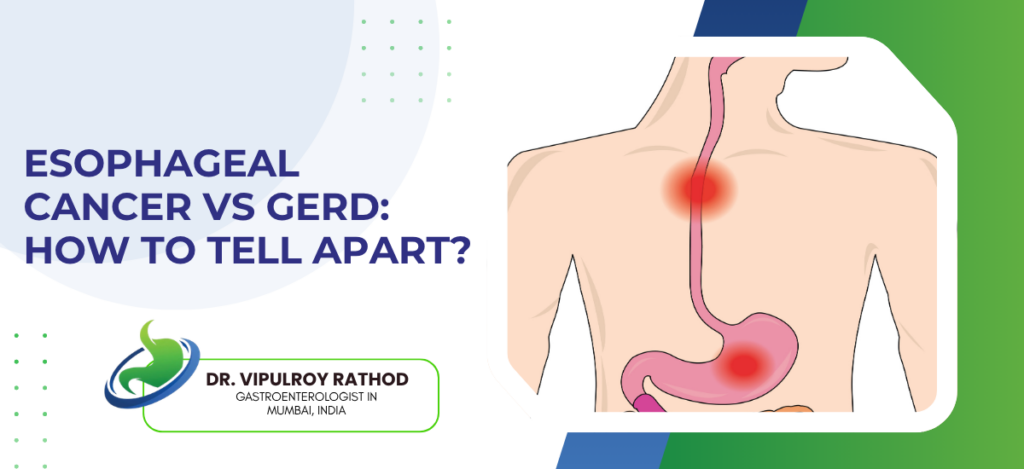
GERD and oesophageal cancer can look worryingly similar at first, since both start with reflux and chest discomfort that a patient can easily dismiss as ordinary acidity. The critical difference is that GERD responds to acid-suppression and rarely progresses, while oesophageal cancer keeps advancing and adds swallowing difficulty and weight loss. What settles the question isn’t the symptom itself but whether it responds to treatment and whether it’s getting worse over time.
According to Dr. Vipulroy Rathod, Gastroenterologist in Mumbai, “The dangerous part is that oesophageal cancer often begins looking exactly like the reflux someone has lived with for years. They keep taking antacids while the real problem grows. The moment reflux stops responding to medication, or food starts sticking on the way down, that’s when it needs a scope rather than a stronger antacid.”
How Do They Differ?
The two overlap early but diverge sharply once you look at how the symptoms behave over time.
Factor | GERD | Oesophageal Cancer |
Main symptom | Heartburn, acid reflux | Progressive difficulty swallowing |
Response to medication | Improves on PPIs | Does not resolve with acid suppression |
Weight | Usually stable | Unintended weight loss |
Course over time | Stable or intermittent | Steadily worsening |
Typical age | Any age | More common over 50 |
GERD comes and goes, cancer only advances. Reflux flares with certain meals and settles with treatment, while the swallowing difficulty of cancer begins with solids and marches steadily onward over weeks regardless of what medication is taken.
Response to PPIs is one of the clearest dividing lines. Heartburn that eases on acid suppression points firmly toward GERD, whereas symptoms that carry on despite proper medication are exactly the ones that warrant a scope.
Weight loss changes the whole picture. Ordinary reflux does not cause someone to lose weight, so unintended weight loss alongside upper GI symptoms shifts the concern toward cancer until an endoscopy proves otherwise.
The link between them is Barrett’s oesophagus, where years of untreated reflux change the lining into a precancerous state, which is precisely why long-standing GERD deserves monitoring rather than indefinite self-treatment.
Settling which one is present, and catching any change early, is what an oesophageal cancer specialist builds the assessment around.
When Should GERD Be Investigated?
Certain features move reflux out of the routine category and into one that needs a closer look.
Food sticking or difficulty swallowing needs a scope. This is never a normal part of reflux, and progressive trouble swallowing is the single most important symptom separating cancer from GERD.
If reflux stops responding to medication, continuing to escalate the dose is the wrong move, and an endoscopy to see what’s actually happening becomes the right one.
Reflux running longer than five years, especially over 50, carries enough Barrett’s risk to justify at least one screening endoscopy even when the symptoms feel manageable.
Bleeding, anaemia, or persistent vomiting appearing alongside reflux are red flags that push the timeline for investigation from weeks to days.
Not everyone with reflux needs a procedure, and some do better with a targeted endoscopic treatment than more medication. Read more on ARMA procedure to understand when reflux is best managed endoscopically rather than with lifelong tablets.
Why Choose Dr. Vipulroy Rathod for Reflux and Oesophageal Cancer?
Dr. Vipulroy Rathod has been distinguishing benign reflux from oesophageal cancer at Fortis Hospital Mulund for over 30 years, with NBI endoscopy and EUS letting him catch early mucosal change that standard endoscopy misses. Patients referred after years of self-treated reflux sometimes turn out to have Barrett’s or an early cancer that a timely scope would have caught sooner, which is the whole argument against waiting. Physicians from 35 countries have trained under his approach at Fortis.
Book your consultation today with one of India’s most experienced specialists for reflux assessment and oesophageal cancer diagnosis.
Frequently Asked Questions
GERD causes heartburn that responds to medication, while cancer causes progressive swallowing difficulty and weight loss. Endoscopy with biopsy tells them apart with certainty.
Long-standing GERD can lead to Barrett’s oesophagus, a precancerous change that raises cancer risk, which is why chronic reflux needs monitoring rather than indefinite self-treatment.
Difficulty swallowing, weight loss, symptoms persisting despite medication, or reflux over five years in someone over 50 should prompt an endoscopy.
It can cause reflux-like symptoms early on, which is why it is often mistaken for GERD, but it typically adds swallowing difficulty that plain reflux does not.
Reference
- Gastro-oesophageal Reflux Disease and Oesophageal Adenocarcinoma Risk — NCBI/PMC, https://www.ncbi.nlm.nih.gov/pmc/articles/PMC4622385/
- Barrett’s Oesophagus and the Progression to Oesophageal Cancer — NCBI/PMC, https://www.ncbi.nlm.nih.gov/pmc/articles/PMC6197218/
