 Skip to content
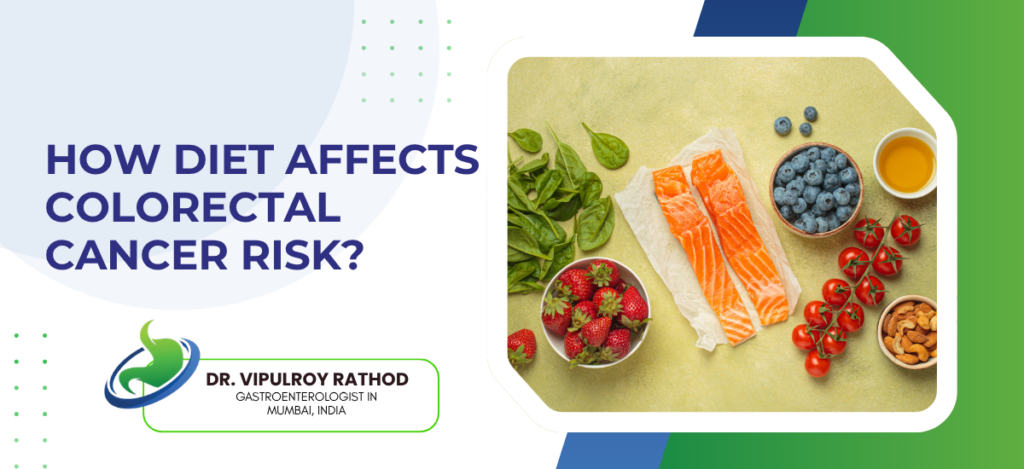
Diet is one of the few colorectal cancer risk factors a person can actually change, and over the years it adds up. Red and processed meat, low fibre, excess weight, and alcohol all push risk upward across study after study. Fibre-rich eating and a healthy weight pull it back down. None of this guarantees prevention, but among the things within a patient’s control, diet carries real weight.
According to Dr. Vipulroy Rathod, Gastroenterologist in Mumbai, “Colorectal cancer isn’t just a screening problem, it’s partly a lifestyle problem, and the dietary patterns that drive it are the same ones driving metabolic disease more broadly. Patients who ask what they can do beyond getting scoped regularly are asking exactly the right question, and diet is one of the most actionable answers.”
Which Foods Raise Colorectal Cancer Risk?
Few areas of cancer research produce evidence this consistent, and a handful of dietary patterns turn up as risk-raisers again and again.
Eating red meat daily raises risk through haem iron and the compounds formed when meat is cooked at high heat, and the link holds across studies from India, Europe, and North America alike.
Processed meat is the clearer culprit. Bacon, sausages, salami, and deli meats carry the strongest evidence of all, and even modest regular intake nudges risk upward measurably.
Alcohol matters at any level, with the risk climbing steadily the more regularly someone drinks rather than needing heavy consumption to register.
Refined carbohydrates and ultra-processed food feed obesity and low-grade inflammation in the colon, and both of those conditions raise cancer risk on their own, which makes this increasingly relevant as Indian diets urbanise.
Several of these habits running together over years is what lifts individual risk to a level worth acting on, and a colorectal cancer specialist can weigh that against the rest of a patient’s clinical picture.
Which Dietary Habits Lower Colorectal Cancer Risk?
The protective side of the evidence is just as solid, and more useful because it’s something patients can act on directly.
Eat more fibre. Vegetables, legumes, whole grains, and fruit speed bowel transit and cut the time carcinogens spend in contact with the colon lining, and the association with lower risk is remarkably consistent.
If weight is the one thing you change, change that. Central obesity creates the inflammatory conditions that drive polyp formation, and reducing it lowers risk independently of any single food.
Keeping red meat to two or three portions a week rather than daily brings the exposure down to a level where the risk link weakens sharply.
Adequate calcium and dairy show a modest protective link in several large studies, and building enough calcium into the diet is straightforward within a broadly sensible eating pattern.
Diet and gut health overlap well beyond cancer risk, shaping how chronic GI conditions behave day to day. Read more on IBD and diet to understand how dietary choices influence gut inflammation and long-term bowel health.
Why Choose Dr. Vipulroy Rathod for Colorectal Cancer?
Dr. Vipulroy Rathod has been managing colorectal cancer and its risk factors at Fortis Hospital Mulund for over 30 years, watching the dietary and metabolic patterns behind late diagnoses play out across his referred patients. His colonoscopy and EUS practice means that when dietary risk turns into an actual finding, assessment and treatment happen in the same workup. Physicians from 35 countries have trained under his approach at Fortis.
Book your consultation today with one of India’s most experienced specialists for colorectal cancer risk assessment and endoscopic screening.
Frequently Asked Questions
Diets high in red and processed meat, low in fibre, and high in refined sugars raise colorectal cancer risk, while fibre-rich plant-based diets and healthy weight lower it.
Red meat, processed meat, alcohol, refined carbohydrates, and ultra-processed foods are consistently linked to higher colorectal cancer risk across large population studies.
Diet alone cannot guarantee prevention, but a fibre-rich diet with limited red meat and no processed meat substantially reduces risk alongside healthy weight and regular screening.
Yes. Excess body weight, particularly central obesity, is an independent risk factor for colorectal cancer through the inflammation it creates in the colon over time.
Reference
- Diet, Nutrition, Physical Activity and Colorectal Cancer — World Cancer Research Fund/NCBI, https://www.ncbi.nlm.nih.gov/pmc/articles/PMC6326011/
- Red Meat Consumption and Risk of Colorectal Cancer — NCBI/PMC, https://www.ncbi.nlm.nih.gov/pmc/articles/PMC4698595/
