 Skip to content
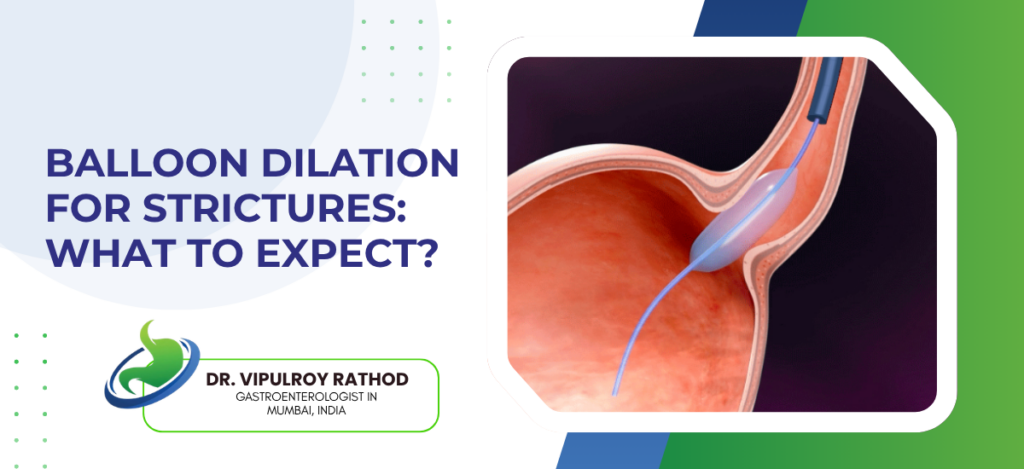
Balloon dilation widens a narrowed segment of the GI tract by inflating a balloon across the stricture through an endoscope, restoring normal passage without any incision. It’s used in the oesophagus, the small bowel, and the colon depending on where the narrowing sits, and in most cases the patient goes home the same day. What the procedure feels like, how many sessions it takes, and how durable the result is all depend on what caused the stricture in the first place.
According to Dr. Vipulroy Rathod, Gastroenterologist in Mumbai, “Balloon dilation is one of those procedures that patients worry about far more than they need to. Done under sedation, it’s usually over in a few minutes and the improvement in swallowing or bowel passage is often immediate. The real clinical question isn’t the procedure itself but how often it needs repeating and whether the underlying cause is being addressed at the same time.”
What Conditions Does Balloon Dilation Treat?
The technique applies across several GI sites, with the balloon adapted in size to the stricture and the organ being treated.
Peptic oesophageal strictures from years of acid reflux scarring the lower oesophageal lining are among the most common indications, and patients who’ve been managing progressive swallowing difficulty often notice improvement within days of the first dilation.
In Crohn’s disease, short fibrotic strictures of the small bowel or colon that are causing obstructive symptoms respond well, and the procedure delays or avoids the bowel resection that would otherwise be the only alternative.
After bowel or oesophageal surgery, anastomotic strictures at the joint site are a common complication and often need one or more dilation sessions before the narrowing stabilises and swallowing or passage returns to normal.
Achalasia-related narrowing at the lower oesophageal sphincter can be opened with balloon dilation, though larger balloons and a slightly different technique apply here compared to a standard peptic stricture.
Deciding which stricture needs dilation, how large the balloon should be, and whether the underlying condition needs addressing alongside it is where a specialist in IBD management shapes the whole approach.
What Happens During and After the Procedure?
Patients often arrive expecting something more uncomfortable than it turns out to be.
Under sedation, the endoscope goes in first to visualise the stricture directly, and the balloon catheter is then passed through the scope and positioned across the narrowed segment.
Inflating the balloon gradually opens the stricture by stretching it outward, held at target pressure for around a minute before deflation, with the degree of opening assessed through the scope immediately after.
Most patients go home within a few hours, feeling mild discomfort or throat soreness after an oesophageal dilation that settles the same day, with diet restricted to liquids for 24 hours as a precaution.
Follow-up depends on the cause. Some strictures hold well after one session; Crohn’s-related narrowings and refractory oesophageal strictures often need repeat dilation at planned intervals to maintain the result.
Strictures from acid reflux are one of the clearest signs that GERD has gone beyond what medication alone can manage. Read more on GERD and endoscopy to understand when reflux complications like strictures need a scope rather than a prescription change.
Why Choose Dr. Vipulroy Rathod for Balloon Dilation?
Dr. Vipulroy Rathod has been performing balloon dilation for oesophageal, intestinal, and anastomotic strictures at Fortis Hospital Mulund for over 30 years, across the full range of causes including Crohn’s, peptic disease, post-surgical narrowing, and achalasia. That breadth means the balloon size, technique, and follow-up interval all get matched to the specific stricture rather than applied by rote. Physicians from 35 countries have trained under his approach at Fortis.
Book your consultation today with one of India’s most experienced specialists for GI stricture assessment and balloon dilation.
Frequently Asked Questions
Balloon dilation widens a narrowed GI segment by inflating a balloon across it through an endoscope, restoring normal passage without surgery.
It treats oesophageal strictures from reflux or surgery, Crohn’s intestinal strictures, anastomotic narrowing after bowel operations, and achalasia.
Some patients need one session; others with Crohn’s or refractory strictures need repeat dilations at planned intervals over time.
Done under sedation, so no pain during the procedure. Mild throat discomfort after oesophageal dilation typically settles within a day.
Reference
- Endoscopic Balloon Dilation for Crohn’s Disease-Associated Strictures — Korean Society of Gastrointestinal Endoscopy, https://www.ncbi.nlm.nih.gov/pmc/articles/PMC5642359/
- Complex Refractory Oesophageal Stricture and Balloon Dilation — NCBI/PMC, https://www.ncbi.nlm.nih.gov/pmc/articles/PMC10305297/
