 Skip to content
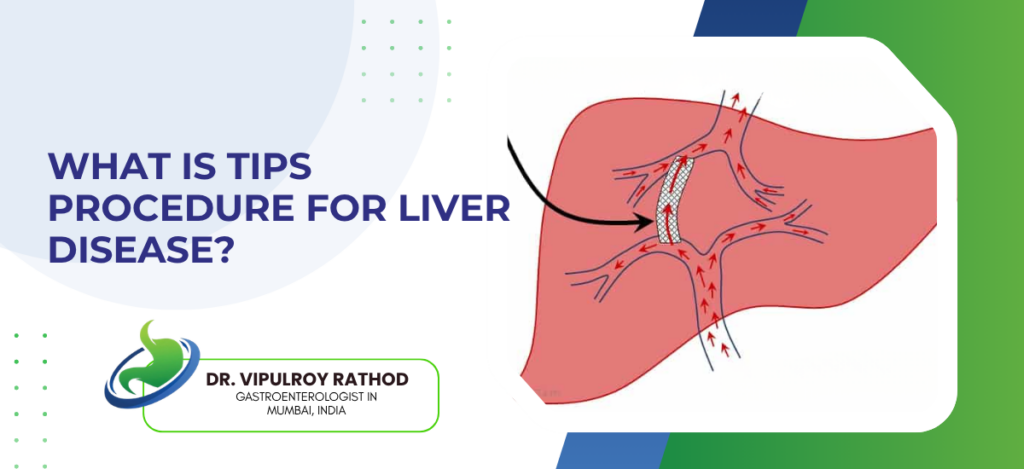
TIPS, transjugular intrahepatic portosystemic shunt, creates a channel inside the liver between the portal and hepatic veins to lower the pressure that builds up in portal hypertension. It’s performed through the jugular vein under imaging guidance, with no open surgery and a recovery considerably shorter than a surgical shunt. The procedure is used when cirrhosis complications, most often variceal bleeding or refractory ascites, stop responding to medical treatment and need a more direct pressure-reduction approach.
According to Dr. Vipulroy Rathod, Gastroenterologist in Mumbai, “TIPS isn’t a first-line treatment, but for patients where medical options have run out, it buys meaningful time. The key is selecting the right patient carefully, because TIPS can genuinely worsen liver function in someone whose hepatic reserve is already compromised, and that selection decision matters more than the procedure itself.”
What Conditions Are TIPS Used For?
TIPS targets the complications of portal hypertension that won’t settle with drugs or endoscopic management.
Variceal bleeding that keeps recurring despite band ligation and pharmacotherapy is the clearest indication, where TIPS reduces the portal pressure driving the varices rather than repeatedly treating the varices themselves.
Refractory ascites that require repeated paracentesis every few weeks is another strong indication, and TIPS relieves the pressure causing fluid accumulation and reduces the paracentesis burden substantially in suitable patients.
Hepatic hydrothorax, fluid accumulating in the chest from portal hypertension, responds to TIPS in selected cases where thoracentesis has become the only management option.
Hepatorenal syndrome can sometimes be reversed through TIPS when the pressure reduction restores enough renal perfusion, though this is reserved for carefully selected patients with sufficient residual liver function.
Understanding how portal hypertension and liver decompensation interact is where a liver cirrhosis specialist decides whether TIPS is the right intervention or whether another route makes more clinical sense.
What Are the Risks and Who Should Not Have TIPS?
Patient selection is what separates a good TIPS outcome from a poor one, and the risks are real enough to make that selection non-negotiable.
Hepatic encephalopathy is the most common complication, because TIPS diverts blood away from the liver and allows ammonia and other toxins to reach the brain rather than being cleared, which is why existing encephalopathy is a relative contraindication.
Shunt stenosis or occlusion can develop over months and needs surveillance imaging to catch early, with covered stents now substantially reducing this problem compared to older bare metal designs.
Patients with severe liver dysfunction are poor candidates because TIPS further reduces what little hepatic blood flow remains and can tip them into decompensation they can’t recover from.
Heart failure and pulmonary hypertension push a significant volume of blood suddenly into the systemic circulation after TIPS, and an adequate cardiac workup before the procedure is essential in patients with any cardiac history.
Managing the complications that lead patients to TIPS in the first place often involves a combination of endoscopic and medical treatment that endoscopy handles directly. Read more on pancreatic necrosis treatment to see how minimally invasive endoscopic approaches tackle other complex GI and hepatic complications without surgery.
Why Choose Dr. Vipulroy Rathod for Liver Disease?
Dr. Vipulroy Rathod has been managing cirrhosis complications and portal hypertension at Fortis Hospital Mulund for over 30 years, with endoscopic variceal management and EUS-guided assessment forming a core part of his practice. Patients approaching TIPS candidacy benefit from that depth of experience in identifying which complications can still be managed endoscopically and which genuinely need a shunt. Physicians from 35 countries have trained under his approach at Fortis.
Book your consultation today with one of India’s most experienced specialists for liver cirrhosis and portal hypertension management.
Frequently Asked Questions
TIPS, or transjugular intrahepatic portosystemic shunt, is a procedure that creates a channel inside the liver between the portal and hepatic veins to reduce portal hypertension and its complications.
TIPS is used to treat portal hypertension complications including refractory variceal bleeding, recurrent ascites, hepatic hydrothorax, and in selected cases hepatorenal syndrome.
No. TIPS is a minimally invasive interventional procedure performed through the jugular vein under imaging guidance, without open surgery and with significantly lower risk than a surgical shunt.
The main risks include hepatic encephalopathy, shunt stenosis or occlusion, and worsening liver function in patients with already compromised hepatic reserve, which is why careful patient selection is essential.
Reference
- The Transjugular Intrahepatic Portosystemic Shunt in the Treatment of Portal Hypertension: Current Status — NCBI/PMC, https://www.ncbi.nlm.nih.gov/pmc/articles/PMC3408669/
- Effects of TIPS Treatment in Patients with Liver Cirrhosis and Portal Hypertension — NCBI/PMC, https://www.ncbi.nlm.nih.gov/pmc/articles/PMC8270572/
