 Skip to content
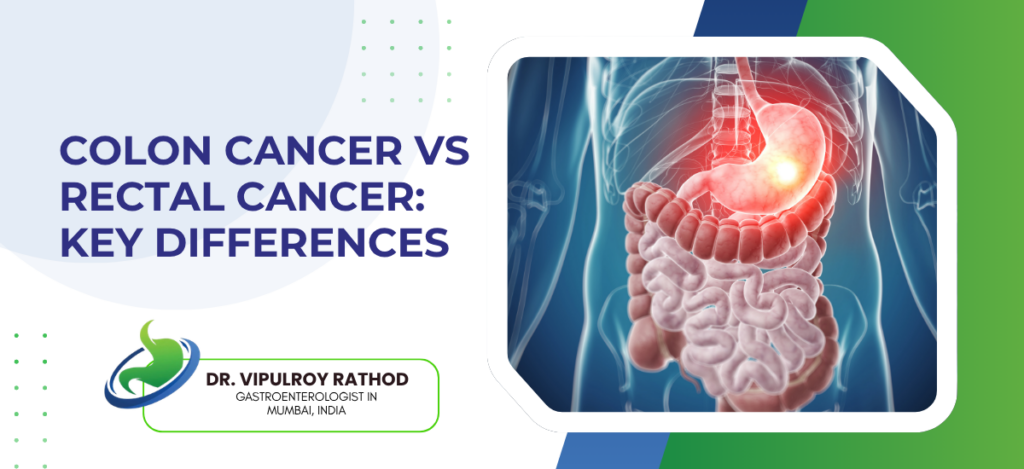
Colon cancer and rectal cancer are often grouped together as colorectal cancer, but they aren’t the same disease, and the distinction matters more than most patients realise. Colon cancer develops in the longer upper section of the large intestine, while rectal cancer arises in the final few inches before the anus. That difference in location changes the symptoms a patient notices, the surgery involved, and whether radiotherapy is part of the plan, which is why an accurate diagnosis of exactly where the tumour sits shapes everything that follows.
According to Dr. Vipulroy Rathod, Gastroenterologist in Mumbai, “Patients tend to think colorectal cancer is one condition, but where the tumour sits genuinely changes how we treat it. A rectal cancer often needs radiotherapy before surgery because of its confined position in the pelvis, whereas a colon cancer usually goes straight to surgery. Pinpointing the location accurately is the first real treatment decision.”
How Do Colon and Rectal Cancer Differ?
The two share an origin in the large bowel but diverge in almost every practical way.
Factor | Colon Cancer | Rectal Cancer |
Location | Upper large intestine | Final few inches before anus |
Common symptoms | Bowel habit change, anaemia | Rectal bleeding, narrow stools |
Primary treatment | Surgery first | Often radiotherapy before surgery |
Surgical challenge | More accessible | Confined pelvic space |
Stoma risk | Lower | Higher in low rectal tumours |
Sitting higher in the large intestine, colon cancer tends to announce itself through changes in bowel habits, bloating, or unexplained anaemia from slow chronic blood loss.
Rectal cancer makes itself known differently, more often through visible rectal bleeding, a sense of incomplete emptying, or stools that become noticeably narrow as the tumour grows.
Because the rectum sits in a tight pelvic space, its surgery is technically harder and frequently needs radiotherapy beforehand to shrink the tumour and protect surrounding structures.
Colon tumours, being more accessible, usually go to surgery first, with chemotherapy added afterward depending on the stage and node involvement.
Pinpointing the location and stage accurately is where a colorectal cancer specialist sets the treatment direction before anything begins.
Why Does the Distinction Matter for Treatment?
Location dictates the treatment sequence, the surgical risk, and the patient’s long-term outlook.
Treatment order changes with location, since rectal cancer often starts with radiotherapy and chemotherapy to shrink the tumour, while colon cancer typically begins with surgical removal.
The risk of a stoma differs, being considerably higher in low rectal tumours close to the anus than in colon cancers higher up the tract.
Follow-up and recurrence patterns vary, with rectal cancer carrying a higher local recurrence risk that demands closer pelvic surveillance after treatment.
Early detection helps both equally, because a tumour caught before it spreads is more likely to be treatable through less invasive means regardless of where it sits.
Catching either type early depends entirely on timely screening, and knowing who should be screened is the starting point. Read more on colon cancer screening to understand who needs screening and when early detection changes the outcome.
Why Choose Dr. Vipulroy Rathod for Colorectal Cancer?
Dr. Vipulroy Rathod has been diagnosing and staging colorectal cancers at Fortis Hospital Mulund for over 30 years, and his EUS practice since 1998 is particularly valuable for rectal tumours, where accurate local staging determines whether radiotherapy is needed before surgery. Patients get a precise diagnosis of tumour location and depth in a single workup rather than a series of scattered tests. Physicians from 35 countries have trained under his approach at Fortis.
Book your consultation today with one of India’s most experienced specialists for colon and rectal cancer assessment and endoscopic diagnosis.
Frequently Asked Questions
Colon cancer develops in the longer upper part of the large intestine, while rectal cancer arises in the final few inches before the anus. Their location leads to different symptoms, treatment, and surgical approaches.
Neither is inherently more serious, but rectal cancer is often harder to treat surgically due to its confined location in the pelvis and frequently requires combined radiotherapy and chemotherapy alongside surgery.
Yes. Colon cancer often causes changes in bowel habits, bloating, and anaemia, while rectal cancer more commonly causes rectal bleeding, a feeling of incomplete emptying, and narrow stools.
Not entirely. Both may need surgery and chemotherapy, but rectal cancer more often requires radiotherapy before surgery due to its location, while colon cancer is usually treated with surgery first.
Disclaimer:
This blog is intended for informational and educational purposes only and should not be considered medical advice.
Please consult a qualified gastroenterologist or healthcare professional for personalized diagnosis and treatment.
