 Skip to content
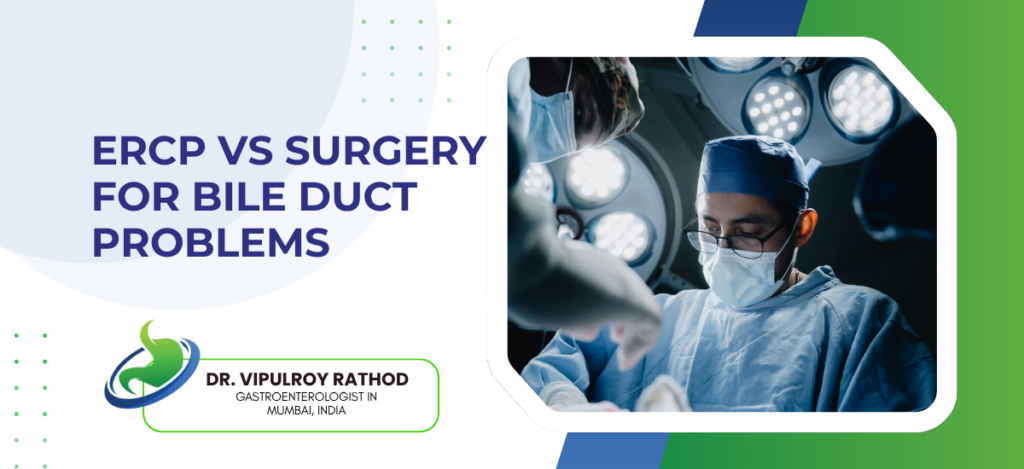
ERCP and surgery are two different approaches to bile duct disease. ERCP is a minimally invasive endoscopic procedure that accesses the bile duct through the mouth and duodenum, used for stone extraction, stricture dilatation, stent placement, and biliary drainage. Surgery is reserved for cases where ERCP has failed, where the underlying disease is surgically resectable, or where biliary reconstruction is required after major duct injury. Most bile duct problems are now managed endoscopically. Surgery becomes the answer only when endoscopy can’t reach or can’t fix what needs fixing.
According to Dr. Vipulroy Rathod, Gastroenterologist in Mumbai, “Patients hear bile duct problems and assume surgery is next. For most conditions, that’s no longer true. ERCP handles stones, strictures, leaks, and drainage. Surgery still has a role, but it’s reserved for the cases ERCP can’t manage rather than the default. Getting that order right matters because surgery in this area carries real risk.”
ERCP vs Surgery at a glance
Factor | ERCP | Surgery |
Approach | Through a scope | Open or laparoscopic |
Recovery | One to two days | Two to four weeks |
Anaesthesia | Sedation, short | General, prolonged |
Use today | First-line treatment | Reserved for failed cases |
When is ERCP the right approach?
ERCP handles most bile duct problems through endoscopic access alone, without any incision.
- Common bile duct stones: The classic indication for ERCP. Stones are removed using basket or balloon extraction after sphincterotomy, often in a single session, with success rates above ninety-five percent.
- Benign biliary strictures from chronic pancreatitis, primary sclerosing cholangitis, or post-surgical scarring. ERCP allows balloon dilatation and stent placement, often with repeated sessions over months until the duct stays open.
- Bile leaks after cholecystectomy: ERCP with sphincterotomy and stent placement closes most post-operative bile leaks without further surgery, with the stent removed once healing is confirmed.
- Malignant biliary obstruction from pancreatic cancer, cholangiocarcinoma, or other tumours. Stent placement relieves jaundice and prevents cholangitis, allowing chemotherapy to proceed in patients unfit for surgery.
ERCP is the first-line approach for most bile duct problems today. Pancreatic and biliary stone extraction services that combine ERCP with EUS for difficult anatomy avoid the gap where patients are sent to surgery prematurely because standard ERCP access wasn’t possible.
When is surgery still necessary?
Surgery hasn’t been replaced by ERCP entirely. Specific indications still require operative management.
- Failed ERCP access: Altered surgical anatomy, large impacted stones, or technical failure of standard cannulation may require surgical exploration of the bile duct. EUS-guided rendezvous has reduced this group considerably but not eliminated it.
- Resectable bile duct cancer: Cholangiocarcinoma and gallbladder cancer with surgical cure intent need formal resection, not endoscopic palliation. The decision between resection and stenting depends on staging.
- Major bile duct injury after surgery: Significant disruption of the bile duct, usually after laparoscopic cholecystectomy, often needs surgical reconstruction with Roux-en-Y hepaticojejunostomy rather than endoscopic management.
- Complications of ERCP: Perforation, severe bleeding not controlled endoscopically, or recurrent strictures that have failed multiple dilatation attempts may require surgical revision in selected cases.
The surgical group is smaller today than it was twenty years ago. Read more on how biliary stones are treated endoscopically for a closer look at one of the conditions where endoscopic management has largely replaced surgical reconstruction.
Why choose Dr. Vipulroy Rathod for bile duct management?
Dr. Vipulroy Rathod has been performing ERCP at Fortis Hospital Mulund since the late 1990s, with experience across stone extraction, stricture dilatation, leak management, biliary stenting, and the EUS-guided rendezvous procedures that get into ducts when standard ERCP can’t. The volume of biliary endoscopy in the unit is among the highest in India, which matters because complication rates fall sharply with operator experience in this field.
The judgment that matters most in bile duct disease is knowing when ERCP can handle it and when surgery is the better option. Pushing ERCP in cases that genuinely need surgery wastes time and adds risk. Sending patients to surgery when ERCP would have worked exposes them to a much bigger operation than necessary. Getting that call right comes from doing both kinds of cases at volume.
Book your consultation today with one of India’s most experienced specialists for bile duct assessment and ERCP management.
Frequently Asked Questions
Generally yes in terms of immediate complications and recovery, but ERCP has its own risks including pancreatitis, bleeding, and perforation that need experienced hands to manage.
Yes in the large majority of cases. Very large or impacted stones may need cholangioscopy with electrohydraulic lithotripsy first, with surgery reserved for the rare cases that fail even advanced endoscopic techniques.
Most patients go home the same day or the following morning, with normal activity resumed within two to three days. Surgery in comparison requires two to four weeks of recovery depending on the procedure.
Any patient with jaundice, recurrent cholangitis, suspected stones, or imaging showing duct dilatation should be assessed by a specialist with experience in both ERCP and surgical referral.
Disclaimer:
This blog is intended for informational and educational purposes only and should not be considered medical advice.
Please consult a qualified gastroenterologist or healthcare professional for personalized diagnosis and treatment.
