 Skip to content
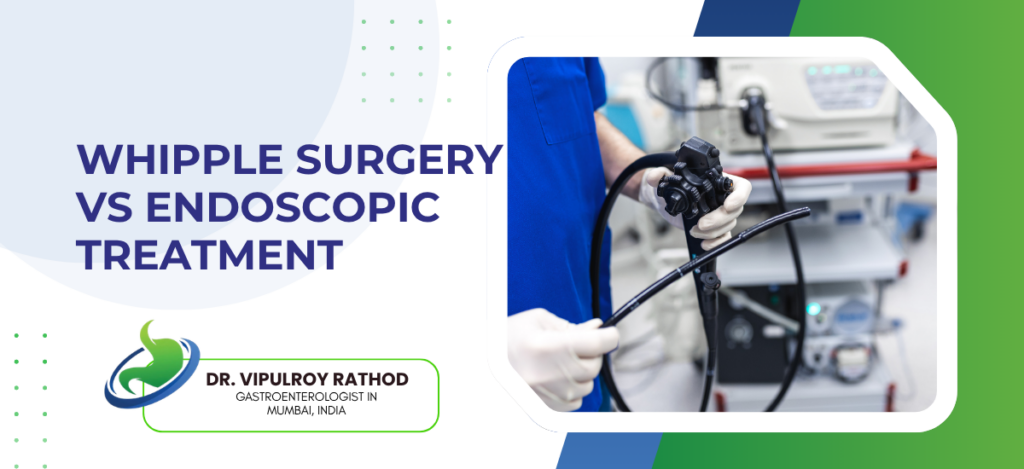
Whipple surgery and endoscopic treatment are two different categories of intervention in pancreatic and biliary disease. Whipple is a major open operation that removes the head of the pancreas with curative intent in resectable cancer. Endoscopic treatment is a group of minimally invasive scope-based procedures used for biopsy, biliary drainage, pain management, and palliation. The two aren’t alternatives. They handle different parts of the same pathway. The mistake patients make is treating them as competing options.
According to Dr. Vipulroy Rathod,Gastroenterologist in Mumbai, “Patients walk in hoping endoscopy can replace the Whipple. For resectable cancer it can’t. What endoscopy does well is everything around the operation. Biopsy. Drainage. Pain control. Without that work, the Whipple doesn’t go well, and for patients who aren’t surgical candidates, endoscopy is the entire treatment.”
Whipple vs endoscopic treatment at a glance
Factor | Whipple Surgery | Endoscopic Treatment |
Approach | Major open surgery | Through a scope |
Intent | Curative removal | Staging or palliation |
Recovery | Three to four weeks | One to two days |
Anaesthesia | General, prolonged | Sedation, short |
Use in cancer | Resectable disease only | Almost all stages |
When Whipple is the right choice?
Whipple is considered only when two conditions are met. The tumour can be removed in one piece. The patient is fit enough to recover.
- Resectable pancreatic head cancer. A tumour confined to the head of the pancreas without major vessel involvement. Removed together with surrounding lymph nodes so the pathologist can stage it properly.
- Periampullary tumours qualify for the same operation. Cancers of the ampulla of Vater, distal bile duct, and duodenum next to the pancreas. Outcomes are often noticeably better than for pancreatic adenocarcinoma itself.
- Neuroendocrine tumours and premalignant IPMNs. Selected cases with high-risk features go to Whipple. Less common, but the operation is the same and the indication is clear when histology supports it.
- After successful neoadjuvant chemotherapy. Borderline resectable cases that converted with chemotherapy are taken to Whipple once restaging confirms the tumour has pulled back from vessels.
Where Whipple doesn’t belong matters as much. Pancreatic cancer treatment planning excludes Whipple in locally advanced disease, in metastatic cancer, and in patients whose general condition makes recovery unrealistic. Sending the wrong patient into theatre causes more harm than the cancer would in the same period.
Where endoscopic treatment fits?
Endoscopy isn’t a competitor to Whipple. It’s the work that surrounds it. Diagnosis, drainage, pain management, complication handling.
- EUS-guided biopsy. Every reasonable pancreatic cancer plan starts here. Tissue from the tumour with millimetre accuracy. Histology decides the regimen, the timing, and whether surgery is even appropriate.
- ERCP with biliary stenting handles the jaundice that pancreatic head tumours cause. Often the first procedure done after diagnosis, well before any conversation about Whipple is finalised.
- ERCP after Whipple. Anastomotic strictures, bile leaks, recurrent stones in the reconstructed plumbing. Problems that would otherwise mean repeat open surgery, fixed through a scope instead.
- EUS-guided celiac plexus block for pain control in unresectable disease. Durable relief, often months at a time, without escalating opioid doses indefinitely.
The two approaches work together in modern pancreatic cancer care, not against each other. Read more on pancreatic cancer detection to see how endoscopy fits into the broader pathway, why it usually comes first, and why so many patients are past the Whipple option by the time they’re diagnosed.
Why choose Dr. Vipulroy Rathod for pancreatic disease management?
Dr. Vipulroy Rathod has been doing advanced endoscopic work in pancreatic and biliary disease at Fortis Hospital Mulund since the late 1990s, with EUS-guided biopsy, ERCP, celiac plexus block, and the staging assessment that decides whether Whipple is the right next step at all. Volume that few centres in India match.
The harder skill in pancreatic disease isn’t doing either procedure well. It’s the sorting. Which patient belongs in which corridor, with which preparation, at which week. Multidisciplinary discussion with surgeons and oncologists is where that gets worked out, not in a single specialist’s clinic in isolation.
Book your consultation today with one of India’s most experienced specialists for pancreatic disease assessment and treatment planning.
Frequently Asked Questions
Not for resectable cancer.
Seven to ten days in hospital, three to four weeks at home before normal activity. Full recovery runs two to three months.
Safer in immediate complication terms, but the two aren’t trying to do the same thing. Endoscopy can’t cure resectable cancer.
Yes, in selected centres with surgeons trained in minimally invasive pancreatic surgery, with outcomes comparable to open Whipple in expert hands.
Reference links-
- Pancreatic Adenocarcinoma Guidelines, National Comprehensive Cancer Network — https://www.nccn.org/guidelines/guidelines-detail?category=1&id=1455
- Therapeutic Endoscopy in Pancreatic Disease, American Society for Gastrointestinal Endoscopy — https://www.asge.org/home/practice-support/guidelines
