 Skip to content
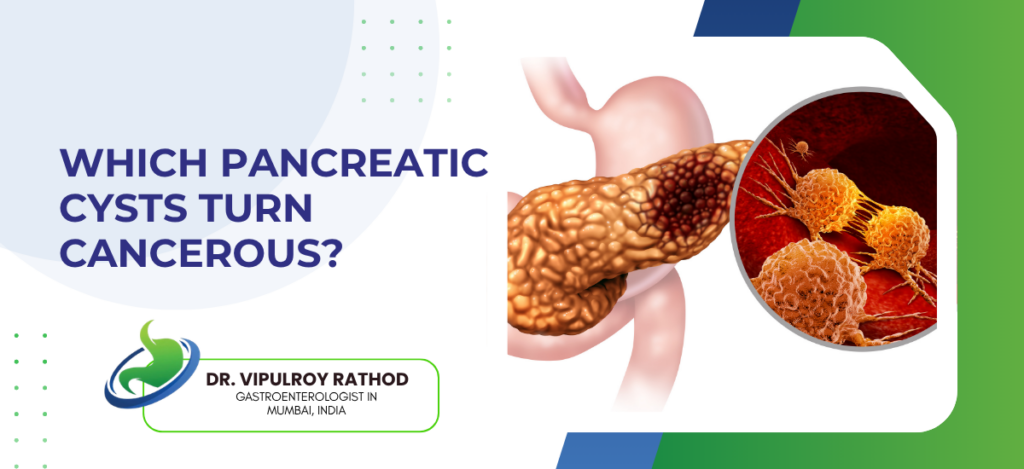
Most pancreatic cysts are harmless, the trouble is that a small but real proportion aren’t, and telling them apart on imaging alone is one of the harder calls in GI medicine. Roughly one in fifteen cysts picked up incidentally on a scan has malignant potential, and another small group are already early cancers by the time they’re found. The type of cyst matters far more than the size, although both factor into the decision. Any Gastroenterologist in Mumbai who sees these regularly will tell you the worst mistake is assuming a cyst is benign without proper characterisation.
According to Dr. Vipulroy Rathod, Gastroenterologist in Mumbai, “Patients are often told their pancreatic cyst is nothing to worry about because it’s small, but size alone is a poor predictor, mucinous cysts of two centimetres can still progress to cancer while serous cysts of seven centimetres almost never do, and the only way to know which one you’re dealing with is proper EUS evaluation with fluid analysis.”
The pancreatic cyst types and their cancer risk
Not all cysts behave the same way, and grouping them is what the entire workup hinges on.
- Serous cystadenoma. Almost always benign, the cancer risk is well under one percent. These are usually small, multi-loculated, and look like a honeycomb on imaging. Most can be watched and never need anything done.
- Mucinous cystic neoplasm, MCN. Found mostly in middle-aged women, in the body or tail of the pancreas. These do have malignant potential, around ten to fifteen percent harbour cancer at the time of surgery, and the consensus is that most should be resected once identified.
- Intraductal papillary mucinous neoplasm, IPMN. The most common cyst with cancer potential, and the most complicated to manage. Risk depends on subtype: main-duct IPMN carries a high risk of malignancy, around forty to seventy percent, while branch-duct IPMN sits at a much lower five to fifteen percent unless worrisome features develop.
- Solid pseudopapillary neoplasm. Rare, mostly in young women, low but real malignant potential. Usually treated with surgical resection because of the long lifespan ahead of the patient.
- Pseudocysts. Not true neoplasms, these form after pancreatitis and don’t turn cancerous. They can mimic cystic tumours on imaging though, which is why fluid analysis matters.
The decision between watch-and-wait and surgical resection comes down to which type is sitting in front of you. Endoscopic ultrasound with fine-needle aspiration is the test that pulls fluid for cytology, CEA, glucose, and now molecular markers, all of which sharpen the diagnosis considerably beyond what a CT or MRI alone can say.
Worrisome features that change the management
Even within a cyst type, certain findings raise the concern level enough to move a case from surveillance into the operating theatre.
- Size above three centimetres in a branch-duct IPMN, especially with growth on follow-up scans. Steady growth is sometimes more concerning than the absolute number.
- A mural nodule or solid component inside the cyst on imaging. This is the single most worrying finding because it often correlates with high-grade dysplasia or invasive cancer.
- Main pancreatic duct dilation above five millimetres, particularly with cyst communication. This shifts the diagnosis towards main-duct or mixed IPMN, which carries the highest malignant risk.
- Jaundice, new-onset diabetes, or unexplained weight loss alongside the cyst. These are clinical red flags that the cyst may already be doing something it shouldn’t.
- Cyst fluid markers. High CEA suggests mucinous, low glucose suggests mucinous, and the newer KRAS and GNAS mutation testing has improved diagnostic accuracy significantly over the last few years.
Worrisome features don’t always mean cancer, but they almost always mean the patient needs closer evaluation rather than a routine yearly scan. Read more on pancreatic cancer vs pancreatic cyst for how the distinction is drawn in cases where imaging alone leaves the question open.
Why choose Dr. Vipulroy Rathod for pancreatic cyst assessment ?
Dr. Vipulroy Rathod has been performing EUS-guided assessment of pancreatic cysts at Fortis Hospital Mulund since the late 1990s, which puts him among the earliest endosonographers in India to characterise these lesions properly. Many of the patients we see have been told their cyst is benign on the basis of a CT scan alone, which is exactly the kind of incomplete workup that misses the cases that needed earlier surgical referral.
The judgment call on a pancreatic cyst sits between two errors. Over-treat a benign serous cystadenoma and the patient gets unnecessary surgery on a notoriously difficult organ. Under-treat a main-duct IPMN and the patient comes back two years later with pancreatic cancer. Volume and proper EUS technique are what keep both errors rare.
Book your consultation today with one of India’s most experienced specialists for pancreatic cyst characterisation and surveillance planning.
Frequently Asked Questions
No, most are benign. The ones with malignant potential are mainly mucinous cystic neoplasms and intraductal papillary mucinous neoplasms, and even within those groups not every cyst becomes cancer.
Surveillance intervals depend on the type, size, and worrisome features. Small branch-duct IPMNs without concerning features are often watched every six to twelve months, while larger or more complex cysts may need imaging every three to six months.
Surgical resection remains the standard for cysts with high cancer risk. Some experimental endoscopic ablation techniques exist for specific cyst types, but they aren’t yet routine and aren’t appropriate for cysts already showing worrisome features.
Most are silent and found incidentally on scans done for other reasons. Larger ones can cause abdominal pain, back pain, or jaundice if they press on nearby structures, and new-onset diabetes or weight loss in someone with a known cyst is always a warning sign.
Reference links-
- Pancreatic Cyst Management Guidelines, American Gastroenterological Association — https://gastro.org/clinical-guidance/asymptomatic-neoplastic-pancreatic-cysts/
- IPMN and Mucinous Cyst Consensus Recommendations, International Association of Pancreatology — https://pancreapedia.org/reviews/international-consensus-fukuoka-guidelines-for-management-of-ipmn-and-mcn-of-pancreas
