

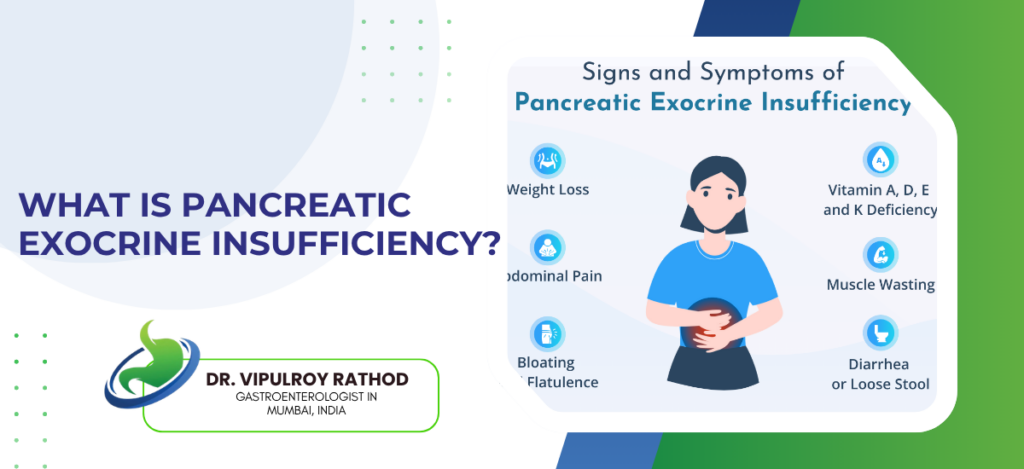
Pancreatic exocrine insufficiency is what you get when the pancreas can’t make enough enzymes to digest food. Lipase, protease, amylase, all of them drop. Fat goes through unabsorbed, protein follows, and the patient ends up malnourished while eating three meals a day. Chronic pancreatitis causes most cases we see. Cancer, surgery, even long-standing diabetes can do it too. And the frustrating part is how long it takes to diagnose, because the symptoms look identical to IBS on paper and nobody orders a fecal elastase until somebody finally thinks of it.
According to Dr. Vipulroy Rathod, Gastroenterologist in Mumbai, “PEI is underdiagnosed because the symptoms look like half a dozen other GI conditions and most clinicians don’t test pancreatic function unless they already suspect pancreatic disease, so the patients who need enzyme replacement the most are exactly the ones who wait the longest to get it.”
What Causes Pancreatic Exocrine Insufficiency?
Several things break the enzyme-producing machinery. Some destroy tissue. Some block delivery. Doesn’t matter how it happens, the gut can’t digest without enzymes.
- Pancreatitis: Most common cause in adults. Years of inflammation replacing functional acinar cells with scar tissue. Here’s the thing though, by the time PEI symptoms show up clinically, 90% of exocrine function is already gone because the pancreas has enough reserve to mask early damage, so patients feel fine until they suddenly don’t.
- Cancer: Tumour blocks the main duct or eats into enzyme-producing tissue directly. PEI showing up with weight loss in a patient over 50 should always trigger imaging. Always. Because the enzyme deficiency might be the first clue that something worse is sitting underneath and starting PERT without investigating is incomplete.
- Surgery: Any operation removing part of the pancreas reduces enzyme output proportionally. Whipple, distal pancreatectomy, total pancreatectomy. Post-surgical PEI is basically guaranteed after major resection. Lifelong replacement from day one, no question about it.
- Diabetes: This one surprises people. Long-standing Type 2 diabetes is associated with PEI in 30 to 50% of patients in some studies. Most endocrinologists don’t screen for it. Diabetic patient with unexplained bloating, oily stools, weight dropping, gets told to fix their diet when a fecal elastase would have given the answer in two days.
Causes overlap in the same patient more often than you’d expect. Specialist in pancreatitis treatment finds out what broke the enzyme production rather than just handing over capsules without asking why.
How Is PEI Diagnosed and Treated?
Diagnosis takes one test. Treatment takes one medication. The problem is neither happens for months because nobody considers the pancreas until everything else has been tried first.
- Fecal Elastase: Stool sample. Result in 48 hours. Below 200 is moderate. Below 100 is severe. That’s it. One test. Would have saved the patient months of elimination diets, probiotics, and frustration if someone had ordered it at the first appointment.
- PERT: Enzyme replacement capsules with every meal and snack. Start at 40,000 to 50,000 units lipase per main meal, 25,000 per snack. Most patients feel genuinely different within 2 to 4 weeks. Stools normalise. Bloating drops. Weight starts recovering. They ask why nobody started this sooner.
- Vitamins: A, D, E, K can’t absorb without lipase. Check levels. Supplement what’s low. Patient comes in with bone pain from D deficiency, bruising from K, fatigue nobody explained. Put those findings next to oily stools and weight loss and the diagnosis writes itself.
- Cause: PERT fixes the symptom. Doesn’t fix the patient. Chronic pancreatitis needs managing. Cancer needs ruling out. Surgical patients need monitoring. Enzyme capsules without investigating why the pancreas stopped working is like treating a fever without looking for the infection.
PEI responds to treatment quickly when diagnosed properly. Read more on enzyme deficiency signs to understand which specific symptoms should trigger testing and how dose titration works in real clinical practice.
Why Choose Dr. Vipulroy Rathod for Pancreatic Exocrine Insufficiency?
Dr. Vipulroy Rathod has spent over 30 years diagnosing pancreatic disease at Fortis Hospital Mulund. Caught PEI in patients labelled IBS for years because one fecal elastase test hadn’t been ordered. EUS since 1998 means the underlying cause gets identified in the same workup, not six months later. 35 countries worth of physicians trained in this approach.
Patients arrive having tried everything except the right test. Most leave with enzyme replacement working within weeks, a diagnosis for why it happened, and a plan that actually addresses both.
Book your consultation today with one of India’s most experienced specialists for pancreatic exocrine insufficiency diagnosis and treatment.
Frequently Asked Questions
Chronic pancreatitis is the most common cause of PEI in adults, destroying enzyme-producing tissue through repeated inflammation over years.
Fecal elastase test on a stool sample is the standard non-invasive diagnostic method, with levels below 200 indicating PEI.
Yes, PEI and pancreatic enzyme deficiency describe the same condition where the pancreas fails to produce adequate digestive enzymes.
PEI from chronic pancreatitis or surgery is usually permanent and requires lifelong enzyme replacement, while PEI from reversible causes may improve with treatment of the underlying condition.
Reference links-
- Pancreatic Exocrine Insufficiency Diagnosis — American College of Gastroenterology
- PEI Management Guidelines — World Gastroenterology Organisation
