 Skip to content
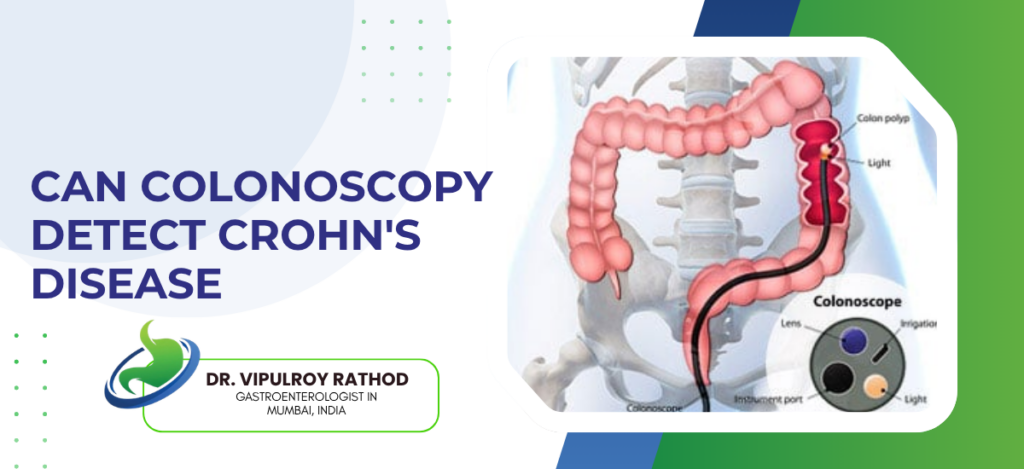
Yes, a colonoscopy is a primary and highly effective tool for detecting and diagnosing Crohn’s disease. It allows doctors to visualize the rectum, colon, and terminal ileum (end of the small intestine) to look for signs of inflammation, ulcers, and “cobblestoning” of the mucosa, while also taking tissue samples (biopsies) for analysis.
According to Dr. Vipulroy Rathod, an experienced Gastroenterologist in Mumbai, “Colonoscopy doesn’t just confirm whether Crohn’s is there or not, it shows us exactly how much of the bowel is affected and how deep the inflammation goes, which is what drives every treatment decision that follows.”
What does colonoscopy actually show in Crohn's disease?
Crohn’s looks different from other inflammatory conditions under the scope. An experienced endoscopist can usually tell within minutes whether the pattern fits, though biopsies still have to go out for confirmation.
- Skip lesions: Ulcerative colitis causes continuous inflammation that starts from the rectum and works its way up. Crohn’s doesn’t do that. It shows up in patches. Normal bowel sitting right next to inflamed bowel. That patchy pattern is one of the first things a gastroenterologist notices during the scope and it’s a strong early clue.
- Deep ulcers: The ulcers in Crohn’s cut deeper than what you see in most other gut conditions. They dig into the bowel wall and create a surface that looks rough, almost like cobblestone paving. Pretty distinctive once you’ve seen it enough times. Shallow erosions point toward other diagnoses.
- Terminal ileum: Crohn’s loves the terminal ileum. That’s the last stretch of small intestine right before the colon starts. A colonoscopy can reach that spot and check for inflammation, narrowing, or ulceration that CT or MRI might hint at but can’t show you directly the way a scope does.
- Biopsy: What the doctor sees through the scope is only half the picture. The biopsy samples go to a pathologist who checks for granulomas and other microscopic features that separate Crohn’s from infections, drug reactions, or other things that can look similar on the surface.
If gut symptoms have been dragging on and you want to know what a colonoscopy actually involves before going in, our colonoscopy page covers the procedure end to end including preparation and recovery.
When should you get a colonoscopy for suspected Crohn's?
Diarrhea and stomach pain are common. Most of the time they pass on their own. But certain patterns don’t pass, and those are the ones where sitting on it means losing months that could have gone toward getting a proper diagnosis.
- Diarrhea that won’t quit: Four to six weeks of diarrhea that doesn’t respond to the usual fixes is a red flag. At that point it stops being about what you ate last week and starts being about what’s actually happening inside the bowel wall. That’s when a scope becomes the logical next step.
- Cramping plus weight dropping: Pain that keeps showing up in the same spot, especially lower right, alongside weight loss you didn’t plan for. Gastroenterologists see this combination a lot in Crohn’s patients. Most will fast-track a colonoscopy once this pattern shows up.
- Blood or mucus showing up regularly: This one shouldn’t be watched from home for months. Younger patients especially tend to get moved up the diagnostic list quickly when blood or mucus pairs with other symptoms because the odds of something inflammatory being behind it go up considerably.
- IBD in the family: A parent or sibling with Crohn’s or UC doesn’t mean you’ll get it. But it does make doctors more willing to scope early rather than spend weeks trying medications that might just be delaying the actual diagnosis.
Understanding how IBD gets managed after diagnosis matters just as much, and our digestive cancer treatment cost in Mumbai blog covers why catching conditions like Crohn’s early through colonoscopy can significantly reduce the long-term financial burden of treatment compared to dealing with complications at a later stage.
Why choose Dr. Vipulroy Rathod for Crohn's disease diagnosis?
Dr. Vipulroy Rathod has spent over 30 years doing advanced endoscopy. More than 80,000 procedures. A big part of that has been IBD work where the difference between Crohn’s and something else comes down to visual details during the scope and how the biopsies get read. Less experienced centres miss that. It happens.
What patients get here goes past the scope itself. Clear explanation of findings. What the biopsy means in practical terms. What the treatment options look like. And an actual plan rather than a vague suggestion to come back in three months.
Book your consultation today with one of India’s most experienced specialists for Crohn’s disease evaluation.
Frequently Asked Questions
Yes, colonoscopy with biopsies is one of the most reliable methods for confirming Crohn’s disease and distinguishing it from other inflammatory bowel conditions.
The procedure is done under sedation so there’s no pain during it, though patients with active inflammation may experience mild discomfort afterwards that typically settles within a day.
Frequency depends on disease activity and duration, with most patients needing surveillance colonoscopies every 1 to 3 years after 8 years of disease to monitor for complications.
Crohn’s affecting only the small bowel beyond the reach of a standard colonoscope can be missed, which is why additional imaging or enteroscopy may be needed in some cases.
Reference links-
- Crohn’s Disease Diagnosis Guidelines — American College of Gastroenterology
- Inflammatory Bowel Disease Endoscopic Assessment — American Society for Gastrointestinal Endoscopy
