

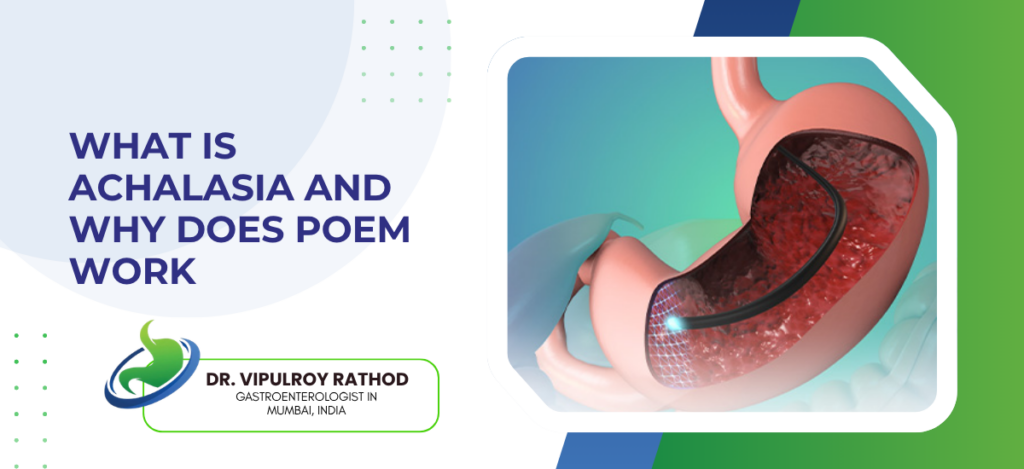
Achalasia is a rare oesophageal motility disorder where the lower oesophageal sphincter fails to relax during swallowing and the oesophagus loses its coordinated muscle contractions, causing progressive difficulty swallowing both solids and liquids, regurgitation of undigested food, chest pain, and significant weight loss over time, POEM (Per-Oral Endoscopic Myotomy) works because it cuts the dysfunctional sphincter muscle from inside the oesophageal wall without any external incision, directly resolving the obstruction that medication and dilation can only temporarily manage.
According to Dr. Vipulroy Rathod, Gastroenterologist in Mumbai, “Achalasia is one of those conditions where patients spend years being treated for reflux or anxiety before anyone thinks to investigate the oesophagus properly, and POEM changed the treatment landscape because it addresses the actual mechanical problem rather than working around it.”
What Is Achalasia and How Does It Develop?
Damaged nerve cells in the oesophageal wall are the root cause and once those cells are gone they don’t regenerate, which is why achalasia is managed not cured and why the intervention needs to be durable rather than temporary.
- Mechanism: Myenteric plexus neurons that coordinate lower oesophageal sphincter relaxation are progressively destroyed, likely through autoimmune processes in most cases, leaving a sphincter that stays contracted during swallowing and an oesophagus that can’t move food downward through organised peristalsis.
- Symptoms: Progressive dysphagia for both solids and liquids is the hallmark, regurgitation of undigested food hours after eating, chest pain from oesophageal spasm, and weight loss that gets attributed to anxiety or functional disorders for months before anyone orders a proper motility study.
- Diagnosis: High-resolution manometry is the gold standard showing absent peristalsis and incomplete LES relaxation, barium swallow shows the classic bird-beak narrowing at the gastro-oesophageal junction, endoscopy rules out malignancy causing pseudoachalasia which has identical symptoms but a completely different clinical picture.
- Types: Chicago Classification divides achalasia into three types based on manometry pattern, Type II with pan-oesophageal pressurisation responds best to POEM, Type I and III also respond well, and knowing which type the patient has changes how the myotomy length and approach gets planned by the endoscopist.
Achalasia diagnosis changes what treatment options exist and which ones are actually appropriate for that patient’s specific manometry pattern. Specialist in endoscopy investigates and stages properly before any intervention gets planned rather than defaulting to dilation because it’s the simpler first step.
Why Does POEM Work Better Than Other Treatments?
Dilation and Botox buy time. POEM fixes the mechanical problem and the outcomes reflect that difference consistently across the literature.
- Myotomy: POEM creates a submucosal tunnel inside the oesophageal wall, cuts the circular muscle fibres of the lower oesophageal sphincter under direct endoscopic vision, and the sphincter that was keeping food out relaxes permanently without any external incision or surgical access needed.
- Durability: Long-term success rates above 85 to 90% at five years in most published series, significantly better than pneumatic dilation which needs repeat sessions in a substantial proportion of patients and Botox injection which typically wears off within months and needs repeating indefinitely.
- Recovery: No external incision means no wound, patients typically eat the following day, discharged within 48 hours in most cases, and the recovery profile looks nothing like surgical Heller myotomy which achieves similar results but requires laparoscopic access and a longer recovery.
- Reflux: POEM does carry higher post-procedure reflux rates than Heller myotomy with fundoplication because no anti-reflux procedure accompanies it, and patients need to understand this going in and commit to post-procedure pH monitoring and proton pump inhibitor management rather than treating POEM as a complete solution with no follow-up required.
POEM is the most effective single intervention for achalasia and patients who understand it commit to post-procedure care far better. Similar endoscopic precision drives neurolysis for pancreatic pain without any incision.
Why Choose Dr. Vipulroy Rathod
Dr. Vipulroy Rathod has been performing advanced therapeutic endoscopy including third space endoscopy procedures at Fortis Hospital Mulund for over 30 years, with the EUS and endoscopic expertise that complex procedures like POEM require in terms of submucosal dissection technique, real-time decision-making during the tunnel creation, and managing any complication that arises without converting to open surgery, trained physicians from 35 countries in exactly this. Patients arrive having been managed with dilation for years with diminishing returns and most leave with a procedure that addressed the mechanical problem directly rather than working around it indefinitely.
Start Your Treatment Journey Today
Frequently Asked Questions
Progressive difficulty swallowing both solids and liquids, regurgitation of undigested food, and chest pain are the most common early symptoms.
High-resolution manometry is the gold standard, supported by barium swallow showing bird-beak narrowing and endoscopy to exclude malignancy.
POEM achieves durable relief in over 85% of patients at five years making it the most effective long-term treatment currently available for achalasia.
POEM increases reflux risk compared to surgical myotomy with fundoplication and patients need ongoing proton pump inhibitor therapy and pH monitoring after the procedure.
Reference links-
- Achalasia Diagnosis and Management — American Society for Gastrointestinal Endoscopy
- POEM Procedure Guidelines — World Gastroenterology Organisation
