 Skip to content
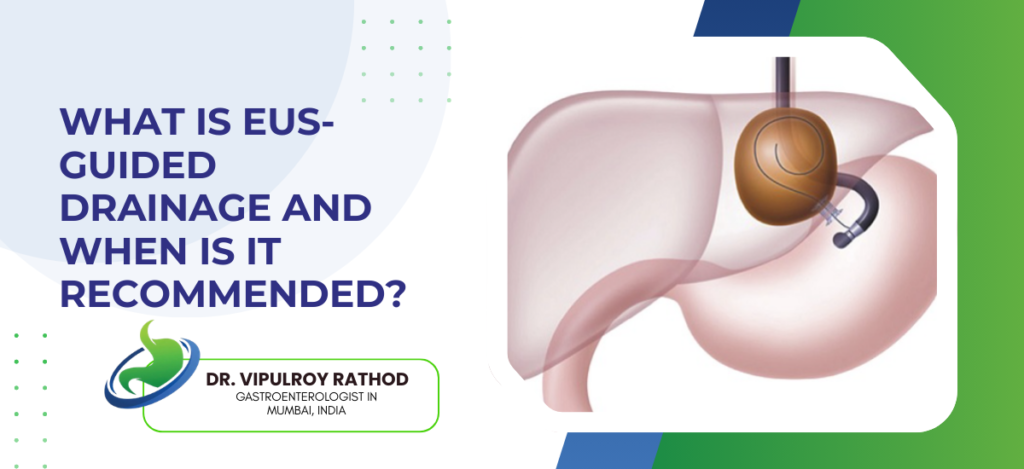
EUS-guided drainage is a non-surgical procedure that drains fluid collections pancreatic cysts, abscesses, blocked ducts using a needle guided by real-time ultrasound from inside the gut. No incisions. No surgical entry point. The endoscope does it all.
According to Dr. VipulRoy,
“Endoscopic Ultrasound guided drainage changed how we handle pancreatic complications. What used to mean surgery or waiting weeks now gets sorted in a single session. Patients recover faster and the risk is far lower.”
How EUS-Guided Drainage Works?
- Endoscope goes in through the mouth — A flexible scope with an ultrasound probe at the tip is guided down into the stomach. It sits right against the gut wall, directly next to the fluid collection on the other side.
- Doctor sees everything before touching it — The ultrasound shows the cyst or abscess in real time. Size, location, what’s inside. Nothing gets punctured until the image is clear.
- Needle drains the collection directly — Guided by that live image, a needle passes through the gut wall into the fluid. It drains out in the same session. As a gastroenterology specialist in Mumbai, Dr. Rathod has been performing EUS procedures since 1998, among the first in South Asia to use it clinically.
- Stent placed if needed — In some cases a small stent goes in to keep the drainage pathway open while the collection fully resolves over the following weeks.
- No wound, no stitches — Nothing is cut from outside. Most patients leave within 48 hours and recover in days, not weeks.
When Is It Actually Recommended?
- Pancreatic pseudocysts after pancreatitis — Small ones sometimes resolve on their own. Larger ones causing pain, blocking the stomach, or showing infection need drainage. EUS handles it directly without surgery.
- Walled-off pancreatic necrosis — Dead pancreatic tissue enclosed in a fluid cavity. Used to mean open surgery every time. At specialist centres now, EUS-guided necrosectomy is the standard and outcomes are significantly better.
- Blocked bile duct when ERCP fails — If conventional ERCP can’t reach the bile duct, EUS creates an alternative route through the stomach wall instead. No surgical incision needed.
- Deep abscesses difficult to reach from outside — For collections that percutaneous drainage can’t access accurately, EUS sometimes gets there more reliably from inside the gut. You can explore our previous blog Advanced GI Procedures Without Open Surgery in India to understand where EUS-guided drainage fits within the broader picture of minimally invasive GI treatment.
Why Choose Dr. Vipulroy Rathod for EUS-Guided Drainage in Mumbai?
EUS-guided drainage is not something most gastroenterologists do. It needs both advanced endoscopy skills and real familiarity with pancreatic and biliary complications together. Dr. Vipulroy Rathod has been doing this at Fortis Hospital Mulund since 1998. Patients arrive with complex collections after incomplete management elsewhere. Three decades of this specific work changes what’s possible on difficult cases.
Dealing with a pancreatic cyst or abscess? Talk to a specialist before it gets complicated.
Frequently Asked Questions
No. It’s done under sedation or general anesthesia. Most patients feel nothing during the procedure and say recovery was easier than they expected.
Most patients go home within 48 hours. Normal activity resumes within a few days. There’s no surgical wound to heal from.
For most pseudocysts and walled-off necrosis, yes. Surgery is rarely needed now when an experienced endoscopist handles it at the right time.
It keeps the drainage pathway open while the collection resolves. A follow-up endoscopy removes it once imaging confirms healing. Straightforward procedure done under light sedation.
Reference links-
- EUS-Guided Drainage Clinical Overview — American Society for Gastrointestinal Endoscopy
- Pancreatic Cyst and Pseudocyst Management — American College of Gastroenterology
- EUS-Guided Biliary and Pancreatic Drainage — National Library of Medicine
- Interventional EUS Standards — World Gastroenterology Organisation
