 Skip to content
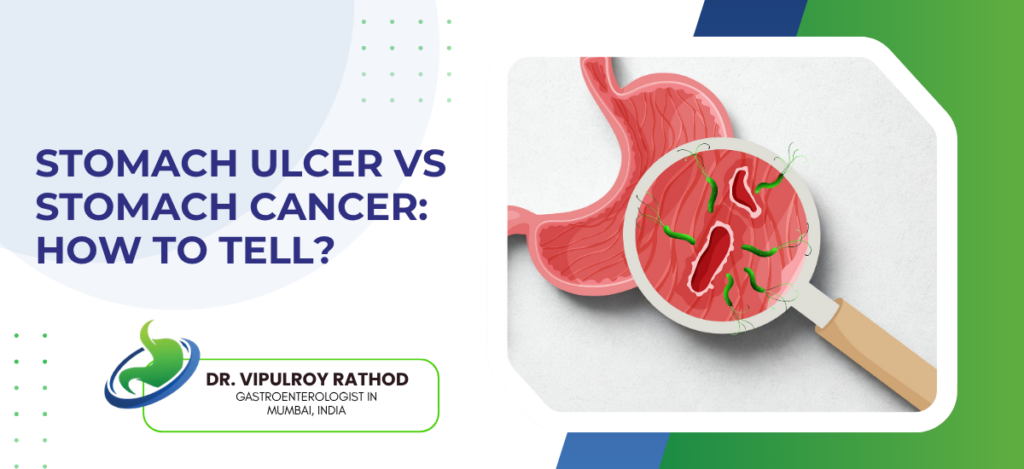
Stomach ulcers and stomach cancer produce almost identical symptoms, and neither a patient nor a clinician can reliably separate them on history alone. Endoscopy with biopsy is the only investigation that gives a definitive answer, and skipping it because an ulcer looks benign on the scope is exactly how early gastric cancer gets missed.
According to Dr. Vipulroy Rathod, Gastroenterologist in Mumbai, “I’ve biopsied ulcers that looked completely benign on the scope and come back as cancer, and I’ve seen lesions that looked worrying turn out to be purely inflammatory. The appearance tells you something but never enough. A biopsy is the only way to know, and skipping it because an ulcer looks benign is exactly how early gastric cancer gets missed.”
How Do They Differ?
Shared symptoms and a common bacterial cause make these two conditions harder to separate clinically than most patients realise.
Factor | Stomach Ulcer | Stomach Cancer |
Primary cause | H. pylori, NSAIDs, acid | H. pylori, dietary factors, genetics |
Typical patient | Any age, often younger | More common over 50 |
Endoscopic appearance | Clean edges, heals with treatment | Irregular edges, raised borders |
Response to treatment | Improves on PPIs | Does not resolve with acid suppression |
Biopsy result | Inflammatory or H. pylori | Malignant cells |
An ulcer that heals cleanly on PPIs and H. pylori treatment is almost certainly benign, but a follow-up scope to confirm healing is not optional; a cancer masquerading as an ulcer can appear to partially improve while continuing to grow underneath.
Irregular or raised edges, no response to treatment, or a recurring ulcer at the same site all push the picture toward malignancy, and each warrants repeat biopsy rather than another course of acid suppression.
Unintended weight loss alongside an ulcer changes the clinical urgency entirely. Benign ulcers cause pain and nausea but rarely drive weight loss, and that combination needs a cancer workup, not more time on omeprazole.
H. pylori sits behind both conditions, directly causing most benign ulcers and also functioning as the strongest modifiable risk factor for gastric cancer, which is why treating the infection matters regardless of which way the biopsy goes.
Accurate tissue diagnosis is the starting point, and a stomach cancer specialist builds the workup around that from the first appointment.
When Should You See a Specialist?
Certain presentations demand a scope rather than a longer trial of medication.
Persisting pain beyond two weeks on a PPI is not an indication for a stronger PPI, it’s an indication for endoscopy and biopsy before continuing to treat something whose cause hasn’t been confirmed.
If the patient is over 50 with new upper GI symptoms, going straight to endoscopy rather than empirical treatment is the safer default, because the prior probability of malignancy at that age makes skipping the scope a meaningful clinical risk.
Vomiting, unexplained anaemia, or a palpable abdominal mass alongside upper abdominal pain are red flags that point well away from a simple peptic ulcer and need urgent investigation in days not weeks.
Known H. pylori infection with new stomach symptoms lowers the threshold for scoping regardless of how mild the presentation seems, given the dual role the infection plays in both ulcer and cancer development.
Understanding why endoscopy answers questions that CT can’t is useful here. Read more on endoscopy vs CT to understand why a biopsy from a scope changes the diagnosis in a way no CT scan can replicate.
Why Choose Dr. Vipulroy Rathod for Stomach Conditions?
Dr. Vipulroy Rathod has been diagnosing and treating both benign and malignant stomach conditions at Fortis Hospital Mulund for over 30 years, with NBI endoscopy and EUS forming a core part of his upper GI practice for picking up early gastric cancers that standard white-light endoscopy misses. Patients referred after months of PPI treatment for a presumed ulcer often arrive with an early gastric cancer that a timely biopsy would have found sooner. Physicians from 35 countries have trained under his approach at Fortis.
Book your consultation today with one of India’s most experienced specialists for stomach ulcer evaluation and gastric cancer diagnosis.
Frequently Asked Questions
Endoscopy with biopsy is the only reliable method. Appearance alone can be misleading, and all gastric ulcers should be biopsied to rule out malignancy.
An ulcer itself does not directly become cancer, but H. pylori infection causes both, and chronic untreated mucosal inflammation raises gastric cancer risk over time.
Progressive weight loss, persistent vomiting, anaemia without obvious bleeding, and pain that does not improve with ulcer treatment all raise concern for cancer.
Yes. H. pylori is the leading cause of peptic ulcers and the most significant risk factor for gastric cancer, so eradication is recommended in all infected patients.
Reference
- Helicobacter Pylori and Gastric Cancer: Epidemiological Evidence and Proposed Mechanisms — NCBI/PMC, https://www.ncbi.nlm.nih.gov/pmc/articles/PMC5561585/
- Distinguishing Gastric Ulcer from Early Gastric Cancer by Endoscopy — NCBI/PMC, https://www.ncbi.nlm.nih.gov/pmc/articles/PMC3950611/
