 Skip to content
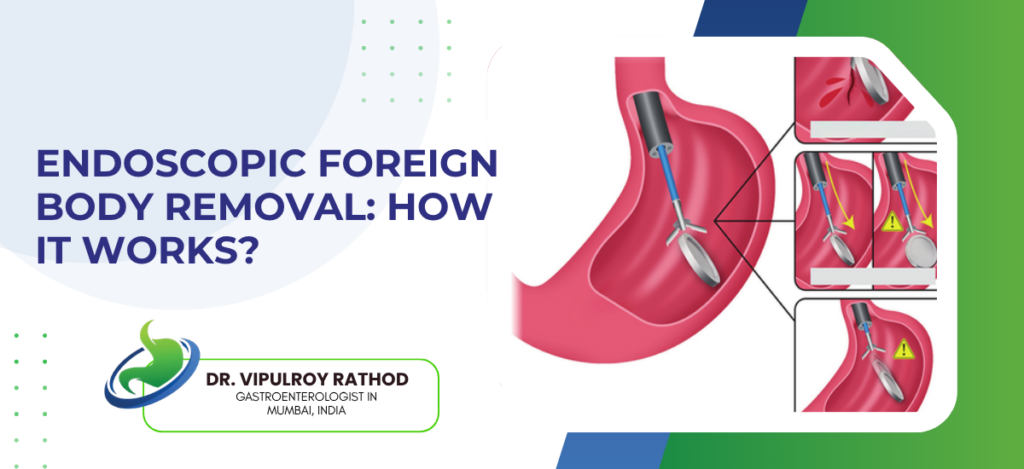
When a foreign object gets swallowed or stuck in the GI tract, the endoscope is almost always the first and only intervention needed. A flexible camera goes in through the mouth or, in colonic cases, from below, locates the object under direct vision, and retrieves it using tools passed through the instrument channel without a single cut. Around 80 to 90% of swallowed foreign bodies pass spontaneously, but the ones that don’t, particularly sharp objects and batteries in the oesophagus, need prompt endoscopic attention.
According to Dr. Vipulroy Rathod, Gastroenterologist in Mumbai, “Button batteries are the ones that keep me up at night. They can cause severe oesophageal burns within two hours of impaction, and families often wait and watch before coming in. Everything else can usually wait until morning. A battery stuck in the oesophagus cannot.”
How Is the Procedure Performed?
The technique adapts to the object, and the endoscopist’s toolkit covers most situations the scope can reach.
Rat-tooth forceps, snares, and retrieval nets are the standard tools, chosen based on the object’s shape and surface something smooth and round needs a net, something flat or fragmented needs forceps, something lodged in a narrow segment needs a snare.
For sharp objects like fish bones or razor blades, an overtube is placed over the scope before insertion, so the sharp edge can be drawn into the tube during withdrawal and pulled out without tearing the oesophageal wall.
Coins and food boluses sitting in the oesophagus are among the most common presentations and usually come out cleanly in a single pass, with the procedure over before the patient has fully woken from sedation.
Button batteries need a different urgency entirely. Once confirmed on X-ray as sitting in the oesophagus, they go straight to emergency endoscopy, and the retrieval technique prioritises speed over everything else.
Once the object is out and the mucosa inspected for damage, a specialist in foreign body removal assesses whether any secondary treatment is needed for burns, lacerations, or perforation risk before discharge.
What Affects the Outcome?
Most removals go smoothly, but a few variables shape how straightforward or complex the procedure turns out to be.
Time matters for batteries and sharp objects. The longer a battery sits in the oesophagus, the more tissue damage accumulates, and a delayed presentation that might have been a clean removal becomes a mucosal repair case.
Location changes the technical difficulty. Objects in the oesophagus are usually more accessible than those in the stomach or small bowel, and deeper objects that have passed the pylorus are monitored conservatively unless they’re sharp or causing symptoms.
Object characteristics determine tool selection. A smooth marble and a jagged piece of bone require different retrieval approaches, and misjudging the grip means the object slips and has to be repositioned, adding time and procedural steps.
Perforation risk rises with attempted passage of sharp objects through narrowed segments or around bends, which is why imaging before endoscopy helps map the position and decide the safest route of withdrawal.
Understanding how endoscopy functions as both a diagnostic and treatment tool helps put foreign body removal in context alongside its other roles. Read more on role of endoscopy to see how the same flexible scope that retrieves foreign bodies also diagnoses and treats a wide range of GI conditions.
Why Choose Dr. Vipulroy Rathod for Foreign Body Removal?
Dr. Vipulroy Rathod has been performing therapeutic endoscopy at Fortis Hospital Mulund for over 30 years, including complex foreign body retrievals involving sharp objects, impacted dentures, batteries, and oesophageal food boluses. That experience means difficult cases, including those referred after failed attempts elsewhere, get handled with the technique and judgment the situation requires. Physicians from 35 countries have trained under his approach at Fortis.
Book your consultation today with one of India’s most experienced specialists for endoscopic foreign body removal and therapeutic endoscopy.
Frequently Asked Questions
The endoscopist passes a flexible scope into the GI tract, locates the object under direct vision, and retrieves it using forceps, a snare, or a basket without any incision.
Button batteries and sharp objects in the oesophagus need removal within hours due to the risk of burns, perforation, and serious mucosal injury.
Yes. It is minimally invasive, performed under sedation, and avoids surgery in the vast majority of cases, with complications being uncommon in experienced hands.
Surgical removal becomes necessary when the object is too large, too deeply embedded, or inaccessible, though this is needed in fewer than 5% of cases.
Reference
- Overtube-Assisted Foreign Body Removal: A Review of Endoscopic Management — NCBI/PMC, https://www.ncbi.nlm.nih.gov/pmc/articles/PMC5707170/
- Removal of Foreign Bodies in the Upper GI Tract: ESGE Clinical Guideline — Endoscopy/PubMed, https://pubmed.ncbi.nlm.nih.gov/26862844/
