 Skip to content
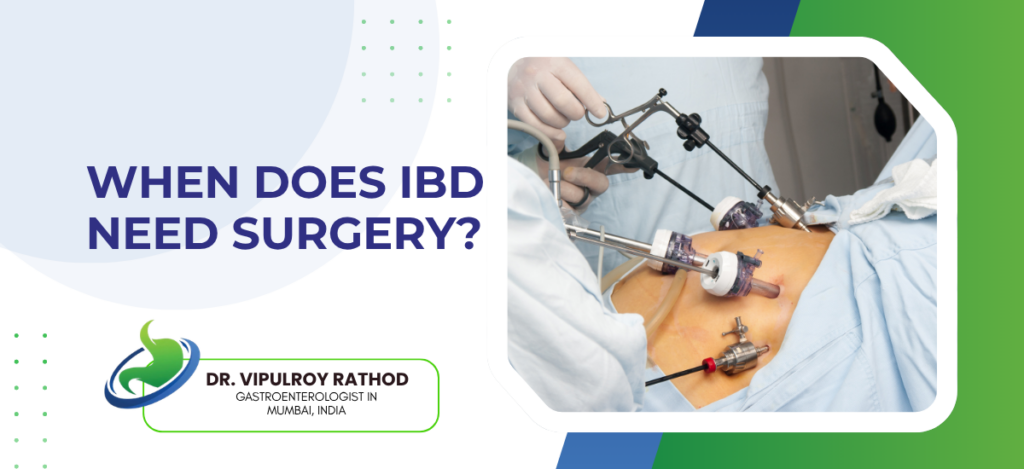
Surgery in inflammatory bowel disease isn’t a failure of medical treatment. It’s a tool used when medical therapy can’t control the disease, when complications develop, or when the damage already done has become structural. Around twenty to thirty percent of ulcerative colitis patients eventually need a colectomy, and the figure rises to fifty percent or more in Crohn’s disease over a lifetime. The decision is rarely simple. It depends on disease pattern, response to medication, the surgeon’s view, and what the patient is willing to live with.
According to Dr. Vipulroy Rathod, Gastroenterologist in Mumbai, “The right time for IBD surgery is a conversation, not a calculation. Some patients are pushed into surgery too early because someone gave up on medication too quickly. Others are kept on failing biologics for years when surgery would have given them their life back. Getting that timing right depends on knowing both the medical and the surgical sides equally well.”
When surgery becomes necessary in IBD?
The indications fall into urgent and elective categories, and the decision-making works differently for each.
- Acute severe colitis not responding to medical rescue. A patient hospitalised with severe ulcerative colitis who doesn’t respond to intravenous steroids or infliximab rescue within three to five days needs urgent colectomy. Continuing medical therapy beyond that window risks colonic perforation, toxic megacolon, or death.
- Bowel obstruction from Crohn’s strictures is the commonest reason for elective surgery in Crohn’s disease. Long-standing inflammation leaves fibrotic narrowings that don’t respond to medication, and the patient develops recurrent obstructive symptoms that medical treatment can’t relieve. Resection or strictureplasty becomes the answer.
- Perforation, abscess, or fistula complications. A perforated bowel from severe IBD needs emergency surgery without delay. Localised abscesses can sometimes be drained percutaneously first, with planned resection later, but the underlying anatomy usually still needs surgical correction.
- Dysplasia or cancer on surveillance colonoscopy. Long-standing ulcerative colitis raises colorectal cancer risk significantly, and high-grade dysplasia or invasive cancer found at surveillance means colectomy regardless of how the disease is currently behaving.
The challenge is that these decisions often look obvious in retrospect but aren’t always obvious in the moment. IBD treatment planning that integrates the gastroenterologist’s medical view with the IBD surgeon’s anatomical view tends to produce better timing decisions than either specialty working in isolation.
What surgery actually looks like for different IBD patients?
The type of surgery depends on which IBD it is and what’s being treated, and the outcomes vary considerably between procedures.
For ulcerative colitis, surgery means removing the colon entirely because the disease only affects the colon and rectum. The standard procedure is a restorative proctocolectomy with ileal pouch-anal anastomosis (IPAA), creating a J-pouch from the small bowel that connects to the anus and allows the patient to pass stool normally without a permanent stoma. Most patients adapt well over six to twelve months, with reasonable continence and quality of life thereafter.
Crohn’s disease surgery works very differently because the disease can affect any part of the gut and recurs in around fifty percent of patients within five years even after successful resection. The surgical principle is to remove as little as possible. Limited resection of the diseased segment, often the terminal ileum, or strictureplasty where the bowel is widened without being removed. Aggressive surgery to “cure” Crohn’s doesn’t work and produces short-bowel problems that are often worse than the disease.
There are situations where a permanent stoma is the right answer. Severely damaged rectum that can’t be reconnected. Recurrent pouch failure in ulcerative colitis. Perianal Crohn’s that destroys sphincter function. For these patients, a permanent ileostomy isn’t a defeat. It’s often the operation that gives them their quality of life back after years of fighting the disease.
The conversation about surgery should include the surgeon early, not as a last resort. Read more on biologics for IBD for how modern medical therapy fits alongside surgical options in the overall treatment plan.
Why choose Dr. Vipulroy Rathod for IBD surgical decision-making?
Dr. Vipulroy Rathod has been managing IBD patients through medical therapy and the decisions around surgery at Fortis Hospital Mulund for over three decades, with the coordinated approach between gastroenterology and IBD surgery that this disease genuinely requires. Many patients arrive having been kept on failing medications for too long, or pushed towards surgery before the medical options were fully tried, depending on which specialty saw them first.
The decision about IBD surgery isn’t a binary one. It’s a judgment about timing, disease behaviour, patient preference, and what the future trajectory looks like with and without an operation. The hardest part is often acknowledging that medical therapy has done what it can, which most gastroenterologists are reluctant to admit too early, and most surgeons too willing to declare too readily.
Book your consultation today with one of India’s most experienced specialists for IBD assessment and integrated medical-surgical management.
Frequently Asked Questions
No. Many never do. Around fifty to seventy percent of ulcerative colitis patients and fifty percent of Crohn’s patients avoid surgery entirely over their lifetime, particularly with modern biologic therapy.
For ulcerative colitis, yes, in the sense that removing the colon removes the disease. For Crohn’s disease no, the disease recurs in around half of patients within five years even after successful resection.
Sometimes, particularly in elective situations where there’s room for further medical optimisation. In urgent situations like perforation or severe colitis not responding to rescue therapy, surgery can’t safely be delayed.
Hospital stay is usually five to ten days. Return to normal activity around four to six weeks for straightforward resections, longer for pouch surgery or staged procedures. Adaptation to a pouch or stoma can take six to twelve months for full adjustment.
Reference links-
- IBD Surgery Guidelines, American Society of Colon and Rectal Surgeons — https://fascrs.org/healthcare-providers/clinical-practice-guidelines
- ECCO Guidelines on Surgical Management, European Crohn’s and Colitis Organisation — https://www.ecco-ibd.eu/publications/ecco-guidelines.html
