 Skip to content
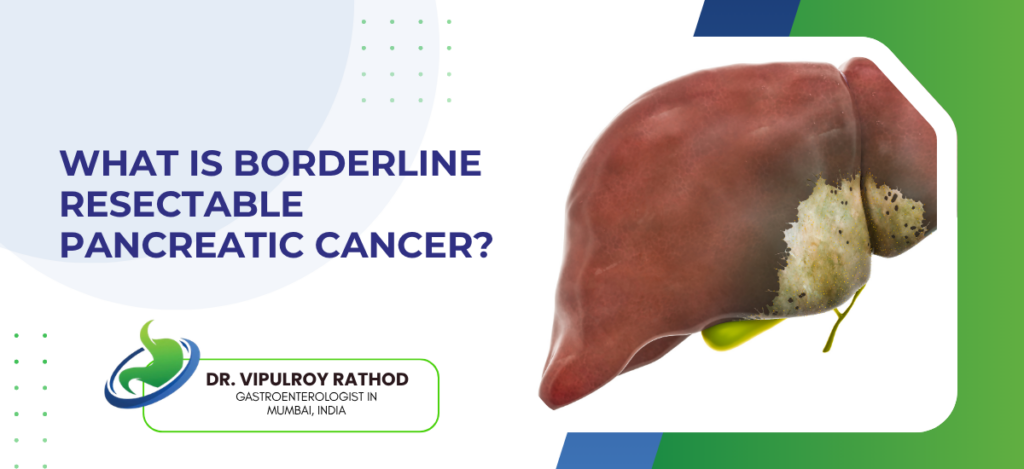
Borderline resectable pancreatic cancer (BRPC) is a stage where the tumour involves nearby blood vessels, making complete surgical removal (R0 resection) difficult or high-risk, though still technically possible. It lies between resectable and locally advanced disease, requiring multidisciplinary care, usually starting with neoadjuvant therapy (chemotherapy or radiation) to reduce tumour size. Around fifteen to twenty percent of pancreatic cancer diagnoses fall into this category, and accurate staging within the first few weeks decides whether conversion to resectable disease is realistic.
According to Dr. Vipulroy Rathod, Gastroenterologist in Mumbai, “Borderline resectable is the category where the most damage gets done by rushing, patients pushed straight to surgery without neoadjuvant therapy often end up with positive margins or abandoned operations, and the ones given proper chemotherapy first frequently come back resectable a few months later with much better outcomes.”
How borderline resectable disease is defined?
It’s defined by the imaging, not by how the patient feels. A radiologist trained in pancreatic imaging looks at exactly how the tumour relates to four key vessels.
- Portal vein and superior mesenteric vein contact. Up to 180 degrees of contact, or short-segment occlusion that’s reconstructible, still keeps a case borderline rather than locally advanced. The vein is forgiving, surgeons can rebuild it if needed.
- Superior mesenteric artery involvement. Less than 180 degrees of contact is the threshold. Anything more than that pushes the case into locally advanced territory, where surgery isn’t appropriate anymore.
- The celiac axis and hepatic artery get measured the same way. Limited contact under 180 degrees keeps the case in borderline category, with the option of reconstruction during surgery if needed.
- Distant spread on imaging. Even small liver lesions or peritoneal deposits change the classification entirely. The cancer is no longer borderline, it’s metastatic, and the treatment route shifts to systemic chemotherapy.
The classification isn’t a judgment call, it’s a measurement, and the measurement is what dictates the next step. Pancreatic cancer treatment planning at this point almost always starts with EUS-guided biopsy to confirm the histology before any chemotherapy begins, because the regimen choice depends on knowing exactly what the tumour is.
How borderline cases are actually treated ?
The standard approach now is chemotherapy first, surgery second, in patients who respond well enough to make resection worthwhile. The reasoning behind this shift has played out across multiple trials over the last decade.
- Neoadjuvant chemotherapy as the opening move. FOLFIRINOX is the most common regimen in fit patients, three to six months of it, followed by a restaging CT to see how the tumour has responded. Gemcitabine-based combinations are used in patients who can’t tolerate FOLFIRINOX.
- Restaging and decision-making. If the tumour has pulled back from the vessel and there’s no new disease elsewhere, surgery is on the table. If it hasn’t responded or has grown, the case is reclassified and the treatment plan changes entirely.
- Surgery, when it happens, is technically demanding. A Whipple procedure or distal pancreatectomy with possible vascular reconstruction, often three to four week recovery, and adjuvant chemotherapy afterwards is almost always recommended.
- What happens if conversion fails. Some borderline tumours don’t shrink, some grow despite chemotherapy, and these patients move into the locally advanced or metastatic category. Treatment then becomes about durable disease control rather than cure.
The reason borderline resectable disease is its own category is because it behaves differently from both resectable and unresectable cancer. Read more on resectable vs unresectable pancreatic cancer to see how the staging logic separates these groups and why the treatment paths diverge so sharply.
Why choose Dr. Vipulroy Rathod for borderline pancreatic cancer assessment?
Dr. Vipulroy Rathod has been involved in the imaging review and EUS-based assessment of borderline pancreatic cancers at Fortis Hospital Mulund for over three decades. Many patients arrive having been told surgery is the next step, when a closer look at vessel involvement shows the case should have gone for neoadjuvant therapy first. The reverse also happens, patients told nothing can be done when the imaging actually puts them firmly in borderline territory with a real chance of conversion.
The borderline category is where careful staging matters most. Push a patient into surgery too early and the operation gets abandoned. Wait too long without giving chemotherapy a real trial and the window closes. Both errors are avoidable with proper imaging review and EUS confirmation upfront.
Book your consultation today with one of India’s most experienced specialists for borderline pancreatic cancer staging and treatment planning.
Frequently Asked Questions
Yes, when the tumour responds well to neoadjuvant chemotherapy and successful surgery follows. Cure rates are lower than in fully resectable disease but meaningfully higher than in locally advanced cases, particularly when adjuvant chemotherapy is given afterwards.
Typically three to six months of FOLFIRINOX or a gemcitabine-based regimen, followed by a restaging scan. The exact duration depends on tolerance, response on imaging, and surgeon preference at the centre managing the case.
The case gets reclassified, usually as locally advanced. Surgery is taken off the table and treatment shifts to continued systemic therapy with or without radiation, focused on controlling the disease rather than removing it.
No. Borderline cases have limited vessel involvement that’s potentially reversible with chemotherapy, while locally advanced cases have arterial encasement that can’t be reconstructed even after good response. The distinction changes everything about prognosis and treatment options.
Reference links-
- Pancreatic Adenocarcinoma Guidelines, National Comprehensive Cancer Network — https://www.nccn.org/guidelines/guidelines-detail?category=1&id=1455
- Borderline Resectable Pancreatic Cancer Consensus, International Study Group of Pancreatic Surgery — https://www.surgjournal.com/article/S0039-6060(14)00227-5/fulltext
